GLP2
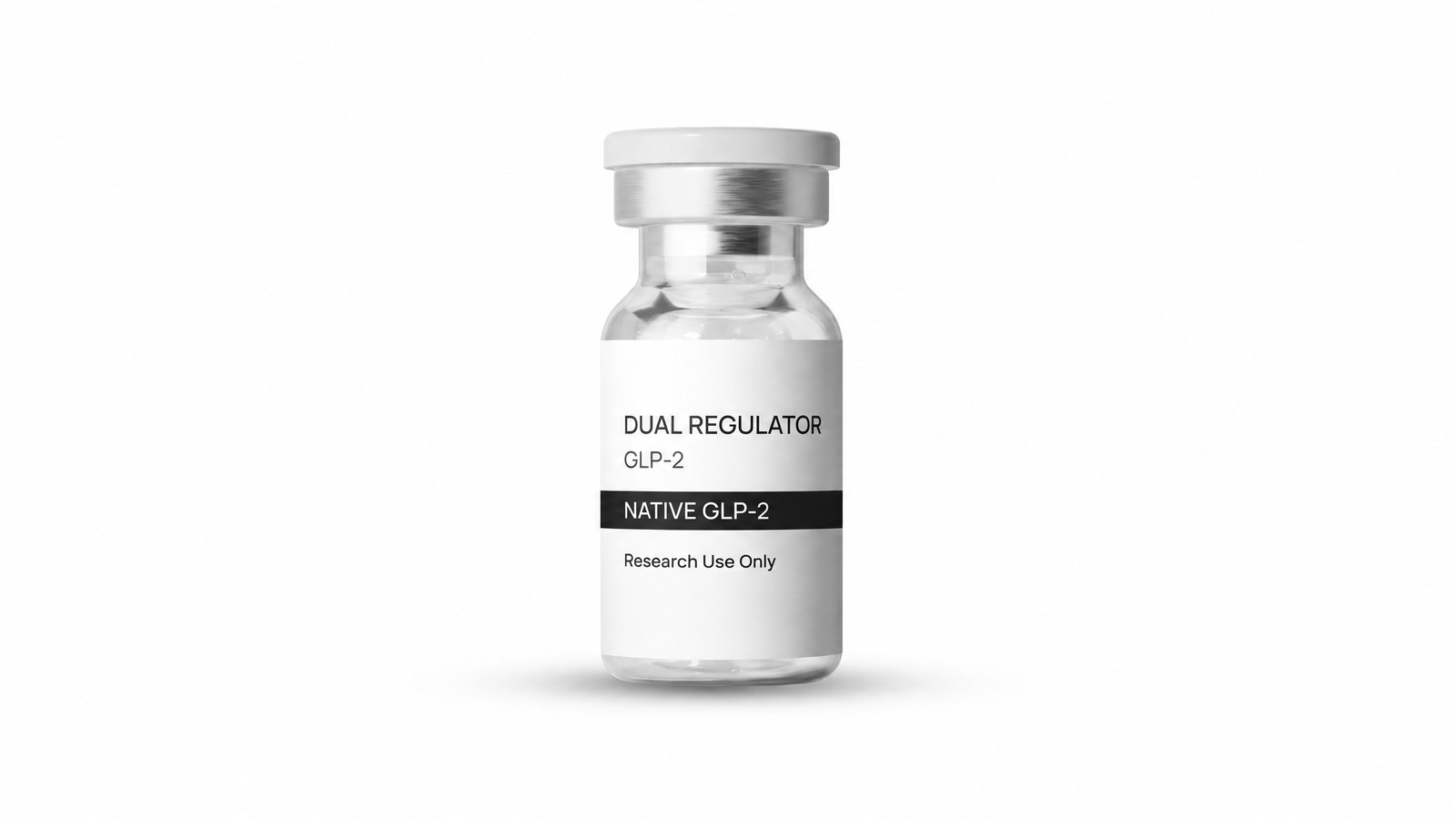
GLP2 (native GLP-2), sometimes referred to as Dual Regulator, is the gut hormone studied for intestinal lining, fluid absorption, and nutrient absorption. It is not tirzepatide or teduglutide.
These eight sections are an original, source-based educational review of native GLP-2, prepared November 9, 2026. They are not transferred Skool lessons. The product name, native GLP-2 identity, and 60mg label were supplied by the site owner; no matching COA has been supplied to independently confirm identity or amount. For educational and research purposes only. Not medical advice. Research materials are not for human or veterinary use.
The Compound, Explained
GLP-2 stands for glucagon-like peptide-2. It is a 33-amino-acid hormone made from proglucagon, a larger protein that is processed into several signals. Intestinal L cells release GLP-2 in response to nutrients. Its best-known research role is helping the intestine adapt and maintain its lining.
Read the GLP-2 biology review, Drucker, 2002
One name, several very different compounds
This profile is about the actual GLP-2 gut hormone, as identified by the site owner. Tirzepatide is a different compound that acts on GIP and GLP-1 receptors. Teduglutide is a modified GLP-2 analog. Neither name can be used interchangeably with native GLP-2.
Dual Regulator is the product name, not a scientific claim that native GLP-2 activates two incretin receptors. The number 2 in GLP-2 is part of the hormone's name; it does not mean a dual GIP/GLP-1 agonist.
See the official description of the separate GLP-2 analog teduglutide
Quick comparison
Native GLP-2 vs GLP-1
Gut-health research and metabolic signaling are different. These are studied roles and mechanisms, not guaranteed benefits of Dual Regulator.
Swipe the table sideways to read both hormone columns.
| Research area | Native GLP-2Intestinal research | GLP-1Hormone mechanisms |
|---|---|---|
| Main role | Studied for intestinal adaptation, maintenance of the gut lining, and absorption. [1] | Helps control blood sugar after meals and regulates appetite and food intake. [3] [4] |
| Receptor signaling | Acts through GLP-2 receptors and signals between gut cells and enteric nerves. [1] | Acts through GLP-1 receptors, including pathways in the pancreas, gut, and brain. [3] [4] |
| Gut lining and barrier | In experimental models, supports lining-cell growth and reduces cell loss and permeability. This is not proof that the product repairs a person's gut. [1] | Its best-established mechanisms center on metabolic signaling and gut motility. It is not interchangeable with GLP-2's intestinal growth pathway. [3] [4] |
| Fluid and nutrient absorption | Absorption is a major research focus. A small native-hormone study in short bowel patients found less fecal fluid loss, but no significant improvement in energy absorption. [1] [2] | Slows delivery of food from the stomach to the intestine, helping regulate the rise in blood sugar after a meal. [3] [4] |
| Blood glucose | Not the same incretin signal as GLP-1. Gut-absorption research does not establish a diabetes-treatment benefit for this product. [1] | Stimulates insulin release when glucose is elevated and suppresses glucagon secretion, helping limit blood-sugar rises after meals. [3] [4] |
| Appetite and stomach emptying | Can influence gastrointestinal motility and secretion. Native GLP-2 is not established as a general weight-loss product. [1] | Slows gastric emptying and contributes to fullness and reduced food intake. Effects of prescription agonists depend on the specific medicine. [3] [4] |
Keep the evidence separate. The GLP-1 column describes hormone physiology; longer-acting prescription GLP-1 receptor agonists are different formulations. GLP-2 mechanisms often come from experimental models, and native GLP-2 human evidence is limited to specific patient groups. This is not a head-to-head product trial, a claim of clinical benefit for Dual Regulator, or a dosing guide. Teduglutide is a separate GLP-2 analog.
Sources behind the comparison
- [1] GLP-2 biology and intestinal adaptation · Drucker, Gut, 2002
- [2] Small native GLP-2 study in short bowel patients · Jeppesen and colleagues, 2009
- [3] The physiology of GLP-1 · Holst, Physiological Reviews, 2007
- [4] GLP-1 mechanisms and receptor agonists · Muller and colleagues, Molecular Metabolism, 2019
Inside the Mechanism
Native GLP-2 activates the GLP-2 receptor, often shortened to GLP-2R. This receptor is found on certain intestinal cells and enteric neurons, the nerve cells within the gut. Its effects on the lining involve signals between cells, rather than a simple direct action on every surface cell.
In experimental work, GLP-2 signaling supports growth of intestinal crypt cells and reduces loss of lining cells. Crypts are the small pockets where new intestinal cells form. Researchers also study nutrient transport, intestinal blood flow, and barrier permeability, which describes how easily substances cross the lining.
Why does that matter? The intestine needs both a working surface for absorption and a controlled barrier. These are research mechanisms, not a promise that a product will repair a person's gut.
Mechanism and intestinal adaptation, Drucker, 2002
Comparative physiology review, Connor and colleagues, 2015
A short-lived native signal
The enzyme DPP-IV rapidly breaks down native GLP-2. A primary human study measured an elimination half-life of about 7 minutes for intact GLP-2 after intravenous administration. The degraded GLP-2 fragment lasted longer. That distinction matters when reading a paper that measures total hormone rather than active hormone.
This in-body half-life is not the storage life of a product and does not establish a dosing schedule. A result from one route of administration is not a universal duration of effect.
Human GLP-2 metabolism and half-life, Hartmann and colleagues, 2000
What the Research Actually Shows
Animal and laboratory evidence
Animal and laboratory studies describe intestinal growth, changes in nutrient absorption, and reduced permeability in particular models. The comparative physiology literature includes rodents, humans, and livestock. Always check which species and conditions produced the finding before applying it to people.
Species and evidence context, Connor and colleagues, 2015
Small human studies of native GLP-2
Native GLP-2 has been studied in people with short bowel syndrome, a condition in which too little functioning intestine remains to absorb enough nutrients or fluid. Those findings are not evidence for routine wellness use in healthy people.
In a two-year longitudinal study, 11 short bowel patients were offered native GLP-2 treatment and 8 completed the study. Among the completers, daily fecal wet weight fell from about 3 kg to about 2 kg. Patients maintained intestinal fluid absorption with lower oral fluid intake. The study did not show significant changes in energy absorption, body composition, or intestinal mucosal morphology.
This was a small study in a specific patient group. It does not establish benefits, safety, or a protocol for this GLP2 research product, and it does not support weight-loss or muscle-building claims.
Read the native GLP-2 human study, Jeppesen and colleagues, 2009
Approved analog evidence is a separate category
GATTEX contains teduglutide, a modified GLP-2 analog. Its official label covers short bowel syndrome in patients dependent on parenteral support, meaning nutrition or fluid delivered through a vein. That approval belongs to the named prescription product and indication. It is not approval of native GLP-2 or this 60mg research product.
Sourcing & Verification
A familiar name is not enough to establish what a research sample contains. Ask for the exact molecule, the sequence or other appropriate identity specification, the lot number, and the test methods. Native GLP-2, teduglutide, and tirzepatide need to remain separate throughout the paperwork.
For this profile, no matching certificate of analysis has been supplied. We have not copied a certificate from another product or treated a published study as a batch report. The identity on this page reflects the owner's description, not an independently authenticated laboratory result.
Check identity, purity, and quantity separately. Identity asks whether the sample matches the stated molecule. Purity asks how much of the measured material is the target compound under that method. Quantity asks how much target material is present. A purity percentage alone cannot confirm a 60mg fill.
A COA is evidence about the submitted sample and stated test methods. It is not automatically proof of sterility, freedom from endotoxin, clinical safety, effectiveness, or all stock. Where those tests matter to the research, they need their own documented results.
Before accepting a batch claim
Match the lot on the product to the report. Check the issuing laboratory, date, identity method, and measured amount. Confirm the report names native GLP-2 rather than a different peptide sold under similar commercial shorthand. Record any unresolved mismatch rather than guessing.
Preparation
This section is about research documentation, not instructions for preparing a product for injection. No product-specific formulation, solvent compatibility, or stability data has been supplied for this GLP2 research product.
Qualified researchers should use the supplier's validated specification and their approved laboratory procedure. The appropriate preparation depends on the exact material and assay. Do not import dilution, solvent, storage, or shelf-life instructions from a different peptide.
Teduglutide has its own prescription formulation and preparation instructions. Those instructions do not validate preparation of native GLP-2. Likewise, a paper describing administration of native hormone does not prove that an unrelated research product has the same formulation or quality.
The distinct teduglutide product formulation is described in its official label
Keep the label, lot, preparation record, storage conditions, and assay conditions together. Until suitable product documentation is available, this site does not state a solvent volume, storage temperature, or use-by period for this material.
For educational and research purposes only. Not medical advice. Research materials are not for human or veterinary use.
Measurement
What does 60mg tell you? It states a mass on the product label. It does not tell you the measured amount in a sample, the concentration of a solution, the purity, or the amount suitable for a study.
Mass, concentration, and volume are different measurements. Concentration describes the amount of material per volume of solution. A concentration cannot be calculated from the 60mg label alone without a known volume, and nominal label mass is not a substitute for measured quantity.
Native GLP-2 also breaks down into fragments. In the primary human metabolism study, researchers used assays that distinguished intact GLP-2 from total immunoreactive material. A test that counts both can give a different picture from a test of intact hormone.
Intact versus degraded GLP-2 measurement, Hartmann and colleagues, 2000
For research interpretation, record the assay target, calibration, units, sample handling, and whether the method distinguishes intact native GLP-2 from fragments. This profile does not provide syringe-unit conversions or a human dosing calculator for the product.
Protocol & Safety Boundaries
There is no product-specific validated human dose or schedule established on this site for this GLP2 research product. Small native GLP-2 studies in short bowel patients are not a general-use protocol. This page does not recommend injection, a treatment cycle, or self-experimentation.
Intestinal growth and fluid absorption are meaningful biological effects, not automatic signs of safety. A useful safety question is not just whether an effect might help; it is also what could go wrong in the wrong setting.
What analog warnings can and cannot tell us
The official teduglutide label warns about accelerated neoplastic growth and gastrointestinal polyps, intestinal obstruction, biliary and pancreatic disease, and fluid overload. These warnings belong to teduglutide. They show why GLP-2-pathway treatment requires careful medical oversight, but they are not measured adverse-event rates for native GLP-2 or this research product.
Safety warnings for the separate GLP-2 analog, GATTEX, 2025
Published hormone research and a research-use label do not establish that a commercially supplied sample is safe for human use. Anyone considering treatment for short bowel syndrome or another digestive condition should discuss approved options with a qualified clinician rather than using a research product.
For educational and research purposes only. Not medical advice. Research materials are not for human or veterinary use.
Comparisons & Key Questions
Native GLP-2 versus tirzepatide
Native GLP-2 is the intestinal hormone discussed here. Tirzepatide is the separate dual GIP/GLP-1 compound. Dual Regulator is a commercial name, not evidence that these molecules share a receptor profile. Similar shorthand should never replace an identity check.
Native GLP-2 versus teduglutide
Teduglutide is a 33-amino-acid analog with a glycine at position 2 instead of the alanine in native GLP-2. The modification reduces breakdown by DPP-IV. Native-hormone kinetics, analog trial results, and prescription product instructions must be read as separate evidence.
Native GLP-2 and DPP-IV biology
Teduglutide structure and product information
Does this profile establish a stack?
No. Separate studies of two compounds do not establish that combining them is effective or safe. This review does not establish a combination protocol for this GLP2 research product with BPC-157, KPV, incretin drugs, or another compound.
What should you take away?
Start with the exact molecule. Separate native GLP-2 evidence from analog evidence. Check whether a result came from humans, animals, or cells. Treat 60mg as a stated product amount until quantity is measured. Ask for the lot-matched COA before treating any batch claim as verified.
Research references
Drucker. Gut adaptation and the glucagon-like peptides. Gut, 2002
Certificate of Analysis
No matching COA has been supplied for this product. Identity and the stated 60mg amount are not independently verified.
Gut hormone research
Frequently Asked Questions
What is GLP2?
GLP2 refers to native GLP-2, sometimes listed as Dual Regulator. It is a hormone released by intestinal L cells in response to nutrients. Researchers study its role in maintaining the intestinal lining and supporting absorption of fluid and nutrients.
Source: GLP-2 biology reviewHow is GLP-2 different from GLP-1?
They are different hormones with different receptors. GLP-2 research focuses on intestinal function and absorption. GLP-1 helps regulate insulin, blood sugar, appetite, and stomach emptying. The number 2 does not mean a dual GLP-1/GIP agonist.
Source: GLP-1 physiology reviewDoes the research prove that GLP2 repairs the gut or causes weight loss?
No. Many intestinal findings come from experimental models, and small native GLP-2 human studies involved short bowel patients. These findings do not establish gut-repair or weight-loss benefits for this product or for routine use in healthy people.
Source: Native GLP-2 study in short bowel patientsIs native GLP-2 the same as teduglutide?
No. Teduglutide is a modified GLP-2 analog with its own prescription formulation, studies, and approved indication. Its results and product instructions cannot be treated as evidence for native GLP-2 or this GLP2 research product.
Source: Official teduglutide product information