The Wolverine Stack
Explore the separate evidence for BPC-157 and TB-500, and what is still unknown about combining them.
This material is educational, not medical advice or a treatment recommendation. Classroom claims and example protocols have not all been independently verified.
The Stack, Explained
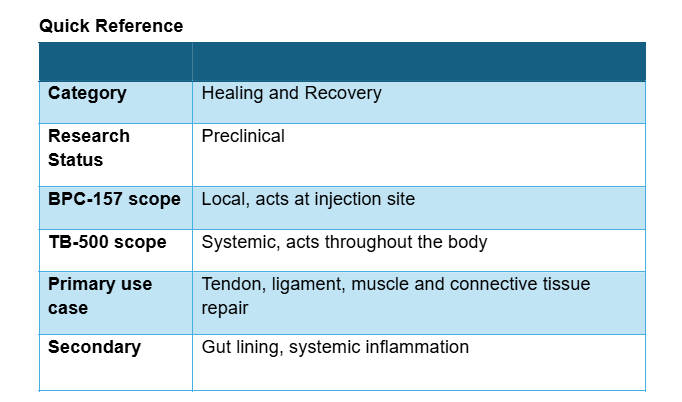
Category: Healing & Recovery
Compounds: BPC-157 + TB-500
Research Status: Preclinical
Regulatory Status: Both recommended for compounding eligibility by the FDA Pharmacy Compounding Advisory Committee, July 23 2026. Non-binding. Neither is FDA approved.
What This Is
Two peptides used together because they repair tissue through entirely different mechanisms.
BPC-157 works locally. Placed near an injury, it acts at that site.
TB-500 works systemically. It acts throughout the body regardless of where it goes in.
One is a targeted repair signal. The other creates a whole-body repair environment. Neither does the other's job, which is the entire reason the combination exists and why it has held up in this space for over a decade while most stacks come and go.
Where the Name Comes From
Wolverine is the Marvel character whose power is healing from almost any injury almost instantly.
When people started combining BPC-157 and TB-500 and reporting recovery noticeably faster than either alone, the name stuck. It is a bit of a joke. But the results people describe are consistent enough that the nickname became the standard term, including among people who take the research seriously.
Who This Is For
People dealing with a specific injury that is not resolving on its own timeline.
Post-surgical recovery.
Training-related connective tissue damage, particularly tendon, which heals slowly because it is poorly vascularized and metabolically quiet.
People with both a localized injury and broader systemic inflammation, which is most real recovery situations.
Inside the Mechanism
BPC-157
Origin
BPC stands for Body Protection Compound. It is a synthetic fragment of a protein found in human gastric juice. Your stomach produces the parent compound. That origin explains why gut research runs alongside musculoskeletal research.
Upregulates growth hormone receptors in tendon fibroblasts.
Tendon is notoriously slow to heal. It has poor blood supply and low metabolic activity, so growth signals already circulating in your bloodstream reach it inefficiently.
BPC-157 increases receptor density on the cells that build tendon. More receptors means the tissue becomes more responsive to growth signals that are already there. It is not adding a signal. It is improving reception.
Promotes angiogenesis through VEGF.
Vascular endothelial growth factor drives formation of new blood vessels. New vessels mean oxygen and nutrient delivery into tissue that previously had poor supply.
This is the mechanism most directly responsible for the healing acceleration people report, and it is why the poor vascularization problem in tendons matters so much. BPC-157 addresses it directly.
Acts locally.
This is the practical consequence of the above and it drives everything in the protocol tabs. BPC-157 does its work where it is placed. Proximity to the injury site is not a detail, it is the point.
Gut effects. The gastric origin is not incidental. Research covers intestinal lining repair alongside musculoskeletal work. People using it for injury frequently report gut effects as a secondary observation.
TB-500
Origin
TB-500 is a synthetic fragment of Thymosin Beta-4, a protein present in nearly every human cell and concentrated in wound fluid. When you injure yourself, Thymosin Beta-4 levels at the wound site rise on their own. It is part of your native repair response.
Upregulates Actin expression.
Actin is the structural protein cells use to move. More actin expression means greater cell motility, which means repair cells can migrate to damaged tissue from elsewhere in the body.
This single mechanism is why TB-500 is systemic while BPC-157 is local. It is not working at a site. It is mobilizing the whole repair system.
Modulates inflammatory cytokines.
Modulation, not suppression. The distinction matters more than most people realize.
Inflammation is a necessary phase of healing. Shut it off entirely and repair is impaired, which is part of why long-term anti-inflammatory use can slow tendon healing. Bringing it into a normal range is different from switching it off.
Supports angiogenesis. Overlaps with BPC-157 here, through separate signaling.
Why These Two Together
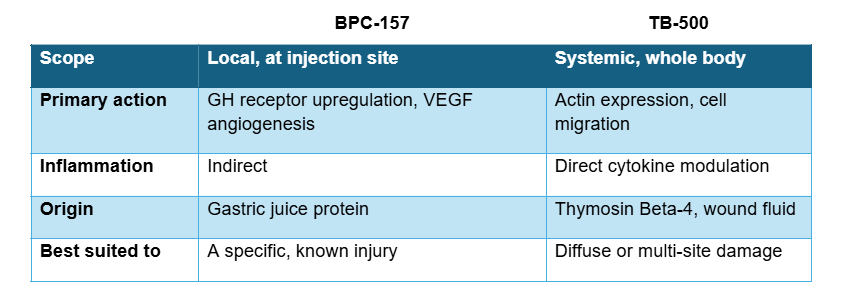
An acute tendon injury is a local problem. Chronic systemic inflammation is not. Most genuine recovery situations are some measure of both, which is why the combination outperforms either compound alone in what people consistently report.
What the Research Actually Shows
This is the section nobody else in this space teaches. It gives you the framework to evaluate any compound you encounter, including ones that haven't even been developed yet.
Read the Status Tag First
The Wolverine Stack is tagged Preclinical. That is not a technicality.
It means the evidence base is predominantly animal studies and in vitro work. Not human clinical trials.
Preclinical is not the same as unproven. It means the research is real, it exists, and it has not yet passed through the stage where human safety and efficacy get established at scale.
Anyone telling you BPC-157 is clinically proven in humans is either misinformed or selling you something.
The Evidence Hierarchy
Learn this and you can assess any compound in this field.
In vitro. Cells in a dish. Tells you a mechanism is possible. Tells you nothing about a whole organism.
Animal model. Usually rodent. Tells you the mechanism operates in a living system.
Human observational. People taking something, outcomes recorded. No control group. Confounded by everything, including the fact that most injuries improve with time regardless.
Human randomized controlled trial. Controlled, randomized, ideally blinded. This is where "proven" becomes an appropriate word.
Most research on these two compounds sits in the middle tiers. BPC-157 has roughly thirty years of it, which is substantial. Thirty years of preclinical research is still preclinical research.
Sample Size
Find the n on any study you read. A study with twelve rats and a study with two thousand humans are not equivalent evidence and should not carry equal weight in your thinking.
Small studies produce dramatic effect sizes more often than large ones, and those effects usually shrink when the study is repeated at scale. That is one of the most reliable patterns in all of science and it is worth internalizing.
The July 2026 Committee Vote
On July 23 2026 the FDA's Pharmacy Compounding Advisory Committee voted on seven peptides.
Recommended: BPC-157, KPV, TB-500, MOTS-c, Epitalon, Semax
Not recommended: Emideltide, also known as DSIP
What it means. The committee found the evidence sufficient to recommend these be eligible for pharmacy compounding.
What it does not mean. FDA approval. The vote is non-binding and the FDA determines separately. No compound on that list is approved to treat any condition.
Two things worth noticing.
The committee assessed each compound individually rather than treating the category as one block. That is more nuance than most public commentary on this manages.
And the compound rejected, DSIP, has more consumer interest than several that passed. Popularity and evidence are separate variables. That vote made the gap visible.
Holding Both Facts
Both compounds in this stack were recommended by the committee. Both remain preclinical. Both have genuine mechanistic research and no large human trials.
Hold both at once. That is what research literacy actually is, and it is more useful than either uncritical enthusiasm or blanket dismissal.
Sourcing & Verification
Original classroom lesson. Preparation, measurement, sourcing, or protocol examples are source material, not verified instructions or clinical guidance.
People will spend six hours reading mechanism studies and then buy from a supplier they know nothing about.
The compound in the vial is the whole thing. A perfect protocol with a mislabeled, underdosed or contaminated vial produces nothing, and you will have no way of knowing why.
The Certificate of Analysis
A COA is third-party lab confirmation of what is in the product and at what purity.
What a real one contains:
Named testing laboratory, not the phrase "third party lab"
Batch or lot number that matches the number on your vial
Test date
Purity percentage with the method stated, usually HPLC
Identity confirmation, usually mass spectrometry
Contact details for the lab that ran it
Walk away if you see:
"Available on request," followed by nothing
No laboratory named anywhere on the document
A batch number that does not match your vial
No date
A screenshot with no verifiable source
Ask whoever you currently buy from for a COA on your specific batch. Whatever happens next tells you everything you need to know about them.
Reading Purity Properly
99% purity means 99% of the material is the stated compound. It does not tell you what the remaining 1% is. A well-documented COA will.
Purity and identity are separate tests. A vial can be 99% pure something other than what the label says. You want both confirmed on the same document.
Storage and Handling
Lyophilised powder is stable for up to a year. Reconstituted solution is not, and it degrades with heat, light and time.
Preparation
Original classroom lesson. Preparation, measurement, sourcing, or protocol examples are source material, not verified instructions or clinical guidance.
Wolverine Stack Reconstitution Guide
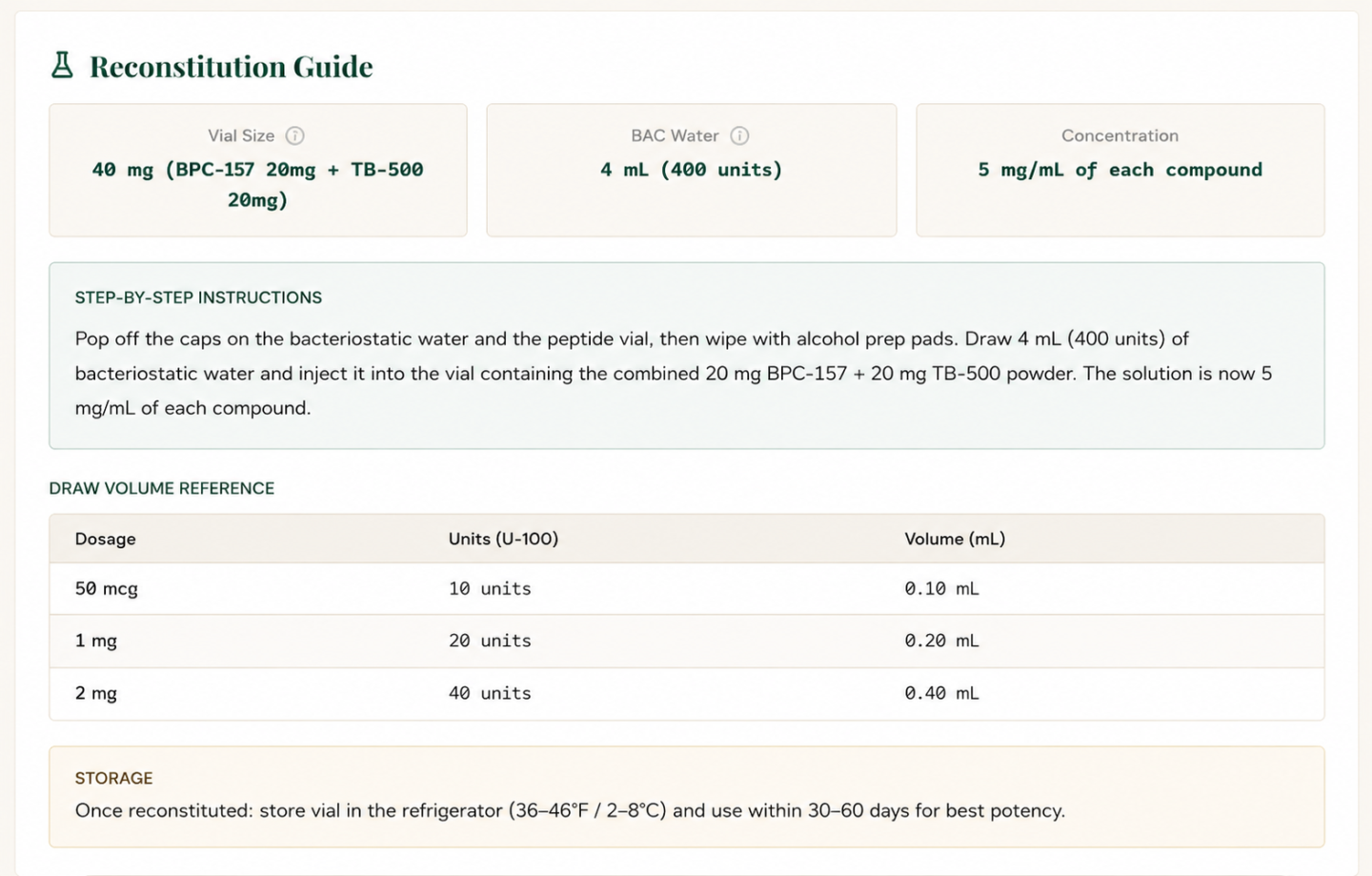
The Wolverine Stack combines BPC-157 + TB-500, two peptides commonly discussed together in the context of tissue repair and recovery. Proper preparation and handling are important when working with peptide products.
Because vial strengths and preparation requirements can vary, always use the reconstitution volume specified for your exact product and vial strength.
What You’ll Need:
BPC-157 Peptide Vial
TB-500 Peptide Vial
Bacteriostatic Water (Reconstitution Solution)
Appropriate Syringe
Alcohol Pads
Step 1: Prepare and Sanitize
Wash your hands and prepare a clean workspace.
Clean the tops of the peptide vial and bacteriostatic water vial using an alcohol pad.
Allow the surfaces to dry before proceeding.
Step 2: Reconstitute the Peptides
Draw the appropriate amount of bacteriostatic water according to the instructions for your specific vial.
Insert the needle into the peptide vial and slowly introduce the solution along the inside wall.
Avoid directing the solution forcefully onto the peptide powder.
Repeat the process separately for the second peptide if it requires reconstitution.
Step 3: Mix Gently
Important: Do not shake the vials.
Instead, gently roll or swirl each vial until the peptide is fully dissolved. Avoid vigorous agitation.
Step 4: Storage After Reconstitution
Store reconstituted peptides according to the manufacturer's storage instructions.
Keep them refrigerated when the product instructions specify refrigeration.
Protect the vials from excessive heat and light.
Do not freeze unless the manufacturer specifically indicates that freezing is appropriate.
Important
Reconstitution instructions can vary depending on the peptide, vial strength, formulation.
Measurement
Original classroom lesson. Preparation, measurement, sourcing, or protocol examples are source material, not verified instructions or clinical guidance.
Wolverine Stack Measurement Guide
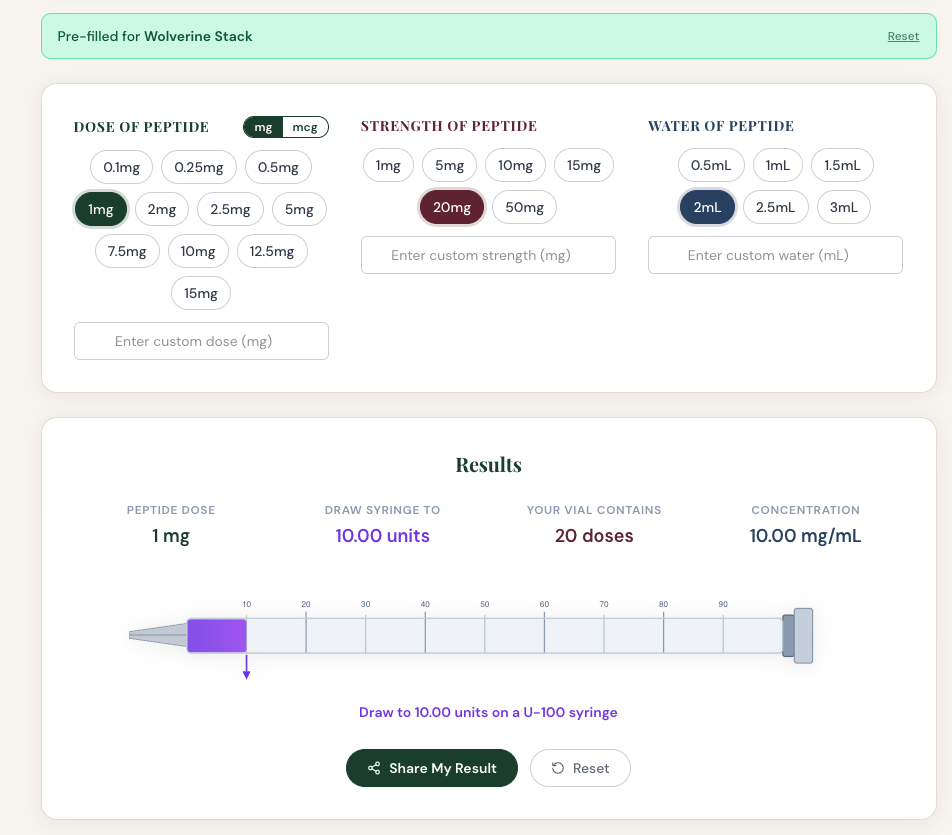
Learn how to convert your peptide concentration into the correct syringe volume for the Wolverine Stack (BPC-157 + TB-500).
Use the reference graphic below as a quick visual guide, then use the dosage calculator for precise measurements based on your specific vial strength and reconstitution volume.
https://peptidetrainings.com/tools/reconstitution-calculator?label=Wolverine%20Stack
Draw Volume Reference
The correct syringe measurement depends on:
Peptide amount in the vial
Volume of reconstitution solution used
Desired dose
Syringe type and size
Calculate Your Dosage
Need to work out the exact syringe measurement for your dose?
→ Click here to calculate your dosage
Enter your peptide strength, reconstitution volume, and desired dose to determine the corresponding syringe measurement.
Important
BPC-157 and TB-500 may have different concentrations depending on how each vial is reconstituted. Do not assume the same syringe measurement applies to both peptides.
Always double-check your vial concentration, dilution, and syringe type before measuring.
Protocol
Original classroom lesson. Preparation, measurement, sourcing, or protocol examples are source material, not verified instructions or clinical guidance.
BPC-157 Dosing Protocol
BPC-157 dosing protocols vary depending on the intended application, product concentration, and individual circumstances. The following framework is provided for educational reference and should not be treated as an established clinical dosing guideline.
Typical Dose
Dose: 1 mg (1,000 mcg) once daily
Frequency: Once daily
Route: Subcutaneous
Common Sites: Abdomen or other appropriate subcutaneous site
Protocol Length: 8+ weeks, followed by a maintenance phase
Weeks 1–4: Initial Phase
Dose: 1 mg (1,000 mcg) once daily
Frequency: Daily
Purpose: Establish a consistent exposure during the initial phase
Duration: 4 weeks
Weeks 5–8: Adjustment Phase
Dose Range: 1–2 mg (1,000–2,000 mcg) once daily
Frequency: Daily
Adjustment: The higher end of the range is sometimes used in community protocols when additional benefit is desired
Duration: 4 weeks
Maintenance Phase
Dose Range: 1–2 mg
Frequency: Every other day
Purpose: Continued recovery and maintenance support
Duration: Beyond Week 8, based on individual response
Clinical Notes
Dosing should be based on the specific product concentration and intended use.
Subcutaneous administration is commonly discussed for BPC-157, but localized injection near an injury has not been established as superior in controlled human studies.
Monitor your response throughout the protocol rather than automatically increasing the dose.
Because human clinical evidence remains limited, consult a qualified healthcare professional before using experimental peptide products.
Stack Logic
Original classroom lesson. Preparation, measurement, sourcing, or protocol examples are source material, not verified instructions or clinical guidance.
Understanding why compounds are combined is more useful than memorising someone else’s stack. The goal is to evaluate whether each addition has a clear purpose, complementary mechanism, and place in the overall protocol.
The Rule
Compounds make sense in a stack when they work through different mechanisms toward the same outcome.
BPC-157 + TB-500 is a good example. They are often paired because they approach tissue repair through different biological pathways while supporting the same overall goal.
By contrast, adding multiple compounds that act through essentially the same pathway can create unnecessary overlap. More compounds do not automatically mean better results. They mean more variables, higher cost, and less clarity about what is actually contributing to an outcome.
What Pairs With This Stack, and Why
CJC-1295 + Ipamorelin
Growth hormone secretagogues. The rationale is straightforward: tissue repair and recovery involve anabolic signalling, and increasing endogenous growth hormone signalling may complement a repair-focused stack through a separate pathway.MOTS-c
The rationale here is metabolic support. MOTS-c is being investigated for its potential effects on mitochondrial function and cellular energy regulation, making it mechanistically interesting alongside compounds focused on repair and recovery. However, it is a newer compound with a much thinner evidence base.GHK-Cu
GHK-Cu is associated with pathways involved in collagen production and structural tissue support. That makes it particularly relevant when connective tissue and skin are the primary focus rather than muscle recovery alone.
Four Questions Before Adding Anything
1. What specific mechanism does this add?
If you cannot identify what it contributes, there may not be a clear reason to add it.
2. Does it overlap with something already in the stack?
Redundancy can add complexity without adding meaningful value.
3. Do I understand what it does independently?
Every compound should have a clear rationale before it becomes part of a combination.
4. Can I tell which compound produced the effect?
This is often overlooked. Add four compounds simultaneously and it becomes difficult to determine what is actually working.
Adding compounds methodically gives you much better information about your individual response.
A Word on Aggressive Stacking
Four-, five-, and six-compound stacks are common in peptide communities, often with limited discussion of how well the combinations have actually been studied.
More compounds do not automatically mean better results.
More compounds can also mean more variables, more cost, more potential interactions, and less clarity about what is producing an effect.
A smaller stack built around distinct mechanisms and a clear rationale is generally easier to understand and evaluate than a long list of overlapping compounds.
The goal is not to build the biggest stack.
The goal is to build one that makes sense.
Certificate of Analysis
Report names a BPC-157 / Thymosin Beta-4 blend; it does not establish that the TB-500 component is the acetylated heptapeptide. A report covers a submitted sample or lot, not safety, sterility, effectiveness, or every product sold. Its provenance has not been independently authenticated.
Open attached COAAll classroom topics