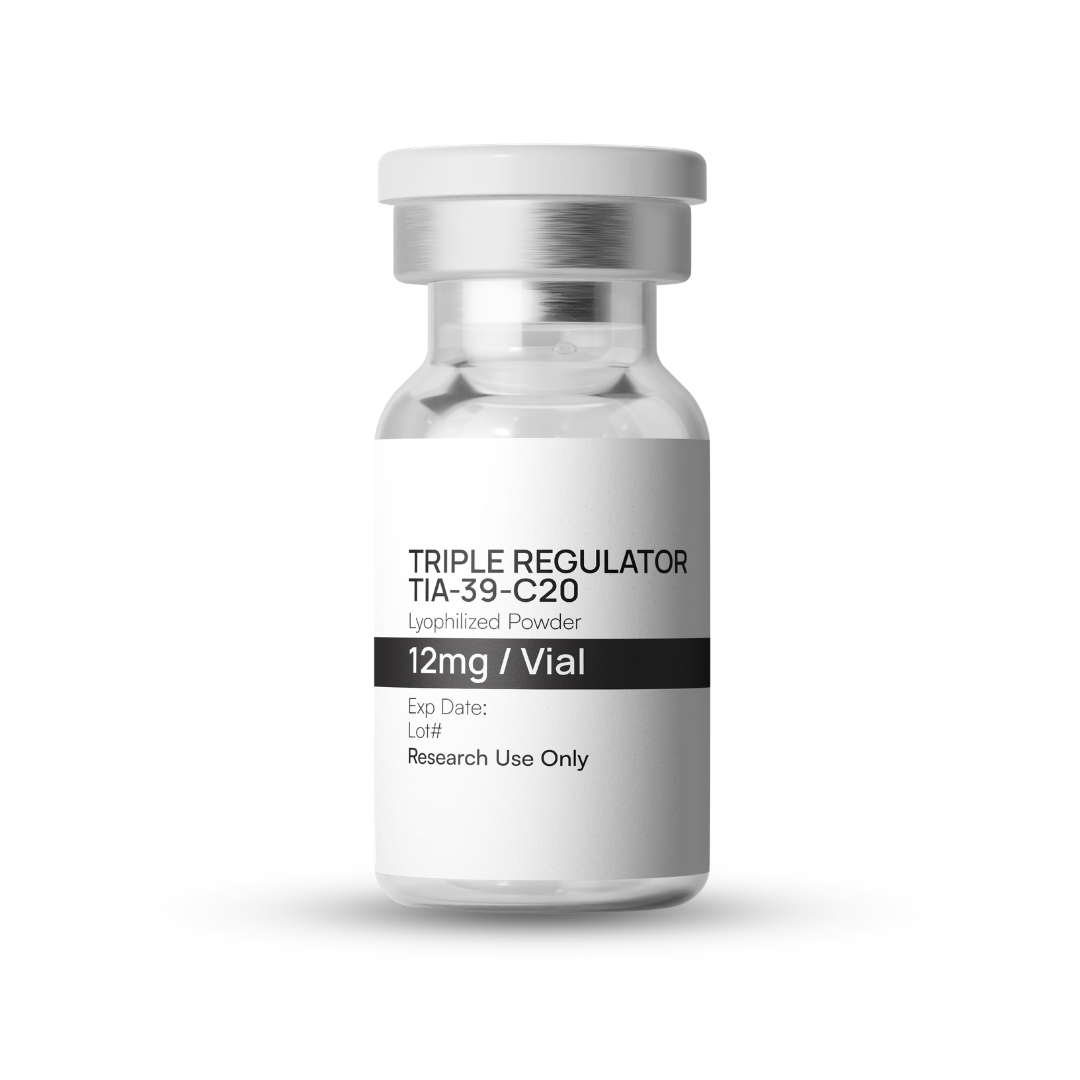
Triple Regulator "Reta"
Retatrutide is an investigational triple-receptor agonist studied in metabolic clinical trials.
This material is educational, not medical advice or a treatment recommendation. Classroom claims and example protocols have not all been independently verified.
The Compound, Explained
Triple Regulator "Reta"
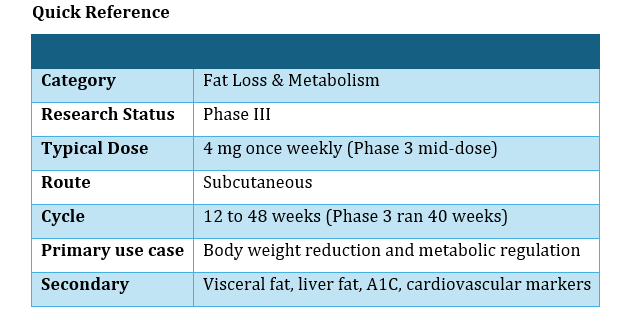
Category: Fat Loss & Metabolism
Compound: Triple Regulator - Reta
Research Status: Phase III
Regulatory Status: Not FDA approved. NDA submission expected Q4 2026, approval projected for late 2027. Currently research use only. Was not among the seven peptides voted on by the FDA Pharmacy Compounding Advisory Committee on July 23 2026.
What This Is
A triple hormone receptor agonist. One molecule acting on three receptors at once.
That number is the whole story. The generation of compounds people already know sits below it:
Semaglutide, sold as Ozempic and Wegovy. One receptor: GLP-1.
Tirzepatide, sold as Mounjaro and Zepbound. Two receptors: GLP-1 and GIP.
Retatrutide. Three receptors: GLP-1, GIP and glucagon.
Each addition is not a minor refinement. The third receptor changes the category of what the compound does.
Why the Third Receptor Matters
GLP-1 and GIP work primarily on intake. Appetite down, gastric emptying slowed, insulin signalling improved. You eat less.
Glucagon works on output. It raises energy expenditure, the rate at which your body burns fuel at rest.
So the first two receptors reduce what goes in. The third increases what goes out. Every compound before this one operated on one side of that equation. Retatrutide operates on both, and that is the mechanistic reason its trial numbers sit where they do.
Where This Sits Against Everything Else in This Course
This is the most important framing in the module, and it cuts against the usual pattern in peptide education.
Most compounds you will study here are preclinical. Animal models, cell culture, community reports. Retatrutide is not. It has completed large randomized controlled human trials with thousands of participants, published outcomes and a pharmaceutical company filing for approval.
That means the evidence is far stronger than almost anything else in this space.
It also means the risk profile is better characterized, and better characterised means known side effects rather than no side effects. This is a serious metabolic drug with a real adverse event profile, not a mild peptide with a gentle mechanism. Strong evidence cuts in both directions.
Who This Is Studied In
Trial populations were people with obesity, and separately people with type 2 diabetes. Not people looking to lose a modest amount of weight, and not athletes seeking body composition changes.
Study populations define what the evidence covers. Applying trial results outside the population they were generated in is one of the most common errors in this field, and this compound is where it happens most.
Inside the Mechanism
Receptor One: GLP-1
Glucagon-like peptide-1. The pathway semaglutide made famous.
Retatrutide activates GLP-1 receptors in the brain and gut. Three effects follow:
Appetite suppression, acting centrally on hunger signalling.
Slowed gastric emptying, so food stays in the stomach longer and satiety lasts longer.
Improved insulin secretion, glucose-dependent, meaning it responds to blood sugar rather than driving it down regardless.
This is the mechanism most responsible for the gastrointestinal side effects. Slowing the stomach is doing exactly what nausea feels like.
Receptor Two: GIP
Glucose-dependent insulinotropic polypeptide. The pathway tirzepatide added.
GIP activation enhances insulin sensitivity and influences fat metabolism. Adding it to GLP-1 produced better outcomes than GLP-1 alone, which is why dual agonists outperformed single agonists in head-to-head data.
Receptor Three: Glucagon
The one that makes this compound different.
Glucagon normally raises blood glucose and increases energy expenditure. Activating it on its own would be counterproductive in a metabolic drug, because you would be raising blood sugar in exactly the population you are trying to help.
The design solution is combination. GLP-1 activation counterbalances the glucose-raising effect while the energy expenditure effect is retained. You get the metabolic acceleration without the blood sugar penalty.
Downstream effects reported in the trials:
Increased resting energy expenditure
Significant reduction in visceral fat, the metabolically active fat around organs
Reduction in liver fat, which is why MASLD and MASH are being investigated as separate indications
Why This Is Not Just a Stronger Ozempic
A stronger single agonist would give you more appetite suppression and more side effects on the same axis.
Retatrutide is doing something structurally different. It is acting on intake and expenditure through separate pathways simultaneously. That is a different mechanism, not a higher dose of the same one, and it is why the outcome data is not simply an extension of the semaglutide curve.
The trial observation that matters most here: weight loss was still progressing when the TRIUMPH-4 trial ended at 68 weeks. No plateau was observed. On single agonists, plateau is the expected pattern.
What the Research Actually Shows
Read the Status Tag First
Triple Regulator is tagged Phase III. In this course that tag is rare, and you should read it as the strong signal it is.
Phase III means large-scale randomized controlled human trials, the tier where efficacy and safety are established at scale. This is the top of the evidence hierarchy.
Phase III is still not approval. The NDA has not been submitted at time of writing, expected Q4 2026, with approval projected for late 2027. Until then this compound is not approved to treat anything, and anything sold outside a trial is research use only.
The Evidence Hierarchy
The same ladder applies to every compound in this course. Triple Regulator is one of the few that reaches the top rung.
In vitro. Cells in a dish. Tells you a mechanism is possible.
Animal model. Usually rodent. Tells you the mechanism operates in a living system.
Human observational. No control group. Confounded by everything.
Human randomized controlled trial. Controlled, randomized, ideally blinded. This is where "proven" becomes an appropriate word.
Use Triple Regulator as your calibration point. When you read that a preclinical compound is "proven," compare the evidence behind that claim to what sits behind this one. The gap is usually enormous.
The Numbers, and How to Read Them
TRIUMPH-4, Phase 3, obesity, results announced December 2025.
28.7% average body weight loss on 12 mg weekly over 68 weeks. On an average starting weight of 248 lbs, that is 71.2 lbs. 58% of participants on the highest dose lost at least 25% of body weight.
Phase 3, type 2 diabetes.
16.8% body weight loss, 36.6 lbs, over 40 weeks. A1C reduction of 1.7 to 2.0%.
Phase 2, obesity.
Up to 24.2% body weight loss over 48 weeks.
Now read them properly.
Averages hide distribution. A 28.7% average means many participants lost more and many lost less. It is not a number any individual should expect.
The number is dose-specific. 28.7% is the 12 mg arm, the highest dose studied. Lower doses produced lower results. Quoting the headline figure alongside a lower dose is a mismatch you will see constantly.
The number is duration-specific. 68 weeks. Sixteen months. It is not a twelve-week result.
The population is specific. Trial participants had obesity, under medical supervision, with structured titration and monitoring.
Compare the diabetes trial. 16.8% in 40 weeks versus 28.7% in 68 weeks. Different population, different duration, substantially different result. Same compound. Population and protocol change outcomes as much as the molecule does.
Trial Funding
Eli Lilly develops retatrutide and funded the trials. That is normal in pharmaceutical development, since nobody else pays for Phase III, and it is still a fact to hold while reading results. Published, peer-reviewed and regulator-scrutinized data is a far higher bar than a supplier's product page, which is exactly why the comparison is worth making explicitly.
The Osteoarthritis Finding
One in eight participants reported complete resolution of knee osteoarthritis pain. Genuinely notable, and worth reading carefully. Self-reported outcomes in a trial where participants lost substantial weight are confounded by the weight loss itself. Less load on a knee reduces knee pain. That does not diminish the outcome, and it does not establish a direct mechanism.
The July 2026 Committee Vote
On July 23 2026 the FDA's Pharmacy Compounding Advisory Committee voted on seven peptides.
Recommended: BPC-157, KPV, TB-500, MOTS-c, Epitalon, Semax
Not recommended: Emideltide, also known as DSIP
Retatrutide was not on that list, and there is a structural reason why. Compounding eligibility is a route for substances outside the normal drug approval pathway. Retatrutide is inside it, moving toward an NDA. Different regulatory track entirely.
Holding Both Facts
Triple Regulator has the strongest human evidence base of almost any compound in this course, and it is not approved, not available through legitimate medical channels for this purpose, and carries a real adverse event profile that scales with dose.
Hold both at once. That is what research literacy is.
Sourcing & Verification
Original classroom lesson. Preparation, measurement, sourcing, or protocol examples are source material, not verified instructions or clinical guidance.
People will spend six hours reading Phase III data and then buy from a supplier they know nothing about.
This part matters more here than anywhere else in the course. Triple Regulator has the highest demand and the least legitimate supply of any compound you will study, because it is genuinely effective, widely publicized and not yet approved. That combination is exactly the condition under which counterfeits appear.
The Certificate of Analysis
A COA is third-party lab confirmation of what is in the product and at what purity.
What a real one contains:
Named testing laboratory, not the phrase "third party lab"
Batch or lot number that matches the number on your vial
Test date
Purity percentage with the method stated, usually HPLC
Identity confirmation, usually mass spectrometry
Contact details for the lab that ran it
Walk away if you see:
"Available on request," followed by nothing
No laboratory named anywhere on the document
A batch number that does not match your vial
No date
A screenshot with no verifiable source
Ask whoever you currently buy from for a COA on your specific batch. Whatever happens next tells you everything you need to know about them.
Identity Testing Is Not Optional Here
For most compounds, purity is the headline number. For retatrutide, identity is.
Retatrutide, tirzepatide and semaglutide are all peptides in the same class, sold into the same market, at very different price points. A vial can be 99% pure and contain the wrong compound. Purity confirms how clean the material is. Identity confirms what it is. You want both on the same document, and for this compound identity is the one that protects you.
Mass spectrometry confirming molecular weight is what you are looking for. Not a purity percentage alone.
Reading Purity Properly
99% purity means 99% of the material is the stated compound. It does not tell you what the remaining 1% is. A well-documented COA will.
Storage and Handling
Lyophilized Powder: Cool, dry, dark, up to one year. Reconstituted: refrigerated, used within 45 to 60 days. Protect from heat and light. Do not freeze unless the manufacturer specifically indicates it.
Preparation
Original classroom lesson. Preparation, measurement, sourcing, or protocol examples are source material, not verified instructions or clinical guidance.
Retatrutide Reconstitution Guide
Retatrutide is supplied as a lyophilized powder requiring reconstitution before use. Vial strengths vary between suppliers, so always use the volume specified for your exact product.
What you will Need:
Retatrutide peptide vial
Bacteriostatic water
Appropriate syringe
Alcohol pads
Step 1: Prepare and Sanitize
Wash your hands and prepare a clean workspace.
Remove the caps from both the bacteriostatic water and the peptide vial.
Clean both stoppers with alcohol pads and allow them to dry.
Step 2: Reconstitute
Draw 100 units (1 mL) of bacteriostatic water.
Insert the needle into the peptide vial and introduce the water slowly along the inside wall.
Avoid directing the stream forcefully onto the powder.
Step 3: Mix Gently
Important: Do not shake.
Gently swirl until fully dissolved. The solution should be clear. At the reference configuration it is now 10 mg/mL.
Step 4: Storage after Reconstitution
Refrigerate.
Use within 45 to 60 days.
Protect from heat and light.
Do not freeze unless the manufacturer specifically indicates it.
Important
Reconstitution volume determines concentration, and concentration determines every draw volume that follows. If you use a different volume of water than the reference above, every number in the Measurement tab changes. This is the single most common source of dosing error with this compound.
Measurement
Original classroom lesson. Preparation, measurement, sourcing, or protocol examples are source material, not verified instructions or clinical guidance.
Retatrutide Measurement Guide
Learn how to convert your concentration into the correct syringe volume.
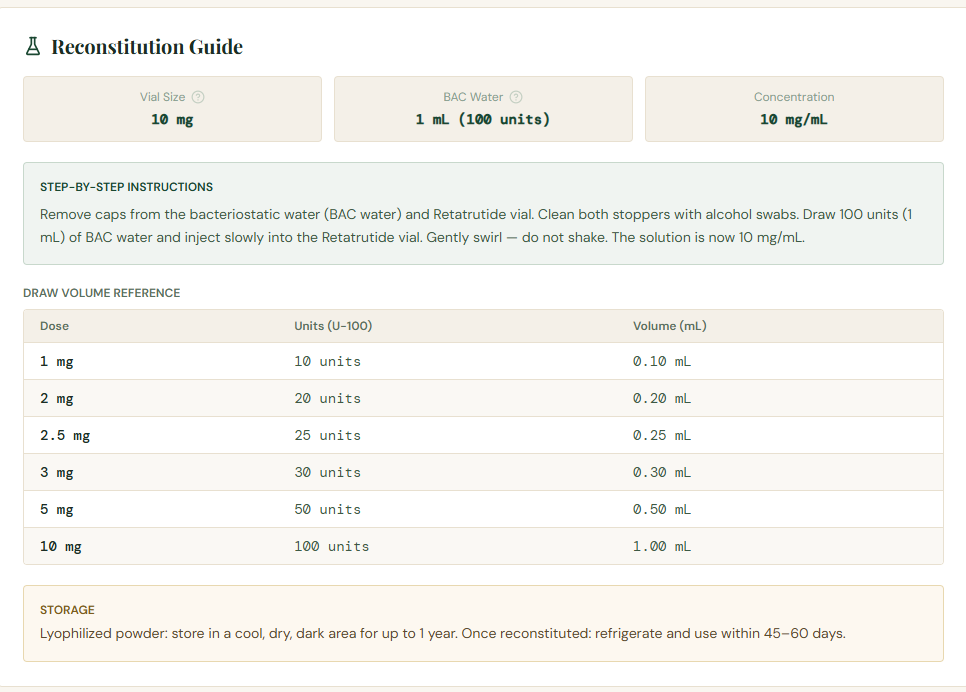
Use the reference graphic below as a quick visual guide, then use the dosage calculator for precise measurements based on your specific vial strength and reconstitution volume.
https://peptidetrainings.com/tools/reconstitution-calculator?label=Retatrutide
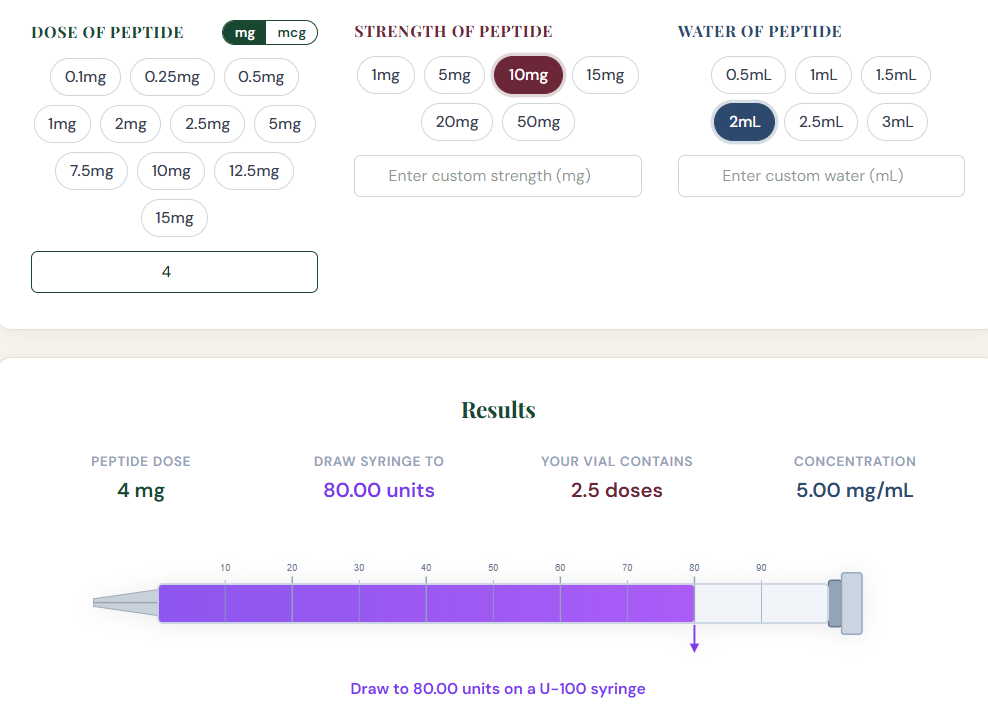
Draw Volume Reference
The correct syringe measurement depends on:
Peptide amount in the vial
Volume of reconstitution solution used
Desired dose
Syringe type and size
Calculate Your Dosage
Need to work out the exact syringe measurement for your dose?
→ Click here to calculate your dosage
Important
The table above is valid only at 10 mg/mL. Reconstitute the same 10 mg vial with 2 mL instead of 1 mL and every figure in that table doubles in volume.
Retatrutide is dosed in single-digit milligrams with meaningful differences between steps. A tenfold error here is a decimal place, not an obvious mistake, and it will not look wrong in the syringe.
Always confirm your vial strength, your reconstitution volume and your syringe type before drawing.
Protocol
Original classroom lesson. Preparation, measurement, sourcing, or protocol examples are source material, not verified instructions or clinical guidance.
Retatrutide Dosing Protocol
Retatrutide protocols vary depending on product concentration, tolerance and individual circumstances. The following framework reflects the structure used in clinical trials and is provided for educational reference. It should not be treated as clinical dosing guidance.
Typical Dose
Dose: 4 mg once weekly, the Phase 3 mid-dose
Dose Range: 1 mg starting, up to 12 mg, the highest dose studied
Frequency: Once weekly
Route: Subcutaneous injection. Abdomen preferred. Thighs or upper arms also used.
Cycle Length: 12 to 48 weeks. Phase 3 ran 40 weeks, with the obesity trial running 68.
Titration is the Protocol
With most compounds in this course, titration is a refinement. Here it is the core of the framework, and skipping it is the most common way people fail on this compound.
Weeks 1 to 4. Start at 1 to 2.5 mg once weekly. Purpose is tolerance, not results.
Thereafter. Titrate upward by roughly 0.5 mg increments every 4 to 6 weeks, as tolerated.
Trial doses. Phase 3 used 4 mg, 8 mg and 12 mg weekly as its arms.
Slow titration is critical to minimise gastrointestinal side effects. The trial results people quote were produced with structured titration under medical supervision, not by starting at the effective dose.
Clinical Notes
Dosing should be based on your specific product concentration.
Titrate on tolerance, not on impatience. Moving up faster does not produce results faster, it produces nausea.
Once weekly means once weekly. This is a long-acting compound and additional dosing does not accelerate anything.
Trial participants were medically supervised throughout, with monitoring that a self-directed protocol does not replicate.
Not FDA approved. Currently research use only.
Consult a qualified healthcare professional before using experimental peptide products.
Side Effects and Safety
Nausea, the most common, especially during titration
Vomiting
Diarrhea
Constipation
Decreased appetite
Injection site reactions
Mild fatigue
The gastrointestinal profile is not incidental. It is the direct consequence of slowed gastric emptying, which is one of the intended mechanisms. It is dose-dependent and titration-dependent, which is precisely why the titration schedule exists.
Research References
1. TRIUMPH-4 Phase 3 Trial, obesity. Eli Lilly, December 2025
2. Retatrutide Phase 3 Trial, type 2 diabetes. Eli Lilly, 2025
3. Retatrutide Phase 2 Trial, obesity. NEJM, 2023
4. Comparative Efficacy and Safety of Tirzepatide vs Retatrutide. PMC, 2025
Stacking & Combinations
Original classroom lesson. Preparation, measurement, sourcing, or protocol examples are source material, not verified instructions or clinical guidance.
Understanding why compounds are combined is more useful than memorizing someone else's stack. The goal is to evaluate whether each addition has a clear purpose, a complementary mechanism and a place in the overall protocol.
The Rule
Compounds make sense in a stack when they work through different mechanisms toward the same outcome.
Why Retatrutide Is Usually Run Solo
This compound is already a triple agonist. Three mechanisms are running inside one molecule.
Adding a second metabolic compound in most cases means duplicating a pathway retatrutide already occupies. Stacking another GLP-1 agonist on top of it is the clearest example: same receptor, more side effects, no additional mechanism.
The compounds that make sense alongside it are the ones addressing something retatrutide does not do, or managing a consequence of what it does.
What Pairs With Retatrutide, and Why
Retatrutide + BPC-157. Complementary. This pairing is not about enhancing fat loss. BPC-157's gut research is the rationale, aimed at managing gastrointestinal side effects during titration. It is a tolerance strategy, not a results strategy.
Retatrutide + Tesamorelin. Moderate synergy. Tesamorelin's visceral fat targeting works through growth hormone signalling, a pathway retatrutide does not occupy. Different mechanism, overlapping target.
Retatrutide + NAD+. Complementary. Mitochondrial function and cellular energy metabolism, alongside retatrutide's effect on expenditure and intake. Separate axis.
Four Questions Before Adding Anything
1. What specific mechanism does this add?
With a triple agonist, this question gets harder to answer honestly. Three pathways are already covered.
2. Does it overlap with something already in the stack?
Redundancy adds complexity without adding value. Here it also adds side effects.
3. Do I understand what it does independently?
Every compound should have a clear rationale before it becomes part of a combination.
4. Can I tell which compound produced the effect?
Particularly relevant here. Retatrutide produces large, obvious effects. Anything added alongside it will have its contribution completely masked, and you will have no way to know whether it did anything at all.
The Question Specific to This Compound
Ask whether you are stacking to add a mechanism or to add reassurance.
Retatrutide's trial results were produced by retatrutide alone. Nothing was stacked on top of it in TRIUMPH-4. The most evidence-backed way to use this compound is the way it was actually studied.
A Word on Aggressive Stacking
Four, five and six compound stacks are common in peptide communities, often with limited discussion of how well the combinations have been studied.
More compounds do not automatically mean better results. More compounds mean more variables, more cost, more potential interactions and less clarity about what is producing an effect.
With a compound this potent, adding variables also makes it harder to identify the source of any adverse effect, which is a safety issue rather than only an analytical one.
The goal is not to build the biggest stack. The goal is to build one that makes sense.
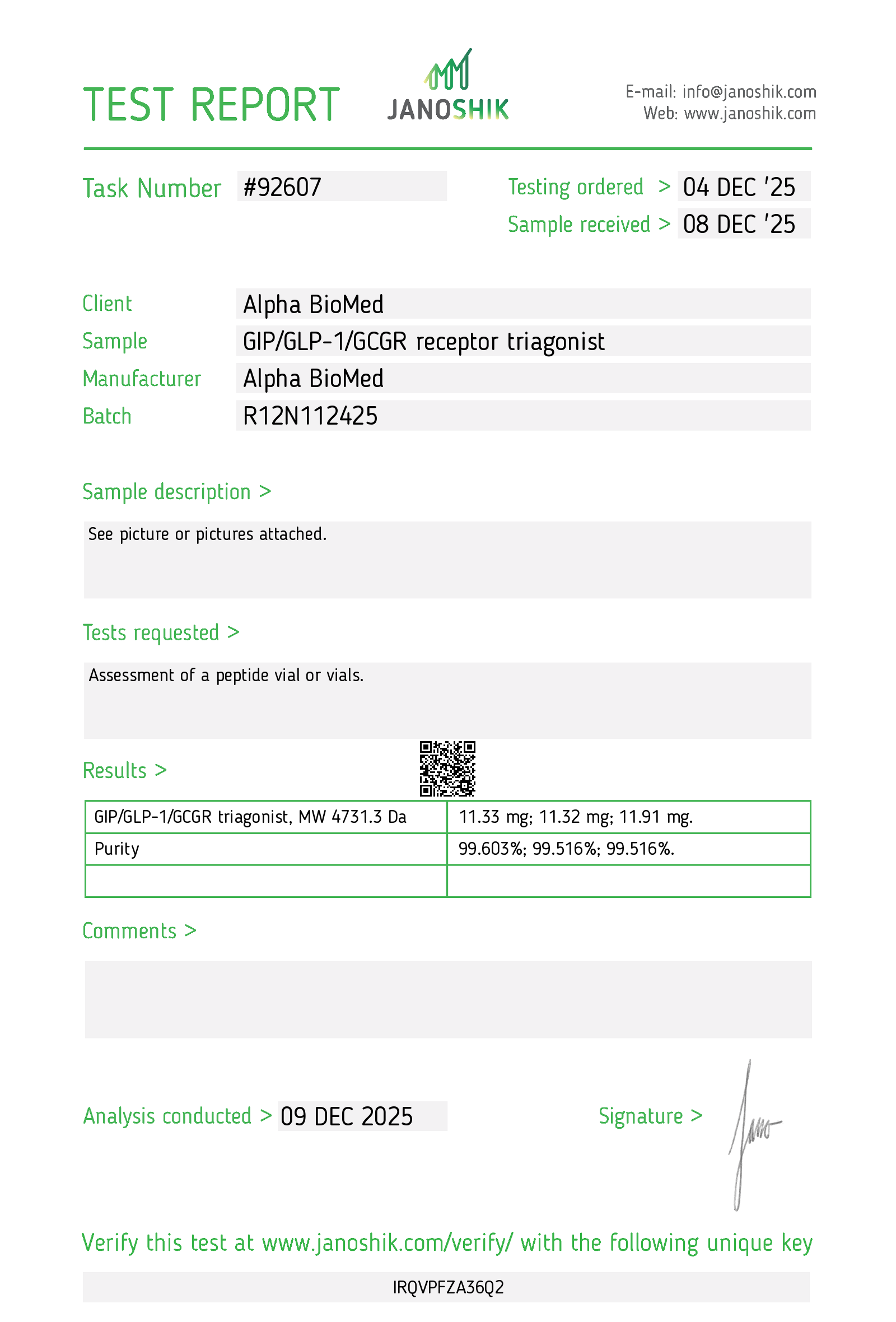
Certificate of Analysis
Report concerns a submitted sample and identified lot only; authenticity has not been independently verified. A report covers a submitted sample or lot, not safety, sterility, effectiveness, or every product sold. Its provenance has not been independently authenticated.
Open attached COAAll classroom topics