Tesamorelin
A growth hormone releasing hormone analog approved for excess abdominal fat in adults with HIV and lipodystrophy.
This material is educational, not medical advice or a treatment recommendation. Classroom claims and example protocols have not all been independently verified.
The Compound, Explained
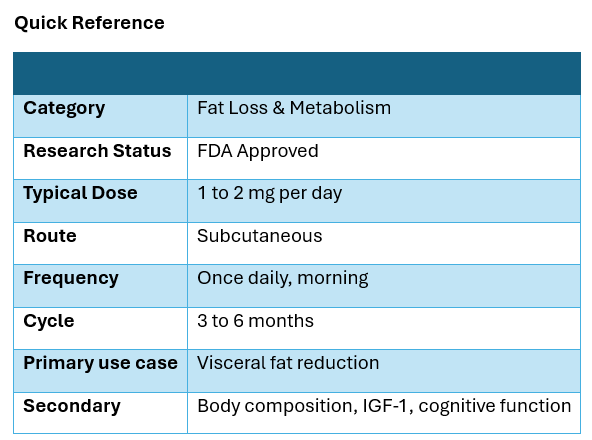
Category: Fat Loss & Metabolism
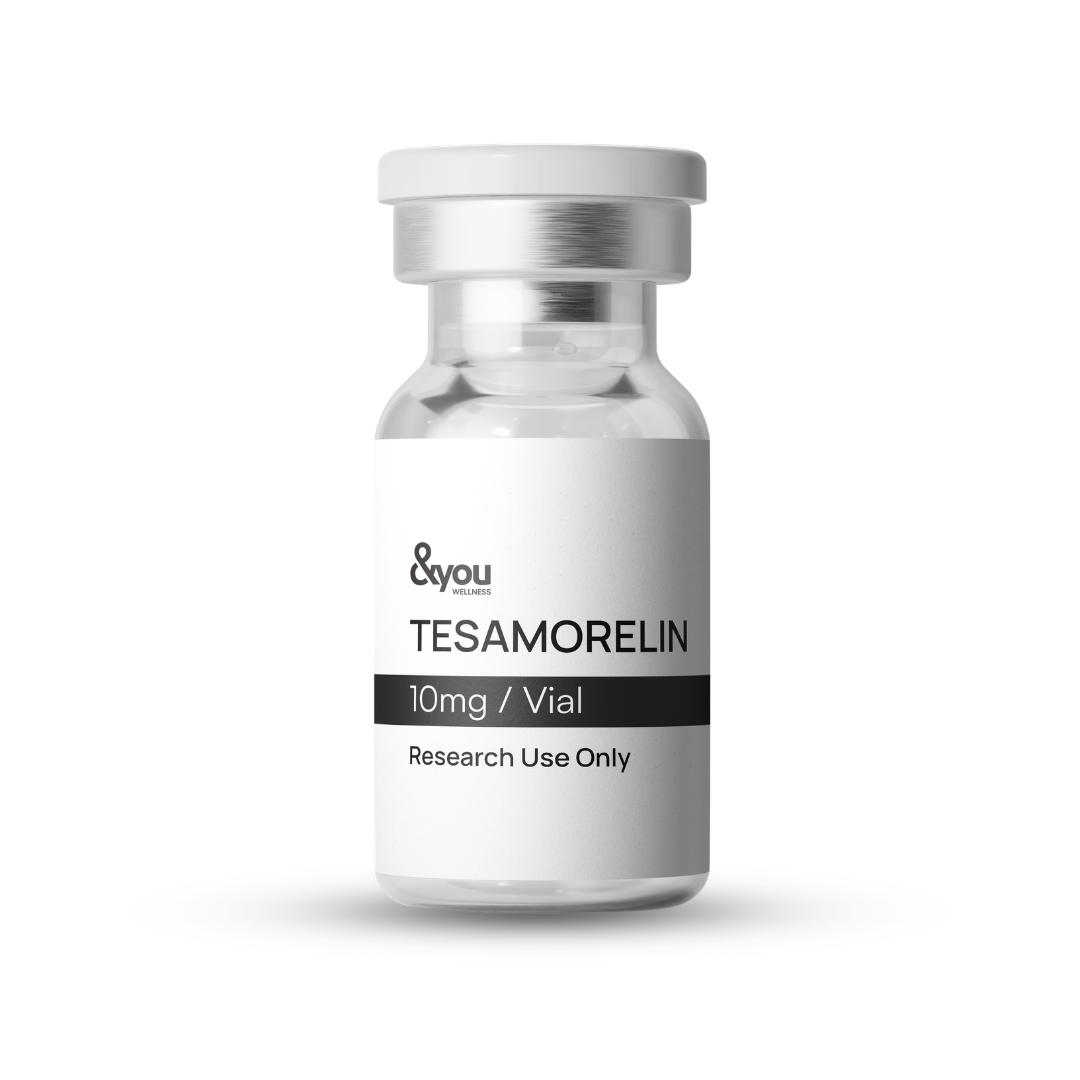
Compound: Tesamorelin. Sold as Egrifta. A GHRH analog.
Research Status: FDA Approved
Regulatory Status: FDA approved for reduction of excess visceral abdominal fat in HIV-infected patients with lipodystrophy. Prescription required. Use for any other purpose is off-label.
Read That Approval Line Carefully
Tesamorelin is one of two approved compounds in this library, and its approval is the most specific one you will encounter.
It is not approved for fat loss. It is approved for one condition, in one population: excess visceral abdominal fat in HIV patients with lipodystrophy.
Almost everyone using tesamorelin is using it off-label.
That distinction is the entire lesson of this module. Approved is not a property of a molecule, it is a statement about a molecule, an indication and a population together. Strip any of those away and the word stops meaning what it appeared to mean.
Off-label use is legal, common and often clinically reasonable. It is also use outside what the evidence formally covers, and knowing which side of that line you are on is the point.
What This Is
A synthetic analog of growth hormone-releasing hormone.
GHRH is produced in your hypothalamus. Its job is telling the pituitary gland to release growth hormone. Tesamorelin is a stabilized version of that signal.
So this compound does not add growth hormone. It tells your body to release its own.
Why That Difference Matters
The most important mechanistic point here, and the reason this compound exists rather than people simply using HGH.
Injecting HGH adds hormone from outside. Levels rise and stay elevated in a way your body does not produce naturally, and your own production downregulates in response.
Tesamorelin prompts your pituitary to release GH in pulses, which is how your body does it anyway. The release pattern stays physiological, and critically, your negative feedback loops remain intact. If GH and IGF-1 climb, your own regulatory systems push back.
That preserved feedback is the real argument for GHRH analogs over direct hormone. It is a meaningful mechanistic advantage, and it is worth stating precisely rather than as "safer." It means the ceiling on the effect is partly set by your own physiology rather than by the syringe.
Visceral Fat Is Not Just Belly Fat
The target matters, and it is more specific than most people assume.
Subcutaneous fat sits under the skin. It is what you can pinch. Largely a cosmetic concern.
Visceral fat sits deeper, wrapped around the organs inside the abdominal cavity. You cannot pinch it. It is metabolically active tissue that produces inflammatory signaling, and it is the fat associated with insulin resistance and cardiovascular risk.
Tesamorelin's approval and its strongest research are specifically about visceral fat.
Two consequences follow. Someone can lose meaningful visceral fat with less visible change than they expected, because the fat they can see is not the fat being targeted. And the health argument for reducing visceral fat is stronger than the aesthetic one, which is an unusual position for a compound in this category.
Who This Is Studied In, and Who Uses It
Studied in and approved for HIV patients with lipodystrophy, a condition producing abnormal fat distribution.
Used off-label by people seeking visceral fat reduction and body composition change, typically in middle age when visceral fat accumulates and natural GH output declines.
The mechanism does not care about HIV status, and the trial evidence was generated in a population with a specific metabolic condition. Those two facts sit next to each other and neither cancels the other.
Inside the Mechanism
The GHRH Cascade
Three steps, and the whole compound follows from them.
Step One: Tesamorelin binds GHRH receptors on the pituitary gland.
Step Two: The pituitary releases growth hormone in a pulse.
Step Three: GH acts on tissue directly and stimulates the liver to produce IGF-1.
Everything downstream, fat mobilization, body composition, side effects, comes from that cascade. You are working one step upstream of the hormone rather than on the hormone itself.
Why Pulsatile Release Matters
Your body does not maintain constant GH levels. It releases in bursts, concentrated during deep sleep and after exercise, with low levels between.
That pattern is not incidental. Receptors respond to changes in signal, and continuous exposure downregulates them. This is a general principle in endocrinology and it explains a lot of what goes wrong when hormones are administered flat.
Tesamorelin preserves the pulse. The pituitary releases, levels rise, levels fall, receptors reset.
Fat Mobilization
Growth hormone promotes lipolysis, the breakdown of stored fat for energy.
The part that is not fully explained is why visceral fat responds preferentially. Proposed reasons include differences in receptor density and in the metabolic activity of visceral versus subcutaneous tissue. The effect is well documented in the trials. The mechanism behind the selectivity is less settled, and it is honest to say so.
IGF-1
Insulin-like growth factor 1, produced mainly by the liver in response to GH. It mediates many of GH's anabolic effects, including muscle maintenance.
IGF-1 is also the practical marker for this compound. It is measurable in bloodwork, it responds reliably, and it is how clinicians track whether a GHRH analog is doing anything. If you want objective feedback on Tesamorelin, this is where you get it.
Cognitive Effects
Tesamorelin has been studied for cognitive function, including in older adults with mild cognitive impairment. GH and IGF-1 both have activity in the brain.
Early research, genuinely interesting, and a smaller body of work than the visceral fat data. Treat it as a research direction rather than a reason to use the compound.
Why the Side Effects Look the Way They Do
Worth connecting, because it makes the safety section make sense rather than reading as a random list.
Every listed side effect is a growth hormone effect.
Fluid retention and joint pain. GH causes sodium and water retention. Joint discomfort follows from the same mechanism.
Carpal tunnel. Fluid retention in a confined space compressing a nerve.
Glucose intolerance. GH raises blood sugar and opposes insulin. This is the one that matters most and it gets its own treatment in the Protocol tab.
These are not unpredictable reactions. They are the expected consequences of raising GH, which is exactly what the compound is designed to do.
What the Research Actually Shows
Read the Status Tag First
Tesamorelin is tagged FDA Approved, and this is the module where you learn what that tag does not cover.
Approval attaches to an indication and a population. Here that is excess visceral abdominal fat in HIV patients with lipodystrophy. The trials were run in that population. The regulator reviewed that evidence and approved that use.
Approval is not a general endorsement of the molecule, and it does not transfer to other uses.
The Off-Label Question, Handled Honestly
Most people using Tesamorelin are not HIV patients, so what is the evidence worth to them?
The Argument for Transfer: The mechanism is not condition-specific. GHRH receptors work the same way regardless of HIV status, and visceral fat is visceral fat. This is a reasonable extrapolation.
The Argument Against: The trial population had a specific metabolic condition affecting fat distribution. Effect sizes in a population with abnormal fat distribution may not be the effect sizes in a population with ordinary middle-aged visceral accumulation. A study that showed a large change in one group is weaker evidence for a different group, even with the same mechanism.
Where that Leaves You: Tesamorelin off-label is better supported than almost anything in this library, and it is still extrapolation. That is a reasonable position to take, provided you know you are taking it.
Compare it against the alternative framings students usually encounter. It is not proven for your use, and it is not unproven in the way a preclinical compound is unproven. It sits between, which is an uncomfortable but accurate place.
The Numbers
The 2011 research on Tesamorelin for visceral adiposity is the reference point. Visceral adipose tissue reduction was measured by CT imaging, which is worth noting on its own: this is objective measurement of a specific fat compartment, not weight on a scale.
Two things to read carefully.
Visceral fat reduction is not weight loss. Total body weight changes modestly. If you judge this compound by the scale you will conclude it does very little, and the scale is measuring the wrong thing.
Effects took months. Results at three months, with continued effect over longer periods. Anyone expecting change in weeks is working on the wrong timeline.
The Discontinuation Finding
Visceral fat returns after stopping. This is consistent across the research.
Read it the same way as the Tirzepatide maintenance data. It is not evidence the compound failed, since the fat came off and stayed off during use. It defines what kind of intervention this is.
Tesamorelin prompts GH release. Stop, and GH returns to your baseline, and so does the metabolic environment that allowed visceral fat to accumulate. The compound did not change the underlying cause.
The practical implication is that a 3 to 6 month cycle is best treated as a window rather than a cure. What you build during it, training, dietary change, sleep, determines what happens after, because those are the things that affect visceral fat without a prescription.
What Is Not Established
Long-Term Off-Label Use: Trials ran months in a specific population. Years of use in healthy middle-aged people is not something anyone has data on.
Optimal Dosing Outside the Indication: The 1 to 2 mg figure comes from the approved protocol. Whether that is optimal for a different population is an assumption.
The GH and Cancer Question: GH and IGF-1 have growth-promoting effects, and there is a long-running discussion in endocrinology about GH therapy and malignancy risk. The evidence is mixed and the topic is not settled. It is worth knowing the question exists rather than discovering it later, and it is a prescriber conversation for anyone with a relevant history.
Holding Both Facts
Tesamorelin is FDA approved, has objective imaging-based trial evidence, works through a mechanism that preserves your own regulatory feedback, and targets the fat compartment that actually matters metabolically. It is also approved for a population most users do not belong to, requires ongoing use to hold its effect, carries a side effect profile that follows directly from raising GH, and has no long-term data in the population actually using it.
Hold both at once.
Sourcing & Verification
Original classroom lesson. Preparation, measurement, sourcing, or protocol examples are source material, not verified instructions or clinical guidance.
Tesamorelin is approved and prescriptible, which makes the sourcing conversation different from most of this library. It is also expensive as Egrifta, which is why a research-grade market exists alongside it.
The Legitimate Route
Tesamorelin is available by prescription as Egrifta. That gives you a pharmaceutical-grade product with verified identity and concentration, plus a prescriber monitoring the things that need monitoring on this compound.
That last part carries more weight here than with most compounds. Tesamorelin affects glucose metabolism, and the sensible protocol includes bloodwork. A prescriber route bundles the monitoring with the medication.
What to Verify If You Are Sourcing Outside That
Identity against other GH compounds. Tesamorelin sits in a market alongside CJC-1295, sermorelin, ipamorelin and others, all of which act on the GH axis and all of which are cheaper. Mass spectrometry identity confirmation is what distinguishes them, and a purity figure alone does not.
Stability is a real issue for this one. Tesamorelin is less stable than many peptides, which is why the pharmaceutical product has specific handling requirements. Ask about the manufacturer's storage and stability data rather than assuming a generic peptide timeline applies.
Concentration accuracy. Prescription tesamorelin arrives at a known dose. Research-grade arrives as powder, which puts dose accuracy on you at a point where the difference between 1 mg and 2 mg is the difference between the bottom and top of the range.
The COA Standard
A valid COA names the testing laboratory, carries a batch number matching your vial, states a test date, gives purity with the method used, and confirms identity. Anything answering "available on request," or arriving as a screenshot with no traceable source, is not a COA.
For Tesamorelin, ask for identity confirmation specifically, given how many similar GH-axis compounds share the same market.
The Verification You Actually Have
Worth naming, because this compound offers something most do not.
IGF-1 is measurable. If Tesamorelin is working, IGF-1 rises. That is an objective check on whether your product is active, available through ordinary bloodwork.
Very few compounds in this library give you that. Take a baseline IGF-1 before starting and retest during the cycle, and you have real feedback rather than documentation and hope.
Storage
Lyophilized Powder: Cool, dry, protected from light. Reconstituted: refrigerate, protect from light, follow the manufacturer's window. Do not freeze unless specifically indicated.
Preparation
Original classroom lesson. Preparation, measurement, sourcing, or protocol examples are source material, not verified instructions or clinical guidance.
Tesamorelin Reconstitution Guide
If you are using prescription Egrifta, follow the product instructions. This tab covers lyophilized powder.
Vial strengths vary, so always use the volume specified for your exact product.
Reference Configuration
Vial Size: 2 mg
Bacteriostatic Water: 1 mL
Resulting Concentration: 2 mg/mL
What you will Need:
Tesamorelin vial
Bacteriostatic water
U-100 insulin syringes
Alcohol pads
Step 1: Prepare and Sanitize
Wash your hands and prepare a clean workspace.
Remove the caps from both the bacteriostatic water and the Tesamorelin vial.
Clean both stoppers with alcohol pads and allow them to dry.
Step 2: Reconstitute
Draw the specified volume of bacteriostatic water.
Insert the needle and introduce the water slowly along the inside wall.
Avoid directing the stream forcefully onto the powder.
Step 3: Mix Gently
Do not shake. Swirl gently until fully dissolved. The solution should be clear.
Step 4: Storage after Reconstitution
Refrigerate.
Protect from light.
Follow the manufacturer's stated window.
Do not freeze unless the manufacturer specifically indicates it.
Handle This One Carefully
Tesamorelin is more fragile than most compounds in this library. Agitation, heat and light degrade it faster than they degrade a robust short peptide like BPC-157.
Practical Consequences:
Swirl gently and be patient rather than speeding dissolution.
Keep it refrigerated and dark between doses rather than leaving it out.
Do not carry a reconstituted vial around at room temperature for convenience.
This matters because degradation is invisible. A partly degraded vial looks identical to a good one, and on a three to six month protocol you would have no way to tell until IGF-1 bloodwork came back flat.
Measurement
Original classroom lesson. Preparation, measurement, sourcing, or protocol examples are source material, not verified instructions or clinical guidance.
Tesamorelin Measurement Guide
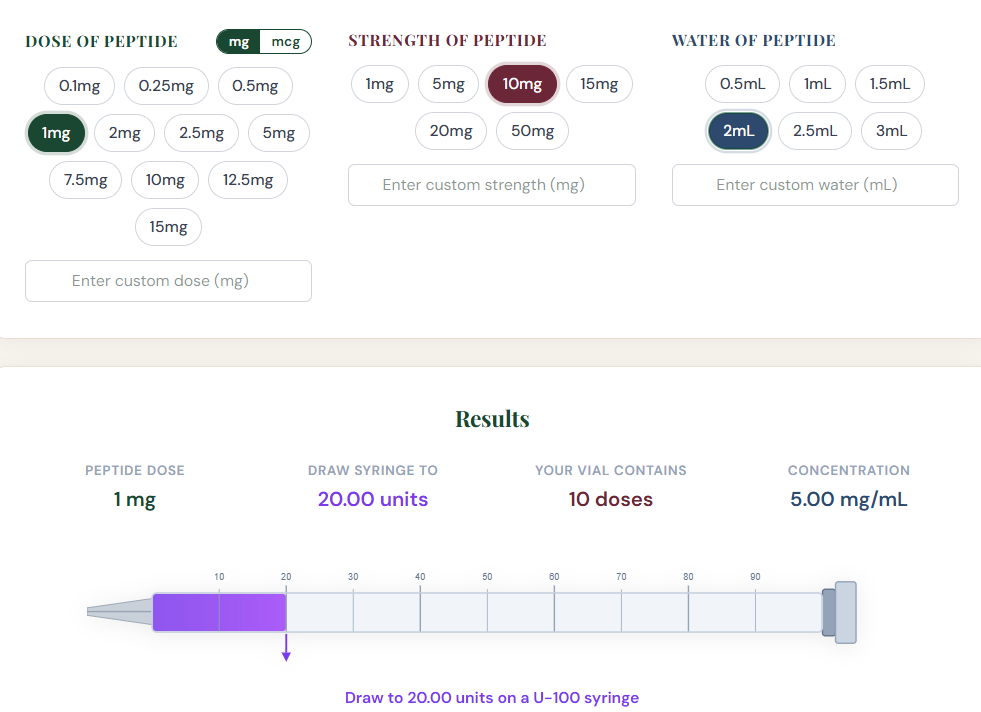
Calculator, pre-filled with Tesamorelin defaults: https://peptidetrainings.com/tools/reconstitution-calculator?label=Tesamorelin
Draw Volume Reference
At 2 mg reconstituted with 1 mL, giving 2 mg/mL, on a U-100 syringe:
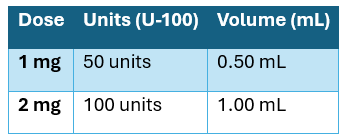
The correct measurement depends on vial strength, reconstitution volume, desired dose and syringe type.
Calculate Your Dosage
→ Click here to calculate your dosage
Important
Note the volumes. At this concentration, a 1 mg dose is half a U-100 syringe and a 2 mg dose is the entire syringe. That is much larger than most compounds in this library, where doses commonly sit at 10 to 20 units.
If a full-syringe injection is uncomfortable, reconstitute with more water and split across sites, or use a higher-strength vial. Do not solve it by taking less than your intended dose.
One vial is one or two doses at this configuration. A 2 mg vial reconstituted in 1 mL gives two 1 mg doses, or one 2 mg dose. On a daily protocol running three to six months, plan your supply and your reconstitution schedule accordingly rather than discovering the throughput mid-cycle.
The dose range is narrow. 1 to 2 mg is a twofold spread, not the tenfold ranges seen elsewhere in this library. There is less room for approximation, which is a reason to measure carefully rather than a reason to relax.
Always confirm your vial strength, your reconstitution volume and your syringe type before drawing.
Protocol
Original classroom lesson. Preparation, measurement, sourcing, or protocol examples are source material, not verified instructions or clinical guidance.
Tesamorelin Dosing Protocol
The following framework reflects the approved protocol and is provided for educational reference. Tesamorelin requires a prescription, and dosing should be directed by a prescriber.
Typical Dose
Dose: 1 to 2 mg per day
Dose Range: 1 to 2 mg per day
Frequency: Once daily, in the morning
Route: Subcutaneous injection
Cycle: 3 to 6 months
Morning, Empty Stomach
Both parts of this are mechanism, not preference.
Morning. Your natural GH pulses concentrate during deep sleep. Morning dosing works with that rhythm rather than against it, and avoids a GH pulse landing at a time your body is not expecting one.
Empty stomach. Elevated blood glucose and insulin blunt GH release. Food raises both. Dosing on an empty stomach and waiting before eating gives the pulse a clearer run.
This is one of the few compounds in this library where timing genuinely changes the result rather than just being tidy.
The Timeline
Weeks 1 to 4: Little visible change. IGF-1 should be rising, which is measurable even when nothing else is.
Month 2: Early changes may appear.
Month 3: The point at which trials measured meaningful visceral fat reduction.
Months 4 to 6: Continued effect.
Three months before assessing is the realistic expectation. Judging this compound at week six is judging it before it has finished doing anything.
Do Not Judge It by the Scale
The single most common mistake with Tesamorelin.
This compound targets visceral fat specifically. Total weight change is modest, and body composition can improve while the scale barely moves.
Better Measures: Waist circumference, how clothes fit, bloodwork. Imaging if you have access to it. The scale is measuring the wrong variable and will tell you the compound is not working when it may be.
Glucose Deserves Its Own Section
Listed among the side effects and it is the one to take seriously, for a reason that is mechanistic rather than incidental.
Growth hormone opposes insulin and raises blood glucose. That is not a quirk of Tesamorelin, it is what GH does. Raising GH raises blood sugar.
Practical Response:
Get fasting glucose and HbA1c before starting.
Retest during the cycle.
Anyone with existing insulin resistance, prediabetes or type 2 diabetes should treat this as a prescriber conversation, not a footnote.
There is an irony worth noticing here. Visceral fat drives insulin resistance, so reducing it should improve glucose handling. Meanwhile the mechanism used to reduce it worsens glucose handling directly. Those two effects run in opposite directions, which is exactly why monitoring rather than assuming is the right approach.
Build the Exit While You Are In It
Visceral fat returns after discontinuation. Given a 3 to 6 month cycle, the useful framing is that you have a window.
Resistance training, dietary change and sleep all affect visceral fat and none require a prescription. Building them during the cycle is what determines whether the result holds afterward. Starting to think about it in month six is starting too late.
Clinical Notes
Best taken in the morning on an empty stomach.
Results typically seen within three months.
Track IGF-1. It is the objective marker for this compound and it tells you whether it is working before anything visible does.
Monitor glucose.
Fluid retention and joint discomfort are GH effects and often ease after the early weeks.
Consult a qualified healthcare professional before use.
Side Effects and Safety
Injection site reactions
Fluid retention, edema
Joint pain
Glucose intolerance
Carpal tunnel syndrome, rare
All of these follow directly from raising growth hormone. They are dose-related, which means an adjustment downward is a legitimate response to them rather than an admission of failure.
Research References
Stack Logic
Original classroom lesson. Preparation, measurement, sourcing, or protocol examples are source material, not verified instructions or clinical guidance.
Tesamorelin initiates a GH pulse. Almost every compound stacked with it is there to change the shape of that pulse, which makes this one of the more mechanically specific stacking conversations in the library.
The GHRH and GHRP Structure
Worth understanding, because it explains all of the pairings below.
There are two separate routes to a GH pulse.
GHRH analogs, including Tesamorelin, act on GHRH receptors and initiate release.
GHRPs, or secretagogues, including ipamorelin, act on a different receptor, the ghrelin receptor, and also prompt release.
Because they work through different receptors, combining them produces a larger pulse than either alone. This is one of the few places in this field where the word synergy is used with a real mechanistic basis behind it.
What Pairs With Tesamorelin, and Why
Tesamorelin + Ipamorelin. The classic GHRH plus GHRP combination. Two receptors, one outcome, a larger pulse than either produces alone. Ipamorelin is favoured in this role because it is relatively selective and does not carry the cortisol and prolactin effects some older secretagogues do.
Tesamorelin + CJC-1295. Both act on the GH axis, and the framing is that CJC-1295 extends pulse duration while tesamorelin initiates it. Worth thinking about carefully rather than accepting: CJC-1295 is itself a GHRH analog, so this is two compounds on the same receptor. That is closer to duration modification than to added mechanism, and it is a reasonable pairing that is not as cleanly complementary as the ipamorelin one.
Tesamorelin + AOD-9604. AOD-9604 is a fragment of growth hormone associated with fat metabolism specifically. The rationale is adding targeted fat-burning alongside visceral reduction. A moderate pairing with a thinner evidence base than the GH-axis compounds above.
The Question Specific to This Compound
How big a GH pulse are you actually aiming for, and what is monitoring it?
This is the stack where escalation happens most easily. Each addition amplifies the same output, and the side effects, fluid retention, joint pain, glucose intolerance, all scale with that output. Stacking two or three GH-axis compounds means stacking their consequences, not just their benefits.
The preserved feedback loop that makes GHRH analogs attractive also becomes less protective the harder you push the system from multiple directions at once.
IGF-1 bloodwork is what turns this from guesswork into a measurable protocol. If you are stacking GH-axis compounds and not tracking IGF-1, you have no idea where you are.
What Does Not Belong Here
HGH itself. Using a compound that prompts your own GH release alongside exogenous GH defeats the purpose of choosing a GHRH analog in the first place, and it suppresses the natural production you were working to stimulate.
Multiple secretagogues at once. Two GHRPs occupy the same receptor. That is duplication, and the second one mostly adds cost and side effects.
Where This Leaves You
Tesamorelin is one of the more rationally stackable compounds in this library, because the GH axis is well characterized and the combinations have a real mechanistic basis rather than a marketing one.
That same clarity is what makes restraint worth practicing here. The system you are stimulating has a feedback loop, a side effect profile that scales with output, and a measurable marker that tells you where you are. Use the marker, add one compound at a time, and let the bloodwork rather than the enthusiasm decide how far the stack goes.
Certificate of Analysis
No COA attachment was available for this course when checked.
All classroom topics