Sermorelin
A GHRH analog with a distinct regulatory history; explore the mechanism and the evidence behind it.
This material is educational, not medical advice or a treatment recommendation. Classroom claims and example protocols have not all been independently verified.
The Compound, Explained
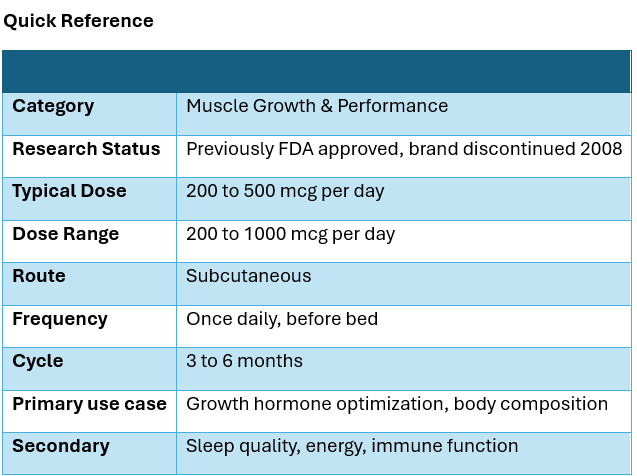
Category: Muscle Growth & Performance
Compound: Sermorelin (GRF 1-29, GHRH 1-29 NH2). Formerly sold as Geref.
Research Status: Previously FDA approved. Brand discontinued in the US in 2008.
Regulatory Status: Was FDA approved for growth hormone deficiency. The branded product was withdrawn from the US market in 2008, largely for commercial reasons rather than safety concerns.
Read That Status Line Carefully
Sermorelin has the most unusual regulatory history in this library, and both simple versions of it are wrong.
"Sermorelin is FDA approved" is misleading in the present tense. The approved branded product, Geref, is no longer marketed in the US.
"Sermorelin is not FDA approved" is also misleading. It went through the full approval process and cleared it. The withdrawal was a commercial decision, not a regulatory or safety one.
The Accurate Version: sermorelin has been through FDA review and passed, and the approved product was discontinued for business reasons. It remains available through compounding pharmacies by prescription, which makes it one of the most accessible compounds in this library through legitimate channels.
That distinction matters because a withdrawn drug and a rejected drug are opposite situations, and the word "discontinued" covers both. Check which one you are looking at.
What This Is
A GHRH analog. It prompts your pituitary to release growth hormone.
Sermorelin is the first 29 amino acids of natural growth hormone-releasing hormone. Research found that fragment carries the full biological activity of the whole molecule, which is why the rest is not needed.
Same fragment logic you have seen throughout this course. BPC-157 from a gastric protein, Semax from ACTH, KPV from alpha-MSH. Take the active piece, leave the rest.
Where It Sits Among the GH Compounds
Three GH-axis compounds appear in this library and they divide cleanly.
Sermorelin, a GHRH analog. Short-acting, closest to the natural signal, longest clinical history.
Tesamorelin, a GHRH analog. Stabilised, longer-acting, FDA approved for a specific indication.
Ipamorelin, a GHRP. Acts on the ghrelin receptor, the other door to the same room.
Sermorelin is the original and the mildest. It is what providers commonly start people on, and it is frequently paired with ipamorelin.
Short-Acting Is the Defining Property
Sermorelin has a short half-life, and this is what separates it from the newer GHRH analogs.
The consequence: it produces a brief pulse that closely resembles your body's own GHRH signal, then clears.
That is simultaneously its main limitation and its main safety argument. A short pulse means less total GH release than a longer-acting analog would produce. It also means less sustained receptor stimulation, which is the mechanism behind downregulation.
People choose sermorelin when they want the mildest, most physiological version of GH support. People choose CJC-1295 or tesamorelin when they want more. Both are reasonable, and the trade is real in both directions.
Your Feedback Loop Stays Intact
The same structural point as tesamorelin and ipamorelin.
Injecting HGH adds hormone from outside. Levels rise and stay elevated, and your own production downregulates.
Sermorelin prompts your pituitary to release its own GH. Your regulatory systems stay in the loop. If GH and IGF-1 climb, negative feedback pushes back.
Sermorelin is the clearest case of this in the library, since it is the closest match to the natural signal and the shortest-acting. The ceiling on its effect is set substantially by your own physiology.
Inside the Mechanism
The GHRH Receptor
Sermorelin binds GHRH receptors on the pituitary, exactly as your own GHRH does.
Three steps follow:
Step One: Sermorelin binds the GHRH receptor.
Step Two: The pituitary synthesises and releases growth hormone.
Step Three: GH acts on tissue and prompts the liver to produce IGF-1.
Note step two carefully. GHRH analogs prompt both production and release, not just release of what is already stored. That is part of why this class is described as supporting natural GH function rather than simply triggering it.
Why the Half-Life Shapes Everything
Sermorelin clears quickly. Every practical feature of this compound follows from that.
The pulse is physiological. Your own GHRH is also short-acting. Receptors respond to changes in signal, and a brief pulse followed by clearance is the pattern the system evolved to handle.
Timing matters more than with longer-acting compounds. A short pulse has to land in the right window, which is why bedtime dosing is not optional here.
Downregulation risk is lower. Sustained receptor occupancy is what drives loss of responsiveness. A signal that clears quickly does not sustain occupancy.
Effects are milder. Less total GH release than a longer-acting analog. This is the honest trade.
The Feedback Loop, Concretely
Worth spelling out because it is the compound's main safety argument.
Your body regulates GH through somatostatin, an inhibitory hormone released when GH and IGF-1 rise. It is the brake on the system.
Injecting HGH bypasses this entirely. The hormone is already in your bloodstream and somatostatin has nothing to act on.
Sermorelin works upstream of the brake. If levels climb, somatostatin rises and the pituitary responds less. The system self-limits.
This is a genuine mechanistic safety property, and it has a limit worth stating: it makes overshooting harder, not impossible, and it becomes less protective when the system is pushed from multiple directions at once. That matters in the stacking tab.
Sleep
GH release concentrates during early deep sleep, and GH itself influences sleep architecture.
The relationship runs both ways, which is why improved sleep is one of the more consistently reported effects on GH-axis compounds and why it tends to appear earlier than body composition change.
Why the Side Effects Look Mild
Flushing, headache, dizziness and injection site reactions. A milder list than tesamorelin's, which includes fluid retention, joint pain and glucose intolerance.
That difference is not accidental. Sermorelin produces less total GH elevation than a longer-acting analog, and GH-related side effects scale with GH elevation. A milder compound produces milder effects, which is the same trade appearing from the other direction.
What the Research Actually Shows
Read the Status Tag First
Sermorelin's position is genuinely strong and it needs the full context.
What Supports it: It completed FDA approval, which almost nothing else here has done. It has decades of clinical use. The 2004 research on adult growth hormone deficiency sits alongside that history. It is available through compounding pharmacies, meaning prescriber involvement is realistic.
What that does not Establish: The approval was for growth hormone deficiency, a diagnosed medical condition. Most people using sermorelin do not have it.
That is the same pattern as tesamorelin, and it is worth recognising as a category by now. Approval attaches to a molecule, an indication and a population together.
Deficiency Versus Decline
The most important distinction in this module, and the one almost all GH-axis marketing blurs.
Growth hormone deficiency is a diagnosed medical condition, usually involving pituitary dysfunction, confirmed by specific testing. It has real consequences and it is what sermorelin was approved to treat.
Age-related GH decline is the normal downward drift in GH output that happens to everyone from early adulthood onward.
These are not the same thing, and the evidence for treating one does not transfer cleanly to the other. Restoring function in a deficient system is a different intervention from nudging a normally declining one.
Whether age-related decline should be treated at all is an open question in endocrinology rather than a settled one. Some view it as a deficit worth correcting, others as a normal process with unclear consequences from intervention. Anyone presenting that as resolved is overstating it.
Why the Brand Was Withdrawn
Worth understanding, because it is a useful case in reading regulatory history.
Geref was discontinued in the US in 2008. This was a commercial decision rather than a safety withdrawal.
Drugs leave markets for many reasons: limited patient populations, competition, manufacturing economics, patent position. A discontinued product is not the same as a recalled or withdrawn-for-safety product, and the two get conflated constantly.
The practical lesson: when you read that something was discontinued, find out why. The answer changes the meaning entirely.
The Compounding Route Changes Things
Sermorelin is widely available through compounding pharmacies by prescription in the US, which is unusual in this library.
Two consequences:
Quality is generally better than research-grade. A compounding pharmacy operates under regulatory oversight that a research chemical supplier does not.
A prescriber is involved. That brings baseline testing, IGF-1 monitoring and someone tracking the protocol, which is worth more on a slow invisible compound than on a fast obvious one.
If you are going to run sermorelin, this route exists and is usually the better one.
GH Does Not Equal Results
Same point as the ipamorelin module and it applies equally.
Raising GH is not the same as achieving what people want from raising it. Body composition, recovery and tissue maintenance depend on training, protein intake, sleep and energy balance. GH is permissive rather than sufficient.
This matters more on sermorelin than elsewhere because results take 3 to 6 months, which is plenty of time for other changes to be responsible for whatever you observe.
What Is Not Established
Long-term use in people without deficiency. Approval was for a diagnosed condition. Years of use in healthy adults for age-related decline is not something anyone has data on.
The GH and cancer question. GH and IGF-1 have growth-promoting effects, and the discussion in endocrinology about GH therapy and malignancy risk is long-running and unsettled. Worth knowing it exists, and a prescriber conversation for anyone with relevant history.
The July 2026 Committee Vote
On July 23 2026 the FDA's Pharmacy Compounding Advisory Committee voted on seven peptides.
Recommended: BPC-157, KPV, TB-500, MOTS-c, Epitalon, Semax
Not recommended: Emideltide, also known as DSIP
Sermorelin was not among the seven assessed at that meeting, and its absence carries no evaluative meaning.
Holding Both Facts
Sermorelin completed FDA approval, has decades of clinical use, works through the most physiological mechanism of any GH compound here, preserves your feedback loop, and is accessible through prescriber-supervised compounding.
It was also approved for a diagnosed deficiency most users do not have, produces milder effects than newer analogs by design, requires 3 to 6 months before results are assessable, and has no long-term data in the population actually using it.
Hold both at once.
Sourcing & Verification
Original classroom lesson. Preparation, measurement, sourcing, or protocol examples are source material, not verified instructions or clinical guidance.
Sermorelin is one of the few compounds in this library where the best sourcing answer is realistically available to most people.
The Compounding Pharmacy Route
Sermorelin is widely compounded in the US by prescription. That gives you a product made under regulatory oversight, at a verified concentration, with a prescriber involved.
For a compound requiring 3 to 6 months before you can assess it, and producing effects you cannot feel, that oversight is not a luxury. The prescriber route also bundles in the baseline and follow-up IGF-1 testing that makes this protocol measurable rather than hopeful.
If you can access this route, take it.
What to Verify Otherwise
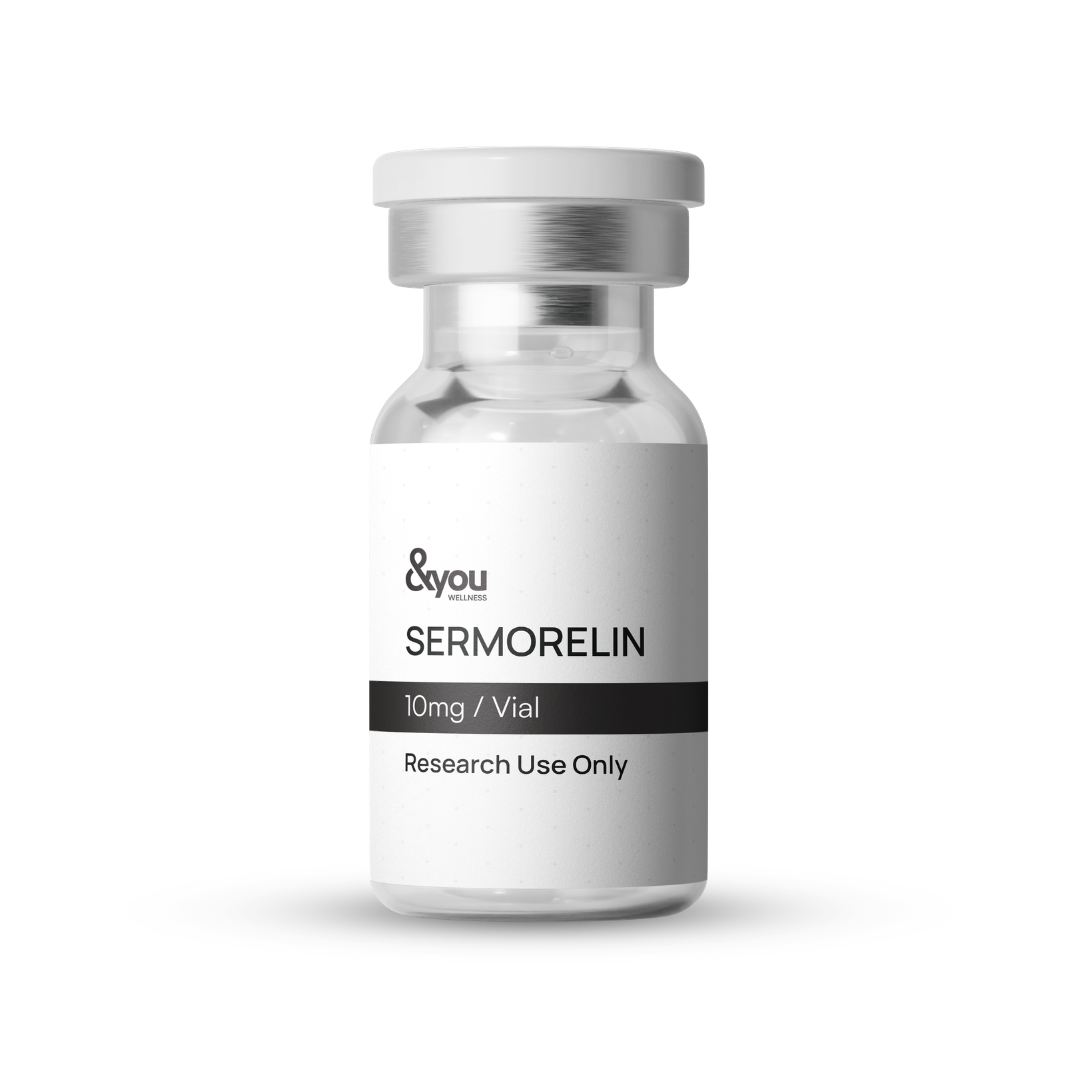
Identity, in a crowded market. Sermorelin shares shelf space with CJC-1295, tesamorelin, ipamorelin and several GHRPs. Some are cheaper, some are more expensive. Mass spectrometry identity confirmation is what distinguishes them, and a purity figure does not.
CJC-1295 is the specific confusion. CJC-1295 is a modified GHRH analog built on the same 1-29 fragment. They are structurally related and pharmacologically quite different, since one is short-acting and the other is not. If you chose sermorelin for its short half-life, receiving CJC-1295 defeats that choice entirely.
Stability. Sermorelin is not among the more robust peptides. Ask about the manufacturer's storage and stability data rather than assuming a generic timeline.
The COA Standard
A valid COA names the testing laboratory, carries a batch number matching your vial, states a test date, gives purity with the method used, and confirms identity. Anything answering "available on request," or arriving as a screenshot with no traceable source, is not a COA.
The Verification You Actually Have
IGF-1 is measurable, and on a compound this slow it is the only real feedback available.
If you dose sermorelin for six to eight weeks and IGF-1 has not moved, something is wrong with the product, the dose or the timing. Without that test you would spend three to six months finding out nothing.
Take a baseline before your first injection.
Storage
Lyophilized Powder: Cool, dry, protected from light. Reconstituted: refrigerate, protect from light, follow the manufacturer's window.
On a daily protocol running three to six months you will go through many vials. Track them individually and check the strength each time you open a new one.
Preparation
Original classroom lesson. Preparation, measurement, sourcing, or protocol examples are source material, not verified instructions or clinical guidance.
Sermorelin Reconstitution Guide
Vial strengths vary between suppliers, so always use the volume specified for your exact product.
Reference Configuration
Vial Size: 3 mg
Bacteriostatic Water: 1.5 mL
Resulting Concentration: 2 mg/mL, which is 2000 mcg/mL
What you will Need:
Sermorelin vial
Bacteriostatic water
U-100 insulin syringes
Alcohol pads
Step 1: Prepare and Sanitize
Wash your hands and prepare a clean workspace.
Remove the caps from both the bacteriostatic water and the peptide vial.
Clean both stoppers with alcohol pads and allow them to dry.
Step 2: Reconstitute
Draw 1.5 mL of bacteriostatic water.
Insert the needle and introduce the water slowly along the inside wall.
Avoid directing the stream forcefully onto the powder.
Step 3: Mix Gently
Do not shake. Swirl gently until fully dissolved.
Step 4: Storage after Reconstitution
Refrigerate.
Protect from light.
Follow the manufacturer's window.
Do not freeze unless specifically indicated.
Plan for the Length of This Protocol
Three to six months of daily dosing is 90 to 180 injections. That is a supply question and a consistency question, and it is worth answering before the first one.
Work out how many vials the full protocol needs, whether your reconstitution schedule keeps each inside its stability window, and whether you will still be doing this in month five.
A GH protocol abandoned at week eight has not given you a partial result. Results are not assessable until month three.
If You Are Running Ipamorelin Alongside
The most common pairing, which means two vials.
Reconstitution volumes differ between the two compounds. Do not apply one figure to the other, since that produces a concentration wrong by a factor of two or more without looking wrong.
Label both vials with compound, concentration and date. You will be drawing these at night, before bed, from a fridge, which is exactly the setup where two small identical vials get confused.
Measurement
Original classroom lesson. Preparation, measurement, sourcing, or protocol examples are source material, not verified instructions or clinical guidance.
Sermorelin Measurement Guide
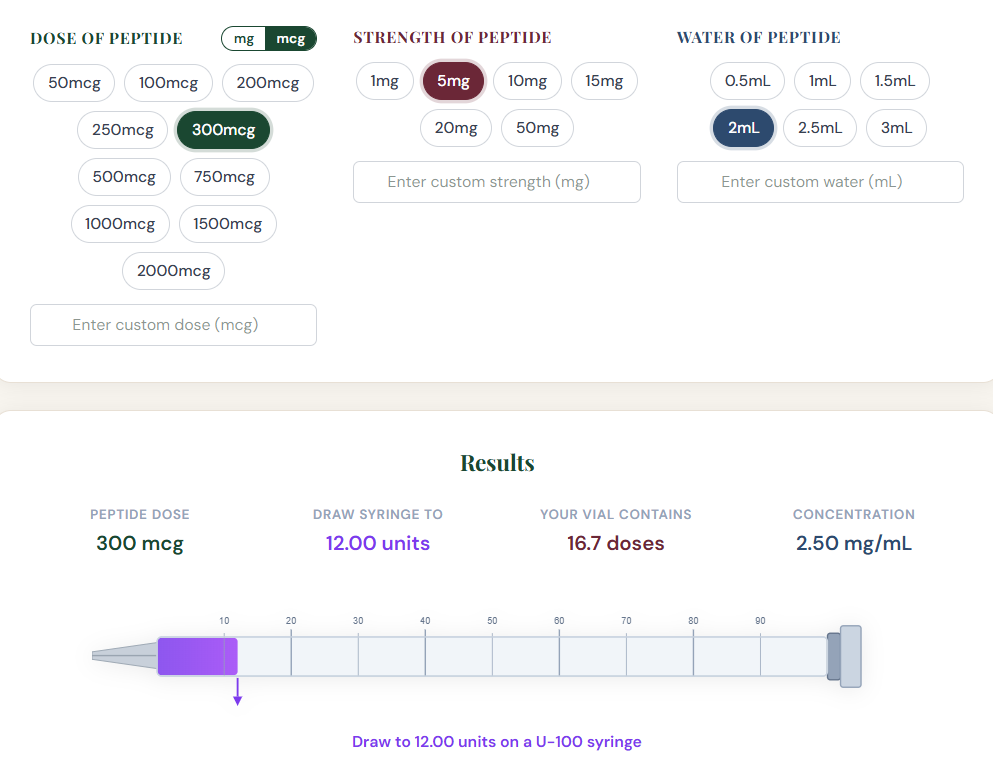
Calculator, pre-filled with Sermorelin defaults: https://peptidetrainings.com/tools/reconstitution-calculator?label=Sermorelin
Draw Volume Reference
At 3 mg reconstituted with 1.5 mL, giving 2000 mcg/mL, on a U-100 syringe:
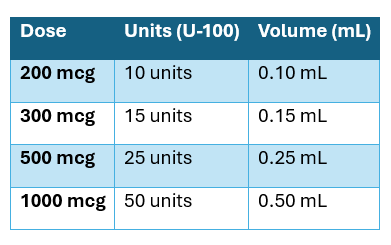
The correct measurement depends on vial strength, reconstitution volume, desired dose and syringe type.
Calculate Your Dosage
→ Click here to calculate your dosage
Important
Micrograms, not milligrams. A 3 mg vial holds 3000 mcg. A 300 mcg dose is one tenth of it.
The range is fivefold. 200 to 1000 mcg per day. That is a wide spread reflecting practice rather than dose-finding trials, and it is a reason to start at the bottom rather than the middle.
You are dosing at night. Drawing in a dim bedroom before bed is where misreads happen. Draw in good light, or prepare earlier in the evening.
Check strength on every new vial. Over three to six months you will use many, possibly from different batches. The powder looks identical regardless of strength.
Always confirm your vial strength, your reconstitution volume and your syringe type before drawing.
Protocol
Original classroom lesson. Preparation, measurement, sourcing, or protocol examples are source material, not verified instructions or clinical guidance.
Sermorelin Dosing Protocol
The following framework is provided for educational reference and should not be treated as an established clinical dosing guideline.
Typical Dose
Dose: 200 to 500 mcg per day
Dose Range: 200 to 1000 mcg per day
Frequency: Once daily, before bed
Route: Subcutaneous injection
Cycle: 3 to 6 months
Bedtime Is Not Optional Here
Timing matters more for sermorelin than for the longer-acting analogs, and the reason is the half-life.
A short-acting compound produces a brief pulse. That pulse needs to land in the window where your body is already primed for GH release, which is early deep sleep.
A longer-acting compound is more forgiving because it covers a wider window. Sermorelin is not. Dosing it in the morning does not make it dangerous, it makes it substantially less useful.
Dose at bedtime, on a relatively empty stomach, since elevated glucose and insulin blunt GH release.
Start Low
The range spans fivefold, 200 to 1000 mcg. Start at 200 to 300 mcg.
There is no reason to start high. Sermorelin is the mild option in this class, and starting at the top of the range gives up the property you chose it for while teaching you nothing about what a lower dose would have done.
Three to Six Months Is the Real Timeline
Longer than most compounds in this library, and it follows from the mechanism.
Weeks 1 to 4: Sleep changes are commonly reported earliest. IGF-1 should be moving, which is measurable even when nothing else is.
Months 2 to 3: Early body composition changes may appear.
Months 3 to 6: The window where results are actually assessable.
Judging this compound at week six is judging it before it has done anything. That is the most common reason people conclude sermorelin does not work.
Consistency Over Dose
Given the timeline, adherence determines the outcome more than dose does.
Ninety to a hundred and eighty consecutive nights, with no felt feedback to reinforce the habit. Missing nights here and there undermines a slow cumulative process in a way that is easy to underestimate.
Fix the time, attach it to an existing bedtime routine, and treat it as standing rather than optional.
Track IGF-1
Baseline before you start. Retest at six to eight weeks.
On a compound this slow and this quiet, that test is the difference between running a protocol and hoping. It tells you whether the product is active, whether the dose is doing anything, and whether your timing is right, all before you have spent five months finding out.
Clinical Notes
Best taken at bedtime to align with natural GH release patterns.
Avoid eating shortly before dosing.
Results typically become noticeable after 3 to 6 months of consistent use.
GH raises blood glucose. Anyone with insulin resistance, prediabetes or diabetes should treat this as a prescriber conversation, and glucose is worth tracking across a protocol this long.
Training, protein intake and sleep determine what the GH has to work with. Without those, the pulse has very little to act on.
Consult a qualified healthcare professional before use.
Side Effects and Safety
Injection site reactions
Flushing
Headache
Dizziness
Hyperactivity, rare
A milder list than the longer-acting GH compounds, and that is by design rather than luck. Less total GH elevation produces fewer GH-related effects. It is the same trade as the milder results.
Research References
Stack Logic
Original classroom lesson. Preparation, measurement, sourcing, or protocol examples are source material, not verified instructions or clinical guidance.
Sermorelin is a GHRH analog, which makes it half of the standard GH pairing. The other half is a GHRP.
The GHRH Plus GHRP Structure
Two separate receptors, one outcome.
GHRH analogs, meaning sermorelin, CJC-1295 and tesamorelin, act on GHRH receptors.
GHRPs, meaning ipamorelin, act on the ghrelin receptor.
Combining them opens both doors rather than pushing harder on one, and produces a larger pulse than either alone. This is one of the few places in this field where synergy has a real mechanistic basis.
What Pairs With Sermorelin, and Why
Sermorelin + Ipamorelin. The pairing this compound is usually run in. Both are the mild, selective options in their respective classes, which makes this the most conservative GH stack available. Providers commonly start here for exactly that reason, and it is a sensible default rather than a compromise.
Sermorelin + Epitalon. Different aging layers. Sermorelin works the GH axis, Epitalon works telomere biology. Minimal mechanistic overlap, which is what makes it complementary rather than additive.
Sermorelin + GHK-Cu. GH-driven repair alongside collagen and elastin synthesis. Signal plus structural material, and it adds a skin dimension the GH axis does not directly cover.
Sermorelin + BPC-157. Not listed in your stacks and worth considering, since it follows the same logic as the ipamorelin pairing. BPC-157 increases growth hormone receptor density on tendon fibroblasts, so sermorelin raises the signal while BPC-157 improves reception.
What Does Not Belong
A second GHRH analog. CJC-1295 or tesamorelin alongside sermorelin is two compounds on one receptor. Duplication rather than synergy, and it also removes the short-acting property that is the reason to choose sermorelin in the first place.
HGH itself. Using a compound that prompts your own GH release alongside exogenous GH defeats the purpose and suppresses the production you were stimulating.
The Question Specific to This Compound
If you are stacking toward a bigger pulse, why did you choose the mild one?
Sermorelin's distinguishing property is that it is gentle and physiological. Adding a GHRP is the standard and sensible extension. Adding a second GHRH, or escalating the dose toward the top of the range, moves you toward what the longer-acting analogs already do, at which point the honest question is whether you should be running one of those instead.
Choosing sermorelin and then working around its mildness is a common pattern and usually means the initial choice was not the right one.
Where This Leaves You
Sermorelin is the most conservative GH-axis option in this library. It cleared FDA approval, has decades of clinical use, works closest to the natural signal, preserves your feedback loop, and is accessible through a prescriber.
The trade is that it does less than the newer analogs and takes three to six months to tell you anything.
That trade is a reasonable one to take, and it only works if you take it fully: run it long enough, dose at night, track IGF-1, and let the mild compound be mild. A conservative protocol run impatiently gets you neither the safety of the conservative option nor the effect of the aggressive one.
Certificate of Analysis
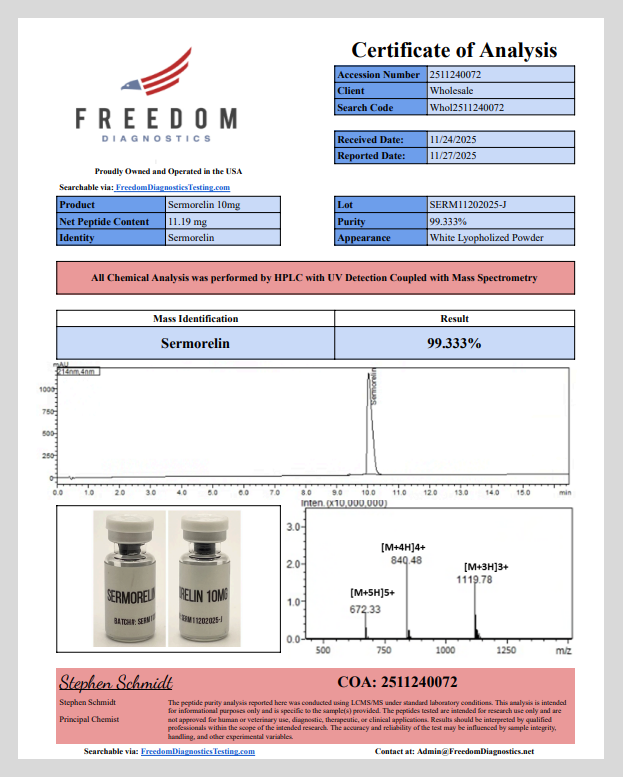
Report 2511240072, dated November 27, 2025, identifies Sermorelin and reports 99.333% purity for the submitted sample. A report covers a submitted sample or lot, not safety, sterility, effectiveness, or every product sold. Its provenance has not been independently authenticated.
Open attached COAAll classroom topics