Semax
An ACTH-derived peptide investigated in neurological research; U.S. drug approval has not been established.
This material is educational, not medical advice or a treatment recommendation. Classroom claims and example protocols have not all been independently verified.
The Compound, Explained
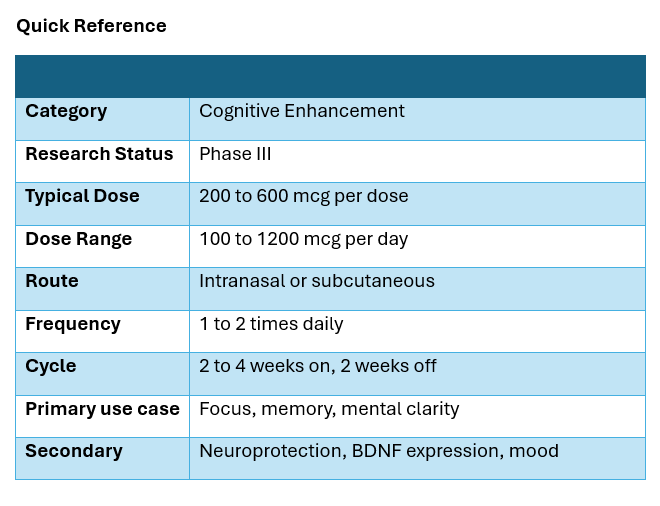
Category: Cognitive Enhancement
Compound: Semax (ACTH 4-7 Pro-Gly-Pro, also N-PGP)
Research Status: Phase III
Regulatory Status: Approved as a pharmaceutical drug in Russia. Not FDA approved in the United States. Recommended for compounding eligibility by the FDA Pharmacy Compounding Advisory Committee, July 23 2026. Non-binding.
What This Is
A synthetic heptapeptide, seven amino acids, derived from adrenocorticotropic hormone.
ACTH is a hormone that triggers cortisol release. Semax takes a fragment of it, positions four through seven, with a short tail attached. That fragment carries the neurological activity without the hormonal activity.
This is the same design logic you saw with BPC-157. Take the piece that does the useful thing, leave the rest behind. Here it means you get the neuroprotective effects of an ACTH-derived sequence without triggering the cortisol cascade the full hormone would.
The Russia Situation
Semax has an unusual regulatory position and you should understand it precisely, because it gets misrepresented in both directions.
Semax is an approved pharmaceutical in Russia, prescribed for stroke, cognitive indications and neuroprotection. It has been in clinical use there for decades.
That is genuine approval by a real regulator, and it is a stronger position than almost anything else in this library.
It is also not FDA approval, and the two are not interchangeable. Russian and American approval processes differ in trial requirements, published data standards and post-market surveillance. Much of the underlying Semax research is Russian-language and has not been replicated by Western research groups.
The Honest Reading: This is not an unstudied research chemical, and it is not a compound that has cleared the evidentiary bar Americans usually mean when they say approved. Both halves of that sentence matter.
Why the Status Tag Says Phase III
Worth flagging because it looks like a contradiction. Approved in one country, Phase III in the classification used here.
The tag reflects the Western regulatory pathway, where Semax has not completed the approval process. The Russian approval sits outside that pathway rather than inside it. Neither statement is wrong. They are describing different systems.
Not a Stimulant
The most common misunderstanding about this compound.
Caffeine and prescription stimulants work by pushing neurotransmitter release or blocking reuptake. You are spending a resource, which is why crashes and tolerance follow.
Semax operates upstream of that, primarily by increasing expression of growth factors that affect neuronal health and connectivity. What people describe is clarity rather than the wired, jittery quality of a stimulant.
Two Implications worth Holding: Effects are subtler than a stimulant, so anyone expecting an Adderall-like signal will conclude it does nothing. And because the mechanism is not resource depletion, the crash pattern people brace for generally does not appear.
Route Is Unusual Here
Semax is primarily intranasal. Almost everything else in this library is injected.
Intranasal delivery targets the nasal mucosa for absorption toward the central nervous system, with onset typically reported within 15 to 30 minutes. Subcutaneous injection is possible but less commonly used for this compound.
That changes preparation, measurement and daily practice substantially, and those tabs reflect it.
Who This Is For
People interested in focus, working memory and verbal fluency.
People approaching cognition from a neuroprotective angle rather than an acute performance one.
People who want a nootropic that does not operate on the stimulant model.
Inside the Mechanism
Increases BDNF and NGF
The central mechanism.
BDNF: Brain-derived neurotrophic factor, supports the survival of existing neurons and encourages growth of new connections. It is one of the most studied molecules in neuroscience, tied to learning, memory formation and mood regulation. BDNF is also what exercise raises, which is why the two get compared.
NGF: Nerve growth factor, supports the survival and maintenance of specific neuron populations.
Semax increases expression of both. That is a structural intervention rather than a chemical one: you are not adding a neurotransmitter, you are supporting the health and connectivity of the cells that use them.
This is also why the effects build. A compound that raises dopamine works within the hour. A compound that supports neuronal health and plasticity works over days and weeks, which is exactly why the cycle structure in this module looks the way it does.
Modulates Dopamine and Serotonin Systems
Modulation, not flooding. Semax influences these systems rather than driving release the way a stimulant does.
This is the likely mechanism behind reported effects on mood, anxiety and motivation alongside the cognitive effects. It is also the reason the felt experience is described as clarity rather than stimulation.
Enhances Cerebral Blood Flow
More blood flow means better oxygen and nutrient delivery to brain tissue. Straightforward, and it is a substantial part of why the stroke research exists. In ischemic stroke, blood supply is precisely the problem.
Anti-Inflammatory Effects in the CNS
Neuroinflammation is implicated in cognitive decline and in the secondary damage that follows brain injury. Semax has reported anti-inflammatory activity in the central nervous system, which connects the cognitive research to the neuroprotective research through one mechanism.
The ACTH Fragment Design
Worth understanding as a piece of pharmacology.
Full ACTH triggers cortisol release. Chronically elevated cortisol is bad for cognition, bad for memory and bad for neuronal health. A compound intended to protect the brain that also raised cortisol would be working against itself.
Isolating the 4-7 fragment retains the neuroprotective sequence and removes the hormonal trigger. The added Pro-Gly-Pro tail improves stability against enzymatic breakdown.
N-Acetyl Semax Amidate
You will encounter NASSA constantly, so understand what it is.
It is Semax with chemical modifications, an acetyl group at one end and an amide at the other, that make it more resistant to enzymatic degradation. More resistant means longer active and effective at lower doses.
Most experienced users consider it the more potent version. What matters practically: NASSA and standard Semax are not dosed identically. Applying a Semax dose to NASSA overshoots. Check which one you have before you calculate anything.
What the Research Actually Shows
Where This Compound Sits
Semax occupies an unusual position in this course, and it takes a moment to place accurately.
Stronger than Most of this Library: Decades of clinical use in Russia, regulatory approval by a national authority, published research on stroke outcomes, and a positive July 2026 committee recommendation. This is not a compound someone invented last year.
Weaker than the Approval Implies: The bulk of the research is Russian-language, much of it from the Soviet and immediate post-Soviet period, and it has not been extensively replicated by independent Western groups. Cross-checking a body of literature is how the rest of science gains confidence in it, and that process has largely not happened here.
Neither dismiss the Russian research because of where it came from nor treat national approval as equivalent to independently replicated evidence. Both are lazy readings.
The Research Is About Stroke, Not Focus
The most important thing on this page.
Look at what the clinical work actually studied. Ischemic stroke. Brain injury. Neuroprotection in damaged tissue. That is where the approval sits and where the strongest outcome data lives.
Now look at how the compound is mostly used: healthy people wanting sharper focus at work.
Those are different populations with different baselines. Evidence that a compound improves outcomes in damaged brain tissue does not establish that it enhances function in an undamaged one. Recovery toward baseline and enhancement above baseline are different claims, and the second one has far less behind it.
This is the single most common error made with Semax, and it is made by people citing real research honestly. They are simply moving it between populations where it does not transfer.
The Self-Assessment Problem
Specific to cognitive compounds, and worth more attention than it usually gets.
The instrument measuring the effect is the thing being affected. If a compound alters your perception of your own mental clarity, your report of improved clarity is not independent evidence that clarity improved.
This is not hypothetical. Studies on cognitive enhancers repeatedly find that subjective ratings of performance and objective measures of performance diverge, sometimes in opposite directions. People feel sharper and test the same or worse.
Add the obvious: nootropics are taken by motivated people, often at the start of a period when they intend to work hard, and the placebo response in cognitive domains is among the strongest anywhere in research.
The practical response is not cynicism, it is measurement. If you want to know whether Semax works for you, decide in advance what you will measure objectively, take a baseline, and compare. Anything else is asking a compound to grade its own homework.
Sample Size and Access
Find the n on any study you read, and note where you can read it. A substantial portion of the Semax literature is not available in English, is not indexed in the databases Western readers use, and cannot be evaluated directly by most people citing it.
That is a real limitation on what anyone, including this course, can tell you with confidence.
The July 2026 Committee Vote
On July 23 2026 the FDA's Pharmacy Compounding Advisory Committee voted on seven peptides.
Recommended: BPC-157, KPV, TB-500, MOTS-c, Epitalon, Semax
Not recommended: Emideltide, also known as DSIP
Semax was recommended.
The committee found the evidence sufficient to recommend it be eligible for pharmacy compounding. That is not FDA approval, the vote is non-binding, and no compound on that list is approved to treat any condition.
Holding Both Facts
Semax has decades of clinical use, national regulatory approval, a plausible and well-described mechanism, and a positive committee recommendation. It also rests on a research base most Western readers cannot access, studied in stroke patients rather than healthy adults, assessed largely through the least reliable form of self-report in the entire field.
Hold both at once.
Sourcing & Verification
Original classroom lesson. Preparation, measurement, sourcing, or protocol examples are source material, not verified instructions or clinical guidance.
Semax carries a sourcing problem no other compound in this library has: the two products sold under its name are different molecules, dosed differently, and the labels are nearly identical.
What to Verify on This Compound
Which Molecule is in the Vial: Semax and N-Acetyl Semax Amidate are sold side by side, often abbreviated, often with the distinction buried in small print. NASSA is more potent and dosed lower. Buying one while dosing for the other is not a rounding error.
The COA identity confirmation is what settles it. Molecular weight differs between them, so mass spectrometry distinguishes them definitively while a product label may not.
Formulation, Not Just Compound: Most Semax is sold as a prepared nasal spray rather than a bare lyophilised vial. That means you are also buying a solution someone else prepared: a concentration, a vehicle, a preservative and a pH.
Ask what concentration the spray is, in mcg per spray. A supplier who cannot answer that immediately is not a supplier who calculated it.
Sterility Matters Differently Here: A nasal spray is used repeatedly over weeks with an applicator that touches mucous membrane. That is a different contamination profile from a single-draw injection, and preservative content and handling instructions are worth asking about specifically.
The COA Standard
A valid COA names the testing laboratory, carries a batch number matching your product, states a test date, gives purity with the method used, and confirms identity. Anything answering "available on request," or arriving as a screenshot with no traceable source, is not a COA.
For Semax, ask two questions: Which molecule, and at what concentration per spray.
Both should be answerable from documentation rather than from a sales page.
Storage
Lyophilized Powder: cool, dry, protected from sunlight, humidity and heat.
Prepared nasal solution is less stable than powder and is in use for weeks rather than days. Refrigerate, keep it dark, and follow the manufacturer's window. If a spray has been sitting at room temperature on a desk for a month, its potency is a question rather than a given.
Preparation
Original classroom lesson. Preparation, measurement, sourcing, or protocol examples are source material, not verified instructions or clinical guidance.
Semax Preparation Guide
Semax is most often supplied either as a prepared nasal spray or as a lyophilized powder for reconstitution. Which one you have determines everything below.
If you have a prepared spray, no preparation is required. Confirm the concentration per spray from the documentation, since that number is what the Measurement tab depends on.
If you have lyophilized powder, reconstitute as follows. Vial strengths vary, so use the volume specified for your exact product.
Reference Configuration
Vial size: 3 mg
Bacteriostatic water: 1.5 mL
Resulting concentration: 2 mg/mL, which is 2000 mcg/mL
What you will Need:
Semax vial
Bacteriostatic water
Appropriate syringe
Alcohol pads
A nasal spray applicator, if using intranasally
Step 1: Prepare and Sanitize
Wash your hands and prepare a clean workspace.
Clean both stoppers with alcohol pads and allow them to dry.
Step 2: Reconstitute
Draw the specified volume of bacteriostatic water.
Introduce it slowly along the inside wall of the vial.
Avoid directing the stream forcefully onto the powder.
Step 3: Mix Gently
Do not shake. Swirl gently until fully dissolved.
Step 4: Storage
Refrigerate.
Protect from heat and light.
Follow the manufacturer's stated window.
Do not freeze unless the manufacturer specifically indicates it.
Two Things Specific to This Compound
Intranasal Preparation is Not Injection Preparation: If you are transferring reconstituted solution to a nasal applicator, you are handling a product that will be used repeatedly over weeks against mucous membrane. Handling standards matter more here than for a single-use draw, not less.
Confirm Which Molecule You Are Preparing: Semax and NASSA reconstitute the same way and are dosed differently. The preparation step is where that error gets locked in for the rest of the vial.
Measurement
Original classroom lesson. Preparation, measurement, sourcing, or protocol examples are source material, not verified instructions or clinical guidance.
Semax Measurement Guide
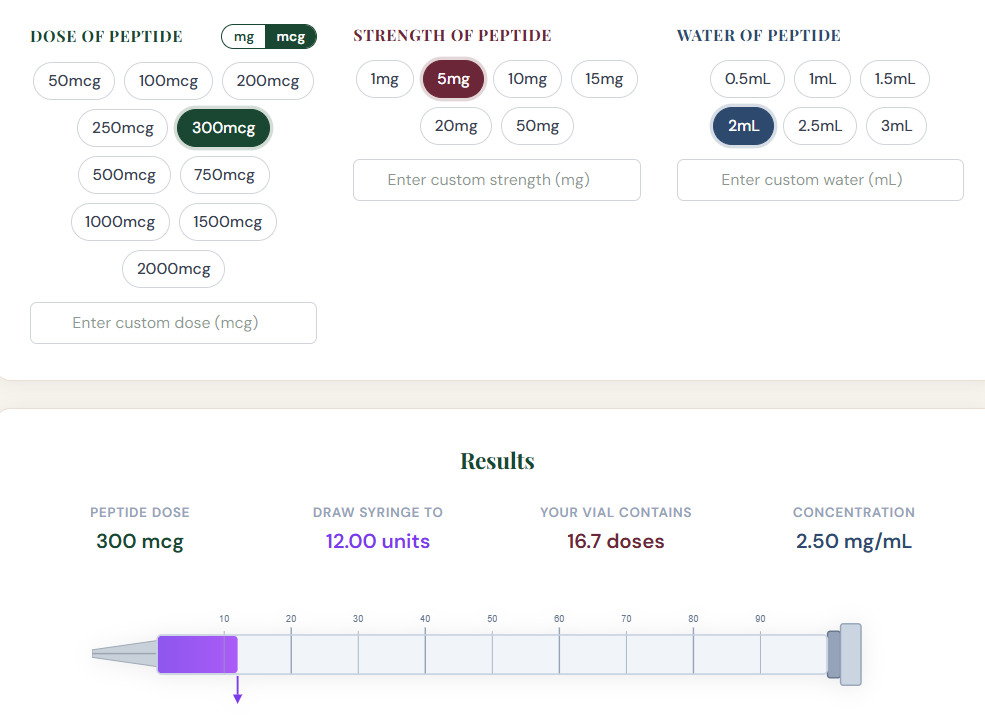
Calculator, pre-filled with Semax defaults:
https://peptidetrainings.com/tools/reconstitution-calculator?label=Semax
Two Different Measurement Problems
Semax is the only compound in this library where measurement works differently depending on your route, so identify which situation you are in.
If you are using a nasal spray, you are not measuring at all. You are counting sprays, and the number that matters is mcg per spray, which is set by whoever prepared the solution. Your entire dosing accuracy depends on a figure you did not calculate.
Get that number from documentation. If it is not stated anywhere, you do not know your dose, regardless of how carefully you count.
If you are drawing from a reconstituted vial, the standard calculation applies.
Draw Volume Reference
The correct syringe measurement depends on:
Peptide amount in the vial
Volume of reconstitution solution used
Desired dose
Syringe type and size
Calculate Your Dosage
→ Click here to calculate your dosage
Important
Micrograms Throughout: Semax is dosed in the hundreds of micrograms. A milligram figure read as a microgram figure is a thousandfold error and will not look wrong.
NASSA Changes the Numbers: The table above is for standard Semax. NASSA is more potent and is dosed lower. Do not carry these figures across.
Both Nostrils: If a protocol specifies a total daily dose and you are splitting between nostrils, that is one dose divided, not one dose per side. This is a simple error that doubles intake.
Protocol
Original classroom lesson. Preparation, measurement, sourcing, or protocol examples are source material, not verified instructions or clinical guidance.
Semax Dosing Protocol
Semax protocols vary by formulation, route and individual response. The following framework is provided for educational reference and should not be treated as an established clinical dosing guideline.
Typical Dose
Dose: 200 to 600 mcg per dose
Dose Range: 100 to 1200 mcg per day
Frequency: 1 to 2 times daily
Route: Intranasal, most common, or subcutaneous injection
Cycle Length: 2 to 4 weeks on, 2 weeks off
The Cycle Structure is Short, and that is Deliberate
Most compounds in this library run 8 to 12 weeks. Semax runs 2 to 4 weeks with a 2 week break.
The reasoning is that a compound acting on neurotransmitter systems and growth factor expression is one where continuous long-term use has not been characterised. The off-period is a hedge against an unknown, not a proven necessity.
It also serves a practical purpose worth using deliberately. The break is your opportunity to find out whether the compound is doing anything, since a cognitive effect you cannot detect the absence of is a cognitive effect worth questioning.
Timing Matters More than with Most Compounds
Onset is rapid intranasally, typically 15 to 30 minutes.
Sleep disruption is a known effect when dosed late in the day.
Dose in the morning, and if dosing twice, keep the second dose well clear of the evening.
This is a compound where timing is part of the protocol rather than a convenience.
Start Low
The stated range spans 100 to 1200 mcg per day, a twelvefold spread. Mild stimulation and restlessness appear at the higher end.
Start at the low end. With a compound whose main effect is subjective, escalating quickly means you never learn what the lower dose actually did.
Clinical Notes
Intranasal delivery provides rapid onset, within 15 to 30 minutes.
NASSA is considered more potent and longer-lasting, and is dosed lower. Confirm which you have.
Effects reported include mental energy, focus and verbal fluency.
Effects build over days rather than appearing fully on day one, which follows from the growth-factor mechanism.
Because effects are subjective, take a baseline on something objective before you start if you want to evaluate this properly.
Consult a qualified healthcare professional before using experimental peptide products.
Side Effects and Safety
Mild stimulation or restlessness at high doses
Nasal irritation with intranasal use
Headache, rare
Sleep disruption if taken too late in the day
Nasal irritation is worth watching over a full cycle rather than dismissing early. Repeated application to mucous membrane over weeks is cumulative, and irritation that is trivial on day three can be the reason someone abandons a cycle on day twenty.
Research References
Stacking & Combinations
Original classroom lesson. Preparation, measurement, sourcing, or protocol examples are source material, not verified instructions or clinical guidance.
Nootropic stacks have a failure mode the rest of this field does not: every component is assessed by how it makes you feel, and feeling is exactly what these compounds alter.
What Pairs With Semax, and Why
Semax + Selank. The classic pairing and a genuinely well-designed one. Semax is activating and focus-oriented. Selank is anxiolytic and calming. They come from the same Russian research programme and were developed alongside each other. The rationale is that focus without anxiety control can become agitation, particularly at higher Semax doses, and Selank addresses the specific failure mode Semax creates.
Semax + Methylene Blue. Different layer entirely. Methylene Blue acts on mitochondrial electron transport, meaning cellular energy availability in neurons. Semax acts on growth factor expression and neurotransmitter modulation. Energy supply plus signalling, not two versions of the same thing.
Semax + Pinealon. Adds neuroprotection and sleep quality. Sleep is worth noting specifically here, since Semax can disrupt it when timed poorly. If you are reaching for something to fix Semax-induced sleep disruption, fix the timing first. A compound added to counteract another compound's side effect is a protocol design problem, not a stack.
The Question Specific to This Compound
How would you know if one of them stopped working?
This matters more with nootropics than anywhere else. Every compound here is assessed by how you feel, the compounds themselves alter how you feel, and the effects are subtle enough that expectation fills the gap easily.
Run them one at a time, with enough of a gap to tell them apart, and with something objective to measure against. A three-compound cognitive stack introduced in one week is uninterpretable by design, and you will end up permanently paying for whichever two do nothing.
The cycle break is your best available tool here. Use it to notice absence rather than treating it as downtime.
Certificate of Analysis
No COA attachment was available for this course when checked.
All classroom topics