Selank
A synthetic peptide studied in neuroscience, with limited high-quality evidence for many advertised claims.
This material is educational, not medical advice or a treatment recommendation. Classroom claims and example protocols have not all been independently verified.
The Compound, Explained
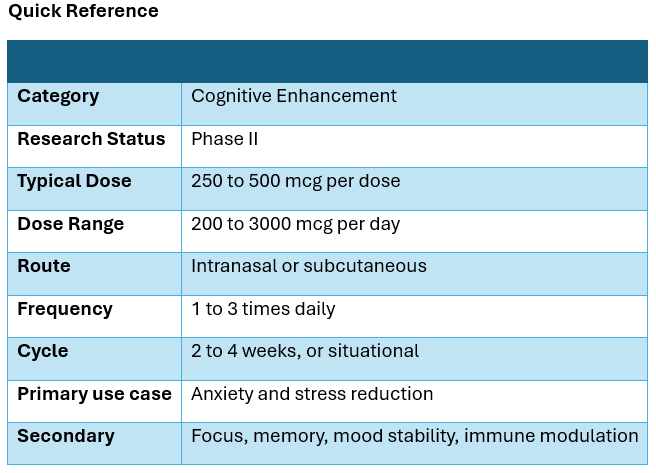
Category: Cognitive Enhancement
Compound: Selank (TP-7, also Selanc). A tuftsin-derived heptapeptide.
Research Status: Phase II
Regulatory Status: Not FDA approved. Approved and prescribed in Russia. Was not among the seven peptides voted on by the FDA Pharmacy Compounding Advisory Committee on July 23 2026.
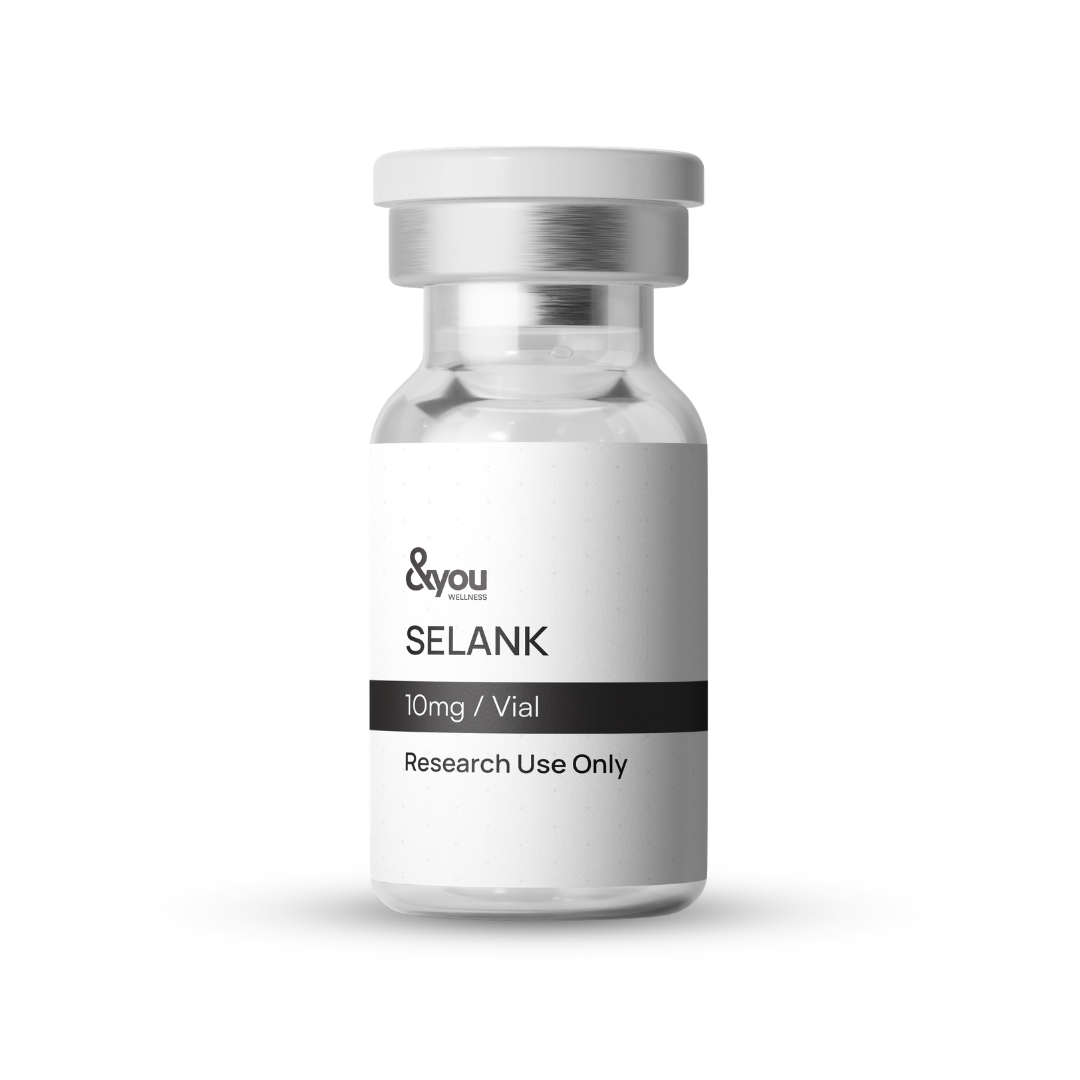
What This Is
A synthetic heptapeptide, seven amino acids, developed at the Institute of Molecular Genetics of the Russian Academy of Sciences.
It is based on tuftsin, a naturally occurring peptide in your body with immunomodulatory activity, with a stabilizing tail added to resist enzymatic breakdown.
Selank is Semax's counterpart. Same research programme, same institute, same era, same intranasal route. Semax was developed for focus and neuroprotection. Selank was developed for anxiety. They are frequently run together for that reason, and the pairing was effectively designed rather than discovered by users.
The Benzodiazepine Comparison
The comparison everyone makes, and the one worth getting precise because both the similarity and the difference are real.
The similarity: Both act on the GABA system, the main inhibitory signaling system in your brain, and both reduce anxiety.
The difference: Benzodiazepines are GABA receptor agonists. They bind and drive the system hard. That produces reliable anxiety reduction alongside sedation, and over time the receptors downregulate in response, which is the mechanism behind tolerance, dose escalation and withdrawal.
Selank modulates the same system without that agonist activity. The reported result is anxiety reduction without sedation, without the cognitive fog, and without receptor downregulation.
That is the mechanistic argument for no tolerance and no dependence, and it is a coherent one. Be clear about the limits of it, though. Absence of dependence in the research so far is not the same as a demonstrated long-term safety record in wide human use over years. The claim is well-reasoned rather than proven.
Anxiolytic Without Sedation
The distinguishing property, and worth understanding as a category rather than a feature.
Most things that reduce anxiety also reduce alertness. Alcohol, benzodiazepines, antihistamines, most sedatives. Anxiety goes down and so does cognitive function, which means the thing you took to cope with a stressful situation impairs your ability to handle it.
Selank is described as separating those. Reduced anxiety with cognition intact, and reportedly improved in some studies.
If accurate, that is a genuinely useful property and it is the reason this compound holds interest despite its research position.
A Note Worth Making Early
Anxiety exists on a spectrum from ordinary situational stress through to diagnosable anxiety disorders, and they are not the same thing.
Anxiety disorders have effective, well-evidenced treatments including therapy and prescribed medication, supported by far more evidence than anything in this library. A peptide is not a substitute for that, and anyone dealing with anxiety that interferes with daily functioning is better served by a clinician than by a nasal spray.
This module is written for someone considering Selank alongside that, not instead of it.
Who This Is For
People with situational stress who want to stay sharp rather than sedated.
People running a cognitive protocol who want the anxiety side balanced.
People who have addressed the fundamentals, meaning sleep, exercise, caffeine load, and still want something for stress reactivity.
Inside the Mechanism
Modulates the GABA System
GABA is your main inhibitory neurotransmitter. It calms neural activity, and dysregulation there is implicated in anxiety.
The important word is modulates. Selank influences GABAergic signalling without acting as a direct agonist, which is the mechanistic basis for the sedation-free and tolerance-free profile.
The analogy that holds: a benzodiazepine turns the volume up on the inhibitory system. Selank adjusts how the system is tuned. One overwhelms, the other nudges, and systems that are overwhelmed adapt by becoming less responsive.
Inhibits Enkephalin Breakdown
The most specific mechanism, and the most interesting.
Enkephalins are endogenous opioid peptides your body produces to regulate stress, mood and pain. They are broken down rapidly by enzymes, which limits how long they act.
Selank inhibits that breakdown. Your own enkephalins persist longer and act longer.
Read what that means structurally. Selank is not adding an opioid or activating opioid receptors directly. It is extending the life of a stress-regulating signal you already produce. That design, working on the persistence of an endogenous molecule rather than substituting for it, is also why the dependence profile differs from compounds that act on those receptors directly.
Increases BDNF
Brain-derived neurotrophic factor, the same growth factor Semax acts on. It supports neuronal survival and the formation of new connections, and it is tied to learning, memory and mood regulation.
This is the likely basis for the cognitive claims, and it explains a timing feature of this compound: the anxiolytic effect is reported within 20 to 30 minutes, while cognitive and mood effects build over days to weeks.
Two different mechanisms operating on two different timescales, which is why acute and daily use are both reasonable with Selank.
Modulates Serotonin and Dopamine
Both are implicated in mood regulation and both are modulated rather than flooded. This is likely behind the reported mood stabilization and reduced emotional volatility.
Immunomodulatory Effects
From the tuftsin origin. Tuftsin is an immunomodulatory peptide, and Selank retains some of that activity.
This is the least developed area of the research and it is rarely why anyone uses the compound. Worth knowing it exists, and worth noting that immune activity is a reason to speak to a prescriber if you take immunosuppressant medication.
What the Research Actually Shows
Read the Status Tag First
Selank is tagged Phase II, which is a meaningful position and needs reading precisely.
Phase II means human clinical trials assessing efficacy in a target population, above animal work and below the large Phase III trials that establish effect at scale.
Compare across this library. Retatrutide and Tirzepatide reached Phase III and approval. BPC-157 and MOTS-c sit at preclinical. Selank sits between: real human clinical work, not yet at the scale that settles the question.
It is also approved and prescribed in Russia, the same position Semax holds, with the same caveats. That is genuine approval by a national regulator and it is not FDA approval, and much of the underlying research is Russian-language and not independently replicated by Western groups.
The Anxiety Research Is Real, and It Is Small
Clinical studies on Selank's anxiolytic effects exist, including work comparing it against benzodiazepines in anxiety populations. The 2009 clinical work and the 2015 cognitive research are the reference points.
What matters when reading them:
Sample sizes are small. Find the n. Small studies produce dramatic effect sizes more often than large ones, and those effects shrink on repetition.
The comparison is informative. Trials measuring Selank against an existing treatment are more useful than trials measuring it against nothing, because an active comparator controls for a great deal that a placebo does not.
Access is limited. A substantial part of this literature is not available in English and cannot be read directly by most people citing it, including this course.
The Measurement Problem With Anxiety
Anxiety research has a specific difficulty worth understanding, separate from the general placebo issue.
Anxiety is measured by self-report. There is no blood test. Assessment uses validated questionnaires, which are the best tools available and still rest on someone reporting their internal state.
Anxiety fluctuates enormously. Week to week, driven by circumstances that have nothing to do with any compound. People start an anxiolytic during a stressful period, and stressful periods end.
Placebo response in anxiety is among the highest in medicine. This is well documented and it is why anxiety trials are hard to run and why so many promising anxiolytics fail at scale.
Expectation is itself anxiolytic. Believing you have something that will help reduces anxiety before any pharmacology occurs.
This is not an argument that Selank does nothing. It is an argument that your own experience, and the experience of everyone posting about it, is weaker evidence than it feels. If you want to evaluate this properly, track over time with a consistent measure and pay particular attention to what happens when you stop.
The "No Tolerance or Dependence" Claim
The most repeated claim about Selank, and it needs careful handling because it is both the main selling point and the hardest thing to have established.
What Supports it: A coherent mechanism. Modulation rather than agonism means no receptor downregulation, which is the actual cause of benzodiazepine tolerance. Research to date has not reported dependence.
What does not yet Support it: Tolerance and dependence are long-timeframe phenomena. Establishing their absence requires extended use in large populations with systematic follow-up, which has not happened for Selank at the scale it has for benzodiazepines, where the dependence problem took years to become clear.
The honest position: the mechanism predicts no dependence, and the available evidence is consistent with that, and absence of evidence of dependence is not the same as evidence of absence. Treat it as well-reasoned rather than settled.
The July 2026 Committee Vote
On July 23 2026 the FDA's Pharmacy Compounding Advisory Committee voted on seven peptides.
Recommended: BPC-157, KPV, TB-500, MOTS-c, Epitalon, Semax
Not recommended: Emideltide, also known as DSIP
Selank was not on that list. Not recommended and not rejected, simply not assessed at that meeting.
Notice that Semax, Selank's counterpart from the same research programme, was reviewed and recommended. That tells you nothing about Selank directly, and it does show the committee reviewed compounds one at a time rather than by association. A sibling compound's result does not transfer.
Holding Both Facts
Selank has genuine human clinical research, national regulatory approval, a well-described mechanism that explains why its profile differs from benzodiazepines, and a property, anxiolysis without sedation, that would be genuinely valuable.
It also rests on small studies in a literature most readers cannot access, operates in a domain with among the highest placebo responses in medicine, and carries a central claim about dependence that the evidence base is not yet large enough to have established.
Hold both at once.
Sourcing & Verification
Original classroom lesson. Preparation, measurement, sourcing, or protocol examples are source material, not verified instructions or clinical guidance.
Selank shares a market and a research lineage with Semax, and it shares Semax's sourcing problem: what you buy is usually a solution someone else prepared.
What to Verify on This Compound
Which Molecule: Selank is sold alongside N-Acetyl Selank Amidate, a modified version with greater stability and different dosing, exactly as Semax is sold alongside NASSA. The names are similar and often abbreviated. Identity confirmation by mass spectrometry is what separates them, since molecular weight differs and a product label may not.
Concentration per Spray: Most Selank is sold as a prepared nasal spray. That means your dose is set by whoever made the solution, not by you. Ask for mcg per spray in writing. A supplier who cannot answer immediately has not calculated it.
Repeated Mucosal Use: A nasal spray is applied to mucous membrane multiple times daily over weeks. That is a different sterility and preservative consideration from a single-draw injection, and it is reasonable to ask what is in the solution besides peptide.
No Feedback Loop on Quality: Worth being blunt about. Given everything in the research tab, an inert Selank spray would produce much the same reports as an active one. Documentation is not one check among several, it is the only one available.
The COA Standard
A valid COA names the testing laboratory, carries a batch number matching your product, states a test date, gives purity with the method used, and confirms identity. Anything answering "available on request," or arriving as a screenshot with no traceable source, is not a COA.
For Selank, ask two things: which molecule, and what concentration per spray.
Storage
Lyophilized Powder: Cool, dry, protected from light.
Prepared nasal solution is less stable than powder and stays in use for weeks. Refrigerate, keep it dark, and follow the manufacturer's window. A spray sitting warm on a desk for a month is a question mark rather than a known quantity.
Preparation
Original classroom lesson. Preparation, measurement, sourcing, or protocol examples are source material, not verified instructions or clinical guidance.
Selank Preparation Guide
If you have a prepared nasal spray, no preparation is required. Confirm the concentration per spray from the documentation, since the Measurement tab depends on that figure.
For lyophilized powder, reconstitute as follows. Vial strengths vary, so use the volume specified for your exact product.
Reference Configuration
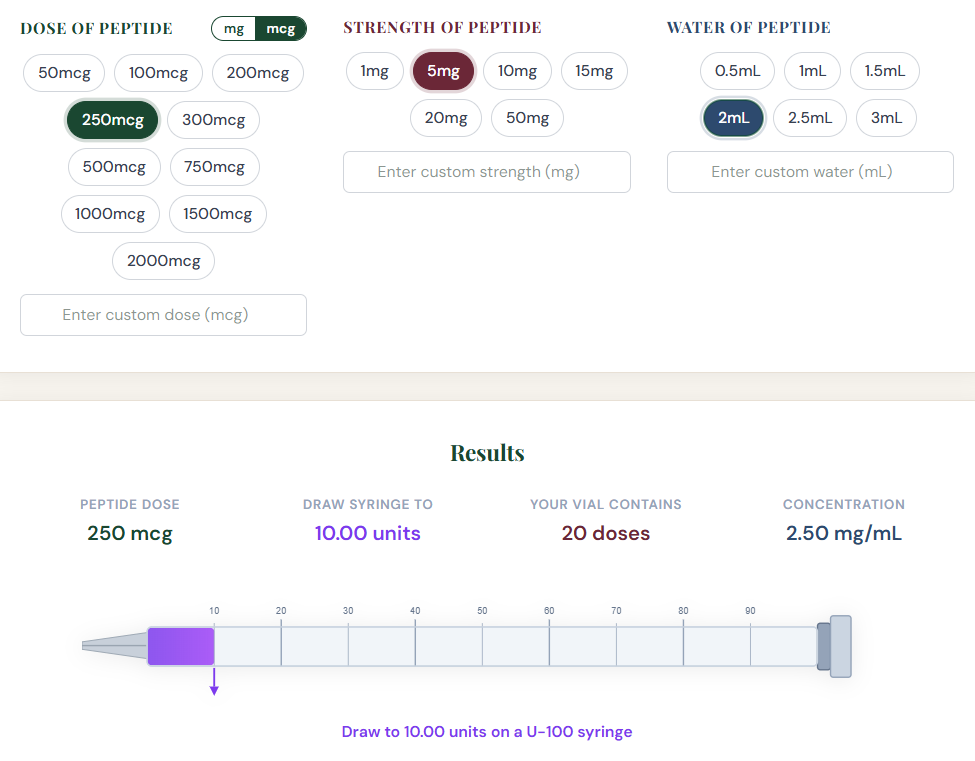
Vial Size: 5 mg
Bacteriostatic Water: 2 mL
Resulting Concentration: 2.5 mg/mL, which is 2500 mcg/mL
What you will Need:
Selank vial
Bacteriostatic water
Appropriate syringe
Alcohol pads
A nasal spray applicator, if using intranasally
Step 1: Prepare and Sanitize
Wash your hands and prepare a clean workspace.
Clean both stoppers with alcohol pads and allow them to dry.
Step 2: Reconstitute
Draw the specified volume of bacteriostatic water.
Introduce it slowly along the inside wall of the vial.
Avoid directing the stream forcefully onto the powder.
Step 3: Mix Gently
Do not shake. Swirl gently until fully dissolved.
Step 4: Storage
Refrigerate.
Protect from heat and light.
Follow the manufacturer's window.
Do not freeze unless specifically indicated.
If You Are Running Selank and Semax Together
The most common way this compound is used, and it introduces a practical problem worth solving before it happens.
Two nasal sprays, similar bottles, similar solutions, similar labels, used at different times of day. Mixing them up is easy and the consequence is dosing a stimulating compound when you wanted a calming one.
Label both clearly, in a way you can read at 7am. Color-code the caps if that helps. Store them somewhere you will not grab the wrong one by reflex.
Measurement
Original classroom lesson. Preparation, measurement, sourcing, or protocol examples are source material, not verified instructions or clinical guidance.
Selank Measurement Guide
Calculator, pre-filled with Selank defaults:
https://peptidetrainings.com/tools/reconstitution-calculator?label=Selank
Two Different Situations
If you are using a nasal spray, you are counting sprays rather than measuring. The figure that matters is mcg per spray, set by whoever prepared the solution. If it is not stated anywhere, you do not know your dose no matter how carefully you count.
If you are drawing from a reconstituted vial, the standard calculation applies.
Draw Volume Reference
At 5 mg reconstituted with 2 mL, giving 2500 mcg/mL, on a U-100 syringe:
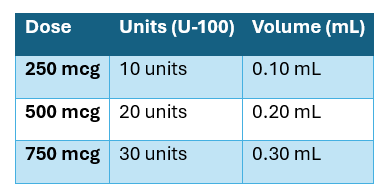
Calculate Your Dosage
→ Click here to calculate your dosage
Important
The stated range is enormous. 200 to 3000 mcg per day is a fifteenfold spread, the widest in this library. That reflects genuine uncertainty about optimal dosing rather than flexibility, and it is a reason to start at the bottom and stay there until you have a reason not to.
Micrograms, not milligrams. A 5 mg vial holds 5000 mcg. A 250 mcg dose is one twentieth of it. Misreading the unit is a thousandfold error that will not look wrong.
Multiple daily doses add up. Dosing three times daily at 500 mcg is 1500 mcg per day. Track the daily total, not just the per-dose figure.
NASA changes the numbers. N-Acetyl Selank Amidate is more stable and dosed differently. Do not carry figures across.
Always confirm your vial strength, your reconstitution volume and your syringe type before drawing.
Protocol
Original classroom lesson. Preparation, measurement, sourcing, or protocol examples are source material, not verified instructions or clinical guidance.
Selank Dosing Protocol
The following framework is provided for educational reference and should not be treated as an established clinical dosing guideline.
Typical Dose
Dose: 250 to 500 mcg per dose
Dose Range: 200 to 3000 mcg per day
Frequency: 1 to 3 times daily
Route: Intranasal, most common, or subcutaneous injection
Cycle: 2 to 4 weeks, or situational use
Two Ways to Use It
Selank is unusual in supporting both, and they are genuinely different protocols.
Situational: Taken before a specific stressor: a presentation, a difficult conversation, a flight. Onset is reported at 20 to 30 minutes, which makes acute use practical. This is the use where the no-sedation property earns its value, since the whole point is performing well while less anxious.
Daily protocol: Run over 2 to 4 weeks for chronic stress. The cognitive and mood effects, which are BDNF-driven, build over time rather than appearing acutely, so this is the route if those are what you want.
Decide which you are doing. Drifting between them means you never learn what either does.
Start Low
The range spans fifteenfold. Mild sedation is reported at the high end, which is the one property you are using this compound to avoid.
Start at 250 mcg once daily. If the reason you chose Selank over a benzodiazepine is the absence of sedation, dosing high enough to produce it defeats the purpose.
A Note on Situational Use
Worth flagging honestly, since it applies to anything taken for acute anxiety.
Reaching for a dose before every mildly uncomfortable situation can become its own pattern, even with a compound that carries no pharmacological dependence. Psychological reliance and physical dependence are different things, and the absence of one does not rule out the other.
If you find you cannot face ordinary situations without dosing first, that is worth noticing, and it is worth discussing with someone qualified rather than managing with a larger supply.
Build in a Way to Evaluate It
Given how hard anxiety is to assess, decide in advance how you will judge this.
Track with something consistent, the same self-rating at the same time of day, for two weeks before you start.
Change one variable at a time.
Pay attention to the off-period. Whether anxiety returns when you stop is the most useful signal available to you.
Note what else changed. A stressful project ending will do more for your anxiety than any peptide.
Clinical Notes
Intranasal administration is the most common route, with good reported bioavailability and easy use.
Effects typically felt within 20 to 30 minutes.
Can be used situationally or as a daily protocol.
No sedation at typical doses is the distinguishing property. Mild sedation at high doses means you have gone past the useful range.
Immunomodulatory activity means anyone on immunosuppressant medication should speak to their prescriber.
Anxiety that interferes with daily functioning warrants professional assessment. This compound is not a substitute for that, and the treatments that exist for anxiety disorders have far more evidence behind them than anything here.
Consult a qualified healthcare professional before using experimental peptide products.
Side Effects and Safety
Mild sedation at high doses
Nasal irritation with intranasal use
Slight dizziness, rare
Generally very well tolerated
Nasal irritation is worth watching across a full cycle rather than dismissing early. Repeated mucosal application is cumulative, and irritation that is trivial in week one is a common reason cycles get abandoned in week three.
Research References
Stack Logic
Original classroom lesson. Preparation, measurement, sourcing, or protocol examples are source material, not verified instructions or clinical guidance.
Selank + Semax
The definitive pairing, and one of the few in this field that was effectively designed rather than assembled by users. Same institute, same research programme, same route, developed alongside each other.
The rationale is clean. Semax is activating: focus, mental energy, drive. At higher doses it can tip into restlessness and agitation, which is its main failure mode. Selank is calming without sedation.
Together they address the specific problem each creates or leaves. Focus without the edge. Calm without the fog.
Two practical notes. Both are nasal sprays, which makes the routine simple and the bottles easy to confuse, so label them. And starting both in the same week means you cannot tell which is doing what, so introduce one, run it, then add the other.
Selank + DSIP
Stress reduction and sleep. Reasonable in principle, since evening anxiety is a common reason people cannot get to sleep, and addressing that is addressing a cause rather than a symptom.
Read the DSIP module before committing to this one. DSIP was the single compound the July 2026 committee declined to recommend, and that is worth knowing before building a protocol around it.
Selank + Pinealon
Neuroprotection alongside anxiolysis. A moderate pairing with a thinner evidence base on the Pinealon side.
The Problem That Applies to All of These
Every compound in this category has the same evaluation problem: subtle effects, self-assessed, in domains with large placebo responses. Stacking them multiplies that rather than averaging it out.
Three subtle compounds started together, all judged by how you feel, all subject to the same expectation effects, produce no interpretable information whatsoever. You will end up paying indefinitely for whichever two do nothing, because you will never know which they are.
Run one at a time, for a full cycle, with consistent tracking. It is slower and it is the only version that tells you anything you keep.
Where This Leaves You
Selank is one of the better-reasoned compounds in this library. The mechanism explains its profile, the Semax pairing has a real design logic behind it, and the property it offers, reduced anxiety with cognition intact, is genuinely difficult to get any other way.
It is also a compound whose central claims sit in the hardest domain in this course to measure honestly, supported by a small literature most of us cannot read.
Use it deliberately if you use it. One compound, one variable, a consistent measure, and real attention to what happens when you stop. That approach costs you nothing and is the only thing that turns a subjective compound into something you actually know about.
Certificate of Analysis
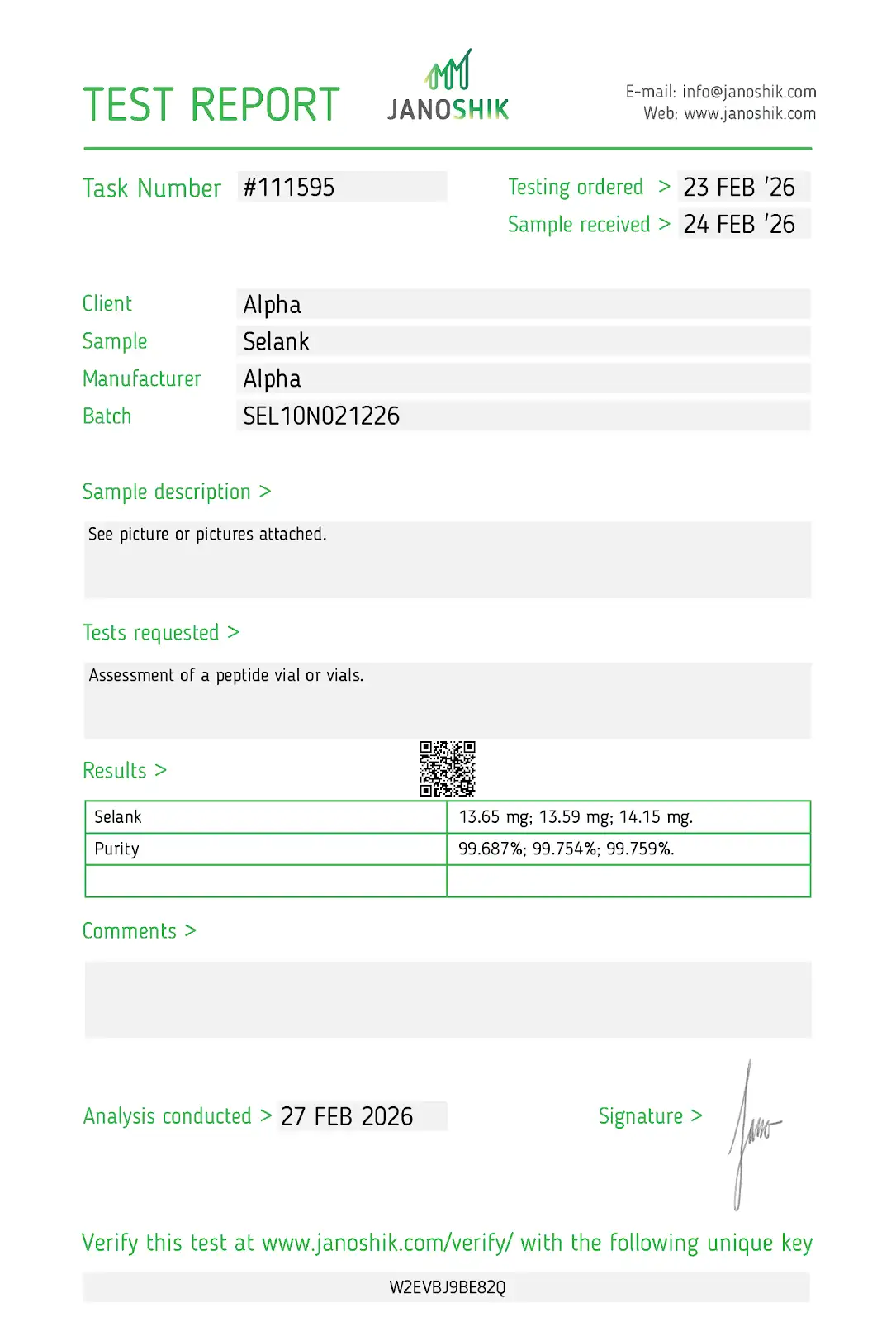
Report 111595, with analysis conducted February 27, 2026, identifies Selank and reports purity results of 99.687%, 99.754%, and 99.759% for three submitted samples. A report covers a submitted sample or lot, not safety, sterility, effectiveness, or every product sold. Its provenance has not been independently authenticated.
Open attached COAAll classroom topics