PT-141
Bremelanotide is a prescription medicine approved for a specific sexual-desire condition in premenopausal women.
This material is educational, not medical advice or a treatment recommendation. Classroom claims and example protocols have not all been independently verified.
The Compound, Explained
Category: Sexual Health
Compound: PT-141, known as Bremelanotide. Sold as Vyleesi.
Research Status: FDA Approved
Regulatory Status: FDA approved in 2019 for hypoactive sexual desire disorder (HSDD) in premenopausal women. Prescription required. Use in men, or in postmenopausal women, is off-label.
What This Is
A melanocortin receptor agonist that acts in the brain.
That second half is the whole point. PT-141 does not work on blood flow. It acts on receptors in the hypothalamus and limbic system involved in sexual desire and arousal pathways.
This is the only FDA-approved peptide for sexual dysfunction, and it is the third approved compound in this library alongside tirzepatide and tesamorelin.
Central Versus Peripheral
The distinction that determines whether this compound is relevant to a given situation.
PDE5 inhibitors, meaning sildenafil and tadalafil, sold as Viagra and Cialis, work peripherally. They affect blood flow. They address the physical response.
PT-141 works centrally. It acts on desire and arousal pathways in the brain.
These address different problems. Someone whose difficulty is vascular is served by a PDE5 inhibitor. Someone whose difficulty is desire is not, and no amount of blood flow assistance changes that.
It also explains a specific research finding: PT-141 has shown effect in men with erectile dysfunction who do not respond to PDE5 inhibitors. Non-response to a vascular drug is consistent with the problem not being vascular, and a different mechanism is exactly what you would want in that case.
Where It Came From
PT-141 was developed from Melanotan II, and the relationship is worth understanding because the two still share a market.
Melanotan II is a melanocortin agonist developed for tanning, since melanocortin receptors also govern pigmentation. Sexual arousal effects were observed as an unintended finding during that research.
PT-141 is the result of isolating that effect and removing the tanning activity. Same receptor family, different selectivity, different purpose.
Two practical consequences. PT-141 is a purpose-built and approved compound while Melanotan II is neither. And the shared receptor family is why hyperpigmentation still appears on PT-141's side effect list despite the redesign, which matters for the frequency guidance later in this module.
Approved For Whom
The approval is specific: Hypoactive sexual desire disorder in premenopausal women.
Male use is off-label. The clinical research includes men and the evidence there is real, and it is not what the FDA reviewed and approved.
This is the same lesson as tesamorelin. Approved attaches to a molecule, an indication and a population together. It is a common and defensible off-label use, and knowing which side of the line you are on is the point.
This Is Not a Daily Compound
Unusual in this library and worth stating early.
PT-141 is used as needed, roughly 45 minutes before activity, with a maximum of one dose in 24 hours. There is no cycle, no loading phase, no maintenance protocol.
The frequency limit is not arbitrary and the Protocol tab explains what drives it.
Inside the Mechanism
Melanocortin Receptors
There are five melanocortin receptors, MC1R through MC5R, and they govern quite different things: pigmentation, appetite, inflammation, sexual function.
PT-141 acts primarily on MC3R and MC4R, located in the hypothalamus and limbic system, which are the regions involved in motivation, emotion and drive.
MC1R is the pigmentation receptor. PT-141 was designed to reduce activity there relative to Melanotan II, which is why tanning is not its primary effect. Reduced is not eliminated, which is why hyperpigmentation with repeated use remains on the safety list.
What Activation Produces
Activating MC3R and MC4R in those brain regions increases sexual motivation and arousal.
Note what that means and what it does not. This is upstream of the physical response, acting on desire rather than on the mechanics. It is also independent of the peripheral vascular system entirely, which is the structural reason it works where PDE5 inhibitors do not.
Independent of Hormonal Status
A distinguishing feature worth understanding.
Many approaches to low desire work through hormones, testosterone or estrogen, which means their effectiveness depends on where someone's hormone levels sit and whether those levels are the cause.
PT-141 acts on a neural pathway rather than a hormonal one. It works regardless of hormonal status, which makes it relevant in situations where hormone-based approaches are not appropriate or have not helped.
Timing and Duration
Effects begin within roughly 45 minutes and last 6 to 12 hours.
That profile is what makes on-demand use practical, and it is also why the compound is not dosed daily. A window that long from a single dose means daily administration would mean near-continuous receptor activation, and continuous activation of any receptor system tends to produce downregulation.
Where the Side Effects Come From
Each traces to the mechanism, which makes the list predictable rather than arbitrary.
Nausea: Melanocortin receptors are present in regions involved in nausea signalling. This is the most common effect and it is dose-related, which is why starting lower is the standard response.
Flushing and Hot Flashes: Vascular effects of melanocortin activation.
Transient Blood Pressure Increase: Melanocortin activation affects cardiovascular regulation. This is the one that carries the most clinical weight.
Hyperpigmentation with Repeated Use: Residual MC1R activity, accumulating with frequency. The direct reason frequent use is discouraged.
What the Research Actually Shows
Read the Status Tag First
PT-141 is tagged FDA Approved. Approval came in 2019 for HSDD in premenopausal women, following randomized controlled trials reviewed by the regulator.
That is the top of the evidence hierarchy, occupied for that indication and that population.
What approval does not cover: use in men, use in postmenopausal women, or use by anyone without the condition it was approved to treat.
The Effect Size Question
Worth being direct about, because it is the honest complication in this module.
HSDD trials measure desire and distress using validated questionnaires. Bremelanotide demonstrated statistically significant improvement over placebo, which is what approval requires.
The magnitude of that improvement has been debated in the clinical literature. Some reviewers characterized the effect as modest relative to placebo. That debate is part of the published record on this drug and it is not something a product page will usually mention.
Statistically significant and large are different claims. A real effect can be a small one, and both things are true here.
This is a useful case for the general habit: When you read that a trial showed a significant result, the next question is how big, not just whether.
The Placebo Response in This Domain Is Large
Sexual function trials have among the highest placebo responses in medicine, for reasons that are structural rather than incidental.
Desire is self-reported. It fluctuates with relationship context, stress, sleep, mood and circumstance. Participating in a trial for low desire means attention, expectation, and often conversations with a partner that would not otherwise have happened.
All of that improves outcomes independently of the drug. It is why the placebo arm in these trials performs well, and why the gap between drug and placebo is the number that matters rather than the improvement in the treatment arm alone.
Male Use
The 2005 research on PT-141 for male sexual dysfunction is real and the mechanism is not sex-specific. Melanocortin receptors in the hypothalamus do not differ by sex in the relevant way.
At the same time, the development programme ultimately pursued approval in women, and male use remains off-label with a smaller evidence base behind it than the approved indication carries.
Reasonable extrapolation. Not the same standing as the approved use.
What Low Desire Usually Is
Worth saying plainly, because it affects whether this compound is the right response at all.
Low sexual desire has many causes: relationship factors, depression, anxiety, medication side effects including SSRIs, thyroid dysfunction, sleep deprivation, chronic stress, hormonal changes.
Several of those are treatable, and treating the cause works better than working around it. HSDD as a diagnosis specifically requires that the low desire is not better explained by another condition, relationship problem or medication, which is a diagnostic step a self-directed protocol skips entirely.
A compound that increases arousal signaling does not address an underlying depression, a medication side effect or a relationship difficulty. It is worth knowing which situation you are in before deciding what to do about it.
The July 2026 Committee Vote
On July 23 2026 the FDA's Pharmacy Compounding Advisory Committee voted on seven peptides.
Recommended: BPC-157, KPV, TB-500, MOTS-c, Epitalon, Semax
Not recommended: Emideltide, also known as DSIP
PT-141 was not on that list, for the same structural reason as tirzepatide. Compounding eligibility is a pathway for substances outside the normal approval process. Bremelanotide completed that process. Its absence carries no evaluative meaning.
Holding Both Facts
PT-141 is FDA approved, works through a well-characterized central mechanism, addresses a real problem that other treatments do not reach, and offers something genuinely different from vascular drugs.
Its trial effect size has been described as modest, it operates in a domain with a very large placebo response, its approval covers one population while most use falls outside it, and low desire frequently has causes this compound does not touch.
Hold both at once.
Sourcing & Verification
Original classroom lesson. Preparation, measurement, sourcing, or protocol examples are source material, not verified instructions or clinical guidance.
PT-141 has one sourcing risk that stands apart from everything else in this library, and it comes from its own origin story.
What to Verify on This Compound
Melanotan II is the specific danger. PT-141 was derived from Melanotan II by removing the tanning activity. The two are structurally related, sold in the same market, and Melanotan II is substantially cheaper.
Receiving Melanotan II labelled as PT-141 means receiving a compound that is not FDA approved, that has strong MC1R pigmentation activity, and that carries a different risk profile including effects on moles and pigmented lesions.
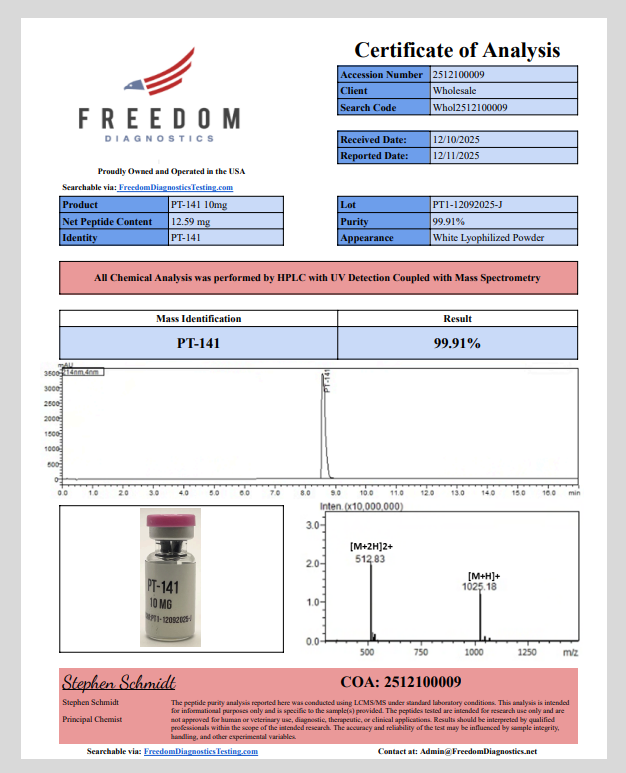
This is not a hypothetical substitution risk. It is the single most relevant thing to verify, and identity confirmation by mass spectrometry is what settles it. Molecular weight differs. A purity figure will not tell you which molecule you have.
The legitimate route exists. Bremelanotide is approved and prescribable as Vyleesi, which gives a pharmaceutical-grade product with verified identity and a prescriber involved. For a compound with a blood pressure effect, that involvement has value beyond the product itself.
Blood pressure makes this different: PT-141 causes a transient blood pressure increase. Anyone with cardiovascular disease, uncontrolled hypertension, or on blood pressure medication should be having a clinical conversation rather than sourcing independently. That is not a formality on this compound.
The COA Standard
A valid COA names the testing laboratory, carries a batch number matching your vial, states a test date, gives purity with the method used, and confirms identity. Anything answering "available on request," or arriving as a screenshot with no traceable source, is not a COA.
For PT-141, identity confirmation is the line item. Ask for it specifically and do not accept purity alone.
Storage
Lyophilized Powder: Cool, dry, protected from light. Reconstituted: refrigerate, protect from light, follow the manufacturer's window.
Note the usage pattern. As-needed dosing means a reconstituted vial may sit in the fridge for weeks between uses, which is different from a daily protocol that empties a vial in ten days. Track the reconstitution date, since you will not be reminded by running out.
Preparation
Original classroom lesson. Preparation, measurement, sourcing, or protocol examples are source material, not verified instructions or clinical guidance.
PT-141 Reconstitution Guide
If you are using prescription Vyleesi, it comes as an autoinjector and no preparation is required.
For lyophilized powder, reconstitute as follows. Vial strengths vary, so use the volume specified for your exact product.
Reference Configuration
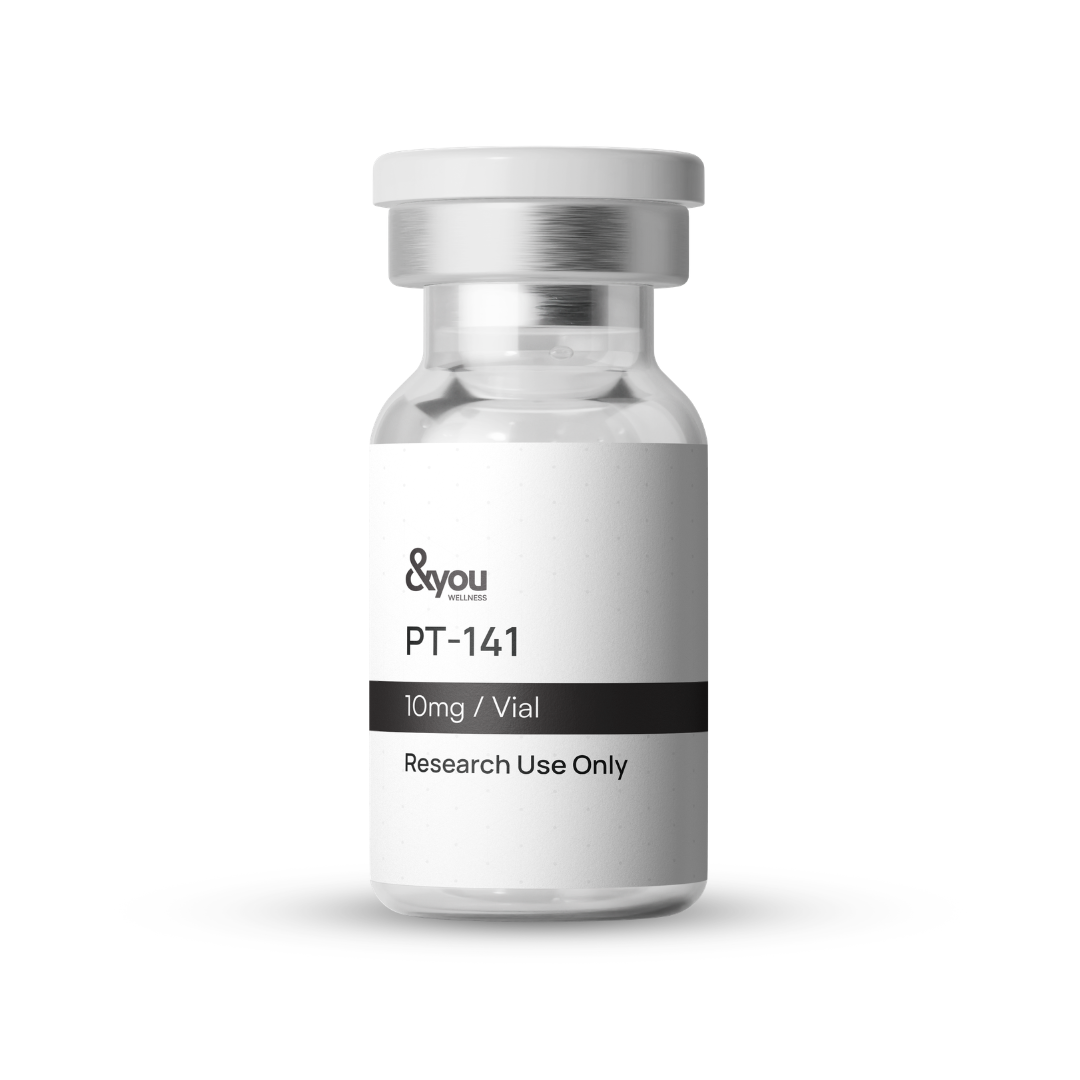
Vial Size: 10 mg
Bacteriostatic Water: 2 mL
Resulting Concentration: 5 mg/mL
What you will Need:
PT-141 vial
Bacteriostatic water
U-100 insulin syringes
Alcohol pads
Step 1: Prepare and Sanitize
Wash your hands and prepare a clean workspace.
Remove the caps from both the bacteriostatic water and the PT-141 vial.
Clean both stoppers with alcohol pads and allow them to dry.
Step 2: Reconstitute
Draw 2 mL of bacteriostatic water.
Insert the needle and introduce the water slowly along the inside wall.
Avoid directing the stream forcefully onto the powder.
Step 3: Mix Gently
Do not shake. Swirl gently until fully dissolved. The solution should be clear.
Step 4: Storage after Reconstitution
Refrigerate.
Protect from light.
Follow the manufacturer's window.
Do not freeze unless specifically indicated.
The Storage Issue Specific to This Compound
Every other injectable in this library is used on a schedule that empties the vial predictably. PT-141 is not.
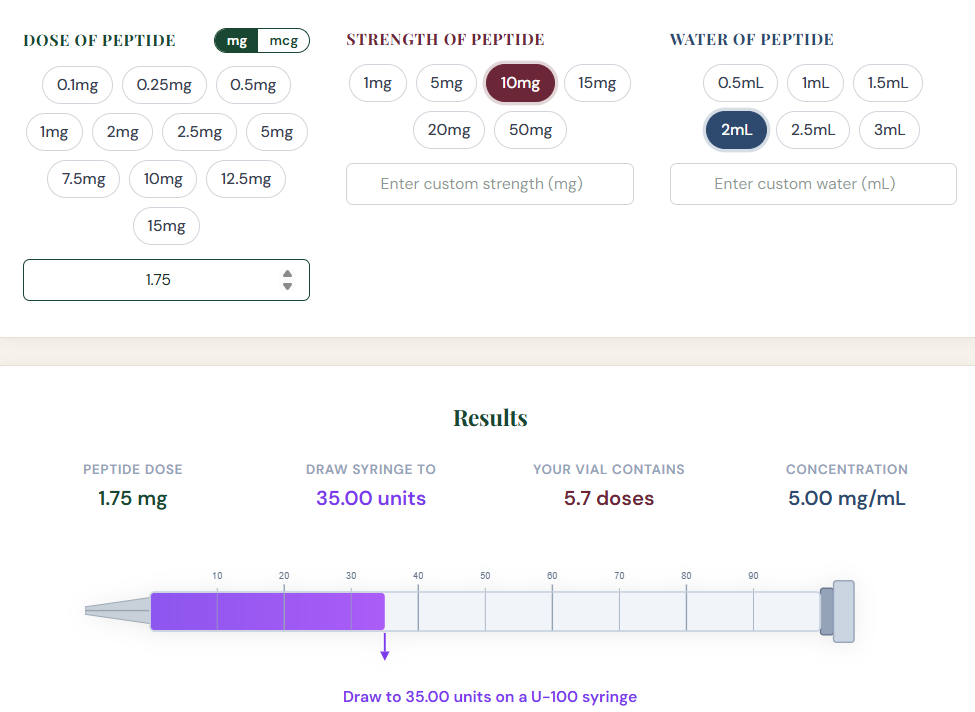
A 10 mg vial at 1.75 mg per dose is roughly five doses. Used as needed, that vial may be open for months.
Two Consequences:
Write the reconstitution date on the vial. You will not be prompted by running out, and a peptide's stability window does not pause because you are not using it.
Consider reconstituting less at a time. If a vial will outlive its window, a smaller reconstitution volume from a smaller vial wastes less.
Measurement
Original classroom lesson. Preparation, measurement, sourcing, or protocol examples are source material, not verified instructions or clinical guidance.
PT-141 Measurement Guide
Calculator, pre-filled with PT-141 defaults:
https://peptidetrainings.com/tools/reconstitution-calculator?label=PT-141
Draw Volume Reference
At 10 mg reconstituted with 2 mL, giving 5 mg/mL, on a U-100 syringe:
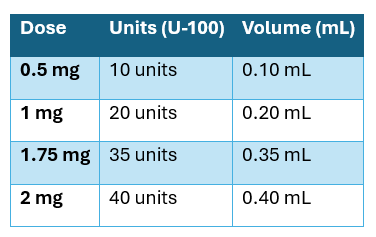
The correct measurement depends on vial strength, reconstitution volume, desired dose and syringe type.
Calculate Your Dosage
→ Click here to calculate your dosage
Important
Nausea is dose-related, which makes measurement accuracy matter more here than usual. The difference between a good experience and an unpleasant one is often the difference between 1 mg and 2 mg. Overdrawing is not a minor error on this compound.
1.75 mg is an awkward number. It lands on 35 units at this concentration, which is readable but not a round figure. Work it out once, write it down, and do not estimate it in the moment.
Infrequent use means no muscle memory. Every other compound here is drawn daily or weekly, so the volume becomes familiar. PT-141 might be drawn once a fortnight. Keep your figure written on or near the vial rather than recalculating from memory each time.
Always confirm your vial strength, your reconstitution volume and your syringe type before drawing.
Protocol
Original classroom lesson. Preparation, measurement, sourcing, or protocol examples are source material, not verified instructions or clinical guidance.
PT-141 Dosing Protocol
The following reflects the approved protocol and is provided for educational reference.
Typical dose
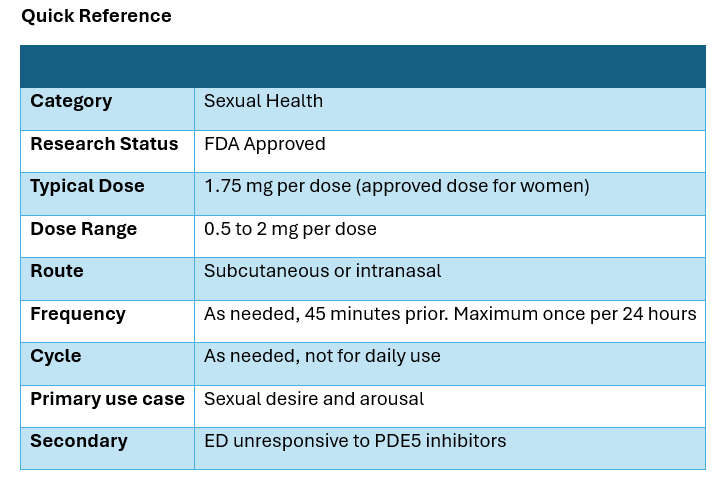
Dose: 1.75 mg, the FDA-approved dose for women
Dose Range: 0.5 to 2 mg per dose. Men typically use 1 to 2 mg.
Frequency: As needed, approximately 45 minutes before activity
Route: Subcutaneous injection, or intranasal
Maximum: One dose per 24 hours. Not for daily use.
Start Lower Than the Target
The standard and sensible approach, for a specific reason.
Nausea is the most common side effect and it is dose-related. Starting at the lower end of the range and establishing tolerance before moving up avoids the common pattern of a first experience being dominated by feeling unwell.
There is no benefit to starting at the top. Unlike a cycled compound, there is no build-up phase you are trying to shorten.
Why the Frequency Limit Exists
Three separate reasons, and it is worth knowing all of them rather than treating the limit as arbitrary.
Duration. Effects last 6 to 12 hours. A second dose inside that window stacks on an active one.
Hyperpigmentation. Listed as occurring with repeated use. The residual MC1R activity accumulates with frequency, so this is specifically a frequency-driven effect rather than a dose-driven one.
Receptor downregulation. Continuous activation of any receptor system tends to reduce its responsiveness. On-demand use preserves the response in a way daily use would not.
The compound is designed around infrequent use. Treating it as something to take regularly works against all three.
Blood Pressure
The most clinically significant item on the safety list and it deserves more than a bullet.
PT-141 causes a transient blood pressure increase. In the trials this was monitored, and the approved labelling reflects it.
Practical implications:
Anyone with cardiovascular disease or uncontrolled hypertension should not be making this decision alone.
Anyone on blood pressure medication should discuss it with their prescriber.
Combining with other things that affect blood pressure, including some recreational substances, is where this becomes genuinely risky rather than theoretically so.
This is the one place in this module where the prescription route is not just the higher-quality option but the safer one.
Clinical Notes
The FDA-approved dose for women is 1.75 mg subcutaneous. Men typically use 1 to 2 mg.
Effects begin within 45 minutes and last 6 to 12 hours.
Do not use more than once every 24 hours.
Nausea is dose-related and reduced by starting lower.
Not for daily use.
Low desire with an identifiable cause, including medication side effects, depression, or relationship factors, is better addressed at the cause. This compound does not reach any of those.
Consult a qualified healthcare professional before use.
Side Effects and Safety
Nausea, the most common, especially at higher doses
Flushing and hot flashes
Headache
Transient blood pressure increase
Hyperpigmentation with repeated use
Every item traces directly to melanocortin activation. They are expected consequences of the mechanism rather than unpredictable reactions, which means dose and frequency are the levers that control them.
Research References
Stack Logic
Original classroom lesson. Preparation, measurement, sourcing, or protocol examples are source material, not verified instructions or clinical guidance.
PT-141 is an on-demand compound, which changes the stacking conversation entirely. There is no cycle to build around and no daily protocol to layer onto.
What Pairs With PT-141, and Why
PT-141 + Oxytocin: The pairing with the clearest rationale. PT-141 acts on arousal and desire pathways. Oxytocin is involved in bonding and connection, which is a different dimension of the same experience rather than a stronger version of the same effect. Different mechanism, different contribution.
PT-141 + Kisspeptin-10: Kisspeptin acts upstream on LH and FSH release, meaning it operates through the hormonal axis while PT-141 operates through a neural one. Genuinely different pathways toward an overlapping outcome, and worth noting that Kisspeptin has a much thinner evidence base.
PT-141 + BPC-157: Listed as complementary on the grounds of injection site support and general wellbeing. That rationale is weak, and it is worth naming as an example rather than passing over. Injection site reactions from an occasional subcutaneous dose are not a problem requiring a second compound, and general wellbeing is not a mechanism. If BPC-157 belongs in your protocol it belongs for its own reasons, not as an accessory to this one.
What Does Not Belong
Melanotan II: Same receptor family, overlapping activity, and the compound PT-141 was specifically redesigned to improve on. Running both means duplicating melanocortin activation while adding back the pigmentation effect the redesign removed.
Anything else affecting blood pressure, without oversight: PT-141 raises blood pressure transiently. Compounds, medications or substances that do the same are additive here, and this is the interaction that actually matters.
The Question Specific to This Compound
Is the problem desire, or is it something desire is downstream of?
PT-141 acts on arousal signaling. It does not treat depression, does not offset an SSRI's sexual side effects at the source, does not resolve relationship difficulty, and does not fix sleep deprivation or chronic stress.
Any of those can present as low desire. A compound that increases arousal signaling in someone whose desire is suppressed by an underlying cause is working against a current, and the more useful intervention is usually upstream.
Where This Leaves You
PT-141 is the only approved peptide for sexual dysfunction and it does something no other approach does: it works centrally, on desire rather than on mechanics, independent of hormonal status.
That specificity is its strength and it is also the boundary of what it can do. It is the right tool when the problem is genuinely in the pathway it acts on, and the wrong one when low desire is a symptom of something else.
Work out which situation you are in first. That single question determines whether this compound is worth anything to you, and no amount of stacking changes the answer.
Certificate of Analysis
Report 2512100009, dated December 11, 2025, identifies PT-141 and reports 99.91% purity for the submitted sample. A report covers a submitted sample or lot, not safety, sterility, effectiveness, or every product sold. Its provenance has not been independently authenticated.
Open attached COAAll classroom topics