NAD+
NAD+ is a cellular coenzyme, not a peptide. Explore its biology and the limits of current clinical evidence.
This material is educational, not medical advice or a treatment recommendation. Classroom claims and example protocols have not all been independently verified.
The Compound, Explained
Category: Longevity & Anti-Aging
Compound: NAD+ (Nicotinamide Adenine Dinucleotide, also Beta-NAD+)
Research Status: Widely used
Regulatory Status: Not FDA approved for any therapeutic indication. Was not among the seven peptides voted on by the FDA Pharmacy Compounding Advisory Committee on July 23 2026.
Start Here: This Is Not a Peptide
NAD+ sits in your peptide library and it is not a peptide.
Peptides are chains of amino acids. NAD+ is a dinucleotide, a coenzyme built from two nucleotides. Structurally it has more in common with the building blocks of DNA than with anything else in this course.
It is grouped with peptides because it is injected, sold by the same suppliers and used in the same protocols. That is a market classification, not a biological one.
Why this matters practically: everything you have learned about peptide behavior, stability, dosing scale and mechanism does not automatically transfer. The clearest tell is dose. Most compounds in this library are dosed in single-digit milligrams. NAD+ is dosed in hundreds. That is not a stronger peptide, it is a different class of molecule doing a different kind of job.
What This Is
A coenzyme present in every living cell, involved in hundreds of metabolic reactions.
Not a signalling molecule that tells cells what to do. A working component that reactions physically require in order to run. Without it those reactions stop.
It does three main jobs:
Energy production. Acts as an electron carrier in cellular respiration, the process that produces ATP.
DNA repair. Consumed by PARP enzymes when they repair damaged DNA.
Gene expression and longevity signalling. Serves as the required substrate for sirtuins, SIRT1 through SIRT7.
Why It Declines, and Why That Matters
NAD+ levels fall substantially with age. By around 50, levels may sit near half of what they were at 20.
Three things drive that decline at once:
CD38 increases. This enzyme consumes NAD+ and its activity rises with age.
Demand rises. Accumulated DNA damage keeps PARP enzymes working, and PARP activity consumes NAD+.
Supply falls. The body's capacity to synthesise new NAD+ declines.
Consumption up, demand up, production down. The entire rationale for supplementing rests on that convergence.
The Substrate Framing
This is the most useful way to think about NAD+, and it will matter again in the stacking tab.
Most longevity compounds are signals. They instruct a cell to do something differently. NAD+ is a substrate, the material those processes consume.
Sirtuins are the clearest case. Sirtuins are widely discussed as longevity enzymes, and they cannot function without NAD+. Low NAD+ means low sirtuin activity regardless of how much you try to stimulate them. You are not switching a process on. You are supplying what it runs on.
That distinction determines when NAD+ is useful and when it does nothing, and it is the thing most marketing around this compound gets wrong.
Who This Is For
People building a longevity protocol who want the foundational metabolic layer in place.
People interested in cellular energy, mitochondrial function or DNA repair capacity.
People stacking sirtuin-dependent or energy-dependent compounds, where NAD+ availability may be the limiting factor.
Inside the Mechanism
Electron Carrier in Cellular Respiration
The most fundamental role, and the least discussed in marketing because it is unglamorous.
NAD+ cycles between two forms, NAD+ and NADH. It accepts electrons during the breakdown of fuel, becoming NADH, then delivers them to the electron transport chain in the mitochondria, where that energy drives ATP production, and returns to NAD+.
It is not consumed in this process. It cycles. What matters is having enough of the molecule in circulation for the cycle to run at full rate.
This is why NAD+ shows up in every conversation about cellular energy. It is not adjacent to energy metabolism, it is a required component of it.
Substrate for Sirtuins
SIRT1 through SIRT7. NAD+-dependent deacetylases, meaning enzymes that remove acetyl groups from proteins and, in doing so, change gene expression, DNA repair activity and metabolic adaptation.
The dependency is absolute. Sirtuins consume NAD+ as they work. No NAD+, no sirtuin activity.
This is the mechanistic backbone of the longevity argument. Sirtuins are among the most studied targets in aging biology, and NAD+ decline is a direct constraint on them. A great deal of what gets attributed to aging at the cellular level may be sirtuins running short of fuel.
Substrate for PARP Enzymes
PARPs detect and repair DNA damage, and they consume NAD+ heavily to do it.
Here is the tension worth understanding, because it is more interesting than the simple version: PARP activity and sirtuin activity compete for the same pool.
When DNA damage is high, PARPs consume NAD+ aggressively. That is appropriate, since damaged DNA is the more urgent problem. But it leaves less available for sirtuins. Damage accumulates with age, PARP demand rises, and sirtuin activity falls as a consequence.
So NAD+ decline is not only about production falling. It is also about a repair system drawing down a shared resource.
Mitochondrial Biogenesis
Sirtuin activity, SIRT1 and SIRT3 in particular, influences the production of new mitochondria. Since sirtuins depend on NAD+, adequate NAD+ is upstream of that process.
Note the chain: NAD+ enables sirtuins, sirtuins drive biogenesis. NAD+ is two steps back from the outcome, not directly causing it. That structure is worth holding on to, because it is exactly what makes NAD+ effects harder to attribute than they look.
Neuroprotection
Neurons are metabolically demanding and heavily dependent on mitochondrial function. The proposed protective mechanism runs through energy availability and DNA repair capacity rather than anything neuron-specific. Research interest is real and the evidence is early.
NAD+ Versus NMN and NR
You will meet this constantly, so get it clear.
NMN and NR are precursors. Raw materials your body converts into NAD+. They are popular in oral form because they survive digestion, which NAD+ largely does not.
Direct NAD+ injection skips the conversion step and delivers the finished molecule into the bloodstream at much higher levels.
The trade-off is real in both directions. Injection gives higher delivered levels and requires injection. Oral precursors are convenient and depend on a conversion step whose efficiency varies. Neither is straightforwardly superior, and anyone telling you one is has stopped describing and started selling.
What the Research Actually Shows
Read the Status Tag First
NAD+ is tagged Widely Used, and that tag is doing something different from the ones on other modules. It is a usage statement, not an evidence statement.
Widely used means many people use it. It does not mean human trials support the outcomes claimed. Popularity and evidence are separate variables, as the July 2026 committee vote demonstrated when it rejected the most consumer-popular compound on its list.
Split the Claim Into Two Parts
This is the key move with NAD+, and it applies to almost nothing else in this course.
Part one: the biology. NAD+ is essential to cellular respiration. Sirtuins require it. PARPs consume it. Levels decline with age. This is textbook biochemistry, established across decades and not seriously disputed.
Part two: the intervention. That injecting NAD+ raises intracellular levels meaningfully, and that doing so produces the outcomes people want, is a separate claim with much thinner support.
The first part is rock solid. The second is where the evidence gets thin. Most marketing presents the first and lets you infer the second.
That inference is not automatic. A molecule being essential does not establish that adding more of it helps, particularly in someone not deficient. Water is essential. Drinking more than you need does not improve performance.
The Delivery Question Nobody Answers
The most important open question, and the one you should ask any supplier.
NAD+ is a large, charged molecule. Getting it across cell membranes into the cells where it does its work is not straightforward. Some research suggests circulating NAD+ is broken down into precursors before entering cells, which would mean injection is functionally an expensive precursor delivery system.
If that is correct, some of the argument for injection over oral precursors weakens considerably.
This is unsettled, and it is worth knowing that it is unsettled. It sits directly underneath the entire injectable NAD+ market and rarely gets mentioned in it.
The Evidence Hierarchy
In vitro. Cells in a dish. Tells you a mechanism is possible.
Animal model. Tells you the mechanism operates in a living system.
Human observational. No control group. Confounded by everything.
Human randomized controlled trial. Where "proven" becomes appropriate.
NAD+ biology sits at the top tier as established biochemistry. NAD+ supplementation outcomes sit much lower, with human trials that are small, short and focused on surrogate markers rather than the outcomes people are actually after.
Most human trial work has been on the oral precursors, NMN and NR, rather than on injectable NAD+. Do not let evidence for one route be quoted in support of another.
The Flushing Point
Flushing during administration is common, especially with rapid delivery. It is worth naming because it gets misread as evidence the compound is working.
It is not. It is a vascular response to administration rate. Feeling something is not the same as the compound doing what you want, and this is one of the clearest cases in the whole library where a felt sensation gets mistaken for efficacy.
The July 2026 Committee Vote
On July 23 2026 the FDA's Pharmacy Compounding Advisory Committee voted on seven peptides.
Recommended: BPC-157, KPV, TB-500, MOTS-c, Epitalon, Semax
Not recommended: Emideltide, also known as DSIP
NAD+ was not on that list, which follows from the first section of tab one. That review concerned peptides, and NAD+ is not one. Its absence carries no evaluative meaning at all.
Holding Both Facts
NAD+ is genuinely essential to cellular function, its decline with age is well documented, and the mechanism behind the longevity interest is real biochemistry rather than speculation. The evidence that injecting it produces the outcomes advertised is thin, delivery into cells remains an open question, and its market runs far ahead of its trial data.
Hold both at once. That is what research literacy is.
Sourcing & Verification
Original classroom lesson. Preparation, measurement, sourcing, or protocol examples are source material, not verified instructions or clinical guidance.
NAD+ is the most expensive thing per session in most longevity protocols and one of the easiest to get wrong, because it is bought in gram quantities and judged by a sensation that tells you nothing.
What to Verify on This Compound
Purity carries more weight here than anywhere else in the library. You are injecting 250 to 1000 mg per session. On a 1 mg peptide, a 2% impurity is 20 micrograms. On a 500 mg NAD+ dose, the same 2% is 10 milligrams of unidentified material. Impurity scales with dose, and this dose is enormous by comparison.
Get the impurity profile, not just the headline purity number. A well-documented COA states what the remainder is.
Confirm the form. NAD+ is sold alongside NADH, NMN, NR and nicotinamide, all related, all cheaper, none the same molecule. Identity confirmation on the COA is what distinguishes them. A label is not a test.
Note the production method. Biofermented and synthetic routes produce different impurity profiles. Neither is inherently better. What matters is that the method is stated and the impurities are characterized for whichever was used.
The COA Standard
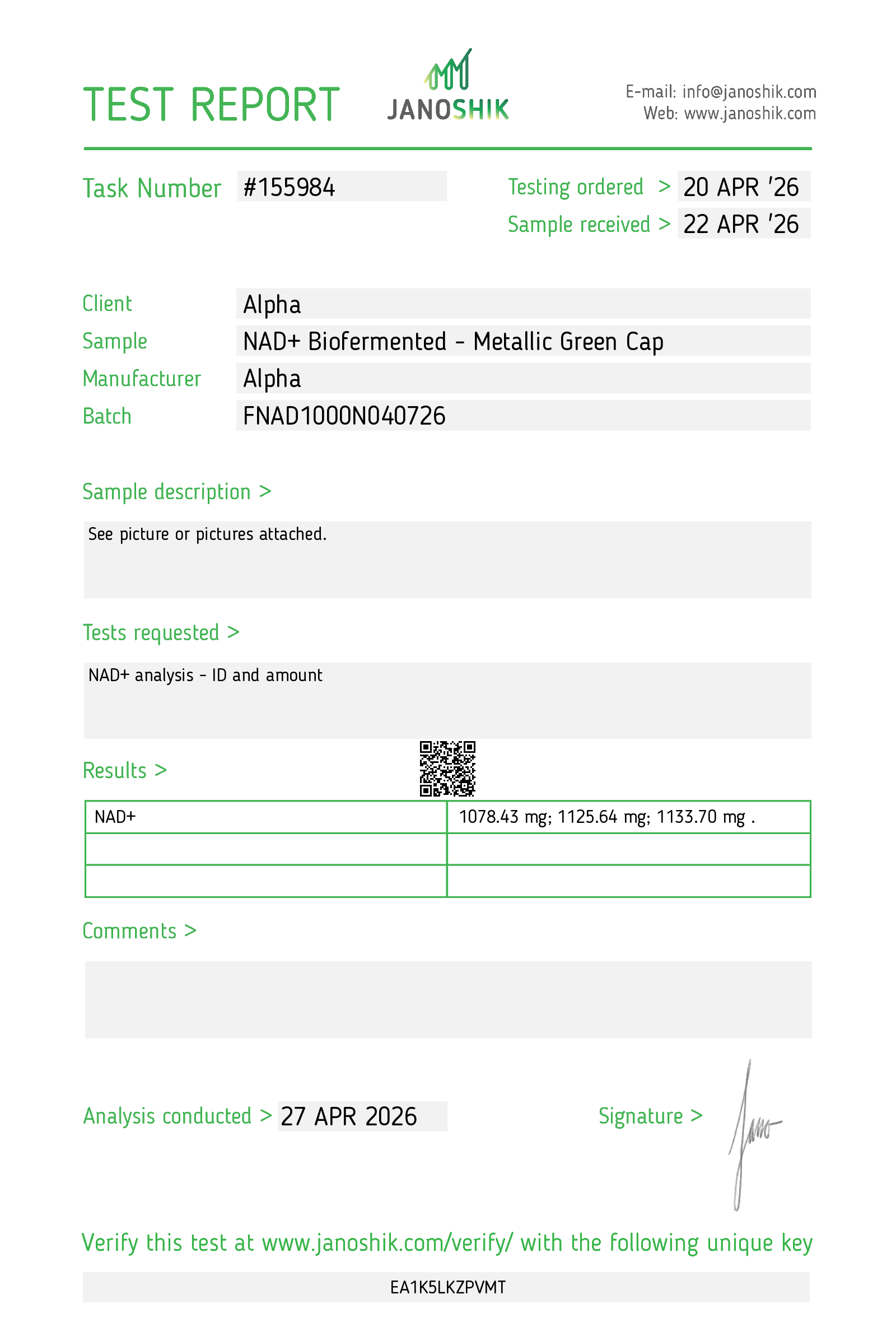
A valid COA names the testing laboratory, carries a batch number matching your vial, states a test date, gives purity with the method used, and confirms identity. Anything answering "available on request," or arriving as a screenshot with no traceable source, is not a COA.
Ask whoever you currently buy from for the COA on your specific NAD+ batch, and ask what the remaining percentage consists of. The second question is the one that separates suppliers.
Storage
Lyophilized powder: cool, dry, protected from direct sunlight, humidity and heat.
NAD+ is less stable in solution than most compounds here, and it is sensitive to heat and light once reconstituted. Refrigerate immediately, keep it dark, and follow the manufacturer's window rather than assuming a peptide timeline applies.
Preparation
Original classroom lesson. Preparation, measurement, sourcing, or protocol examples are source material, not verified instructions or clinical guidance.
NAD+ Reconstitution Guide
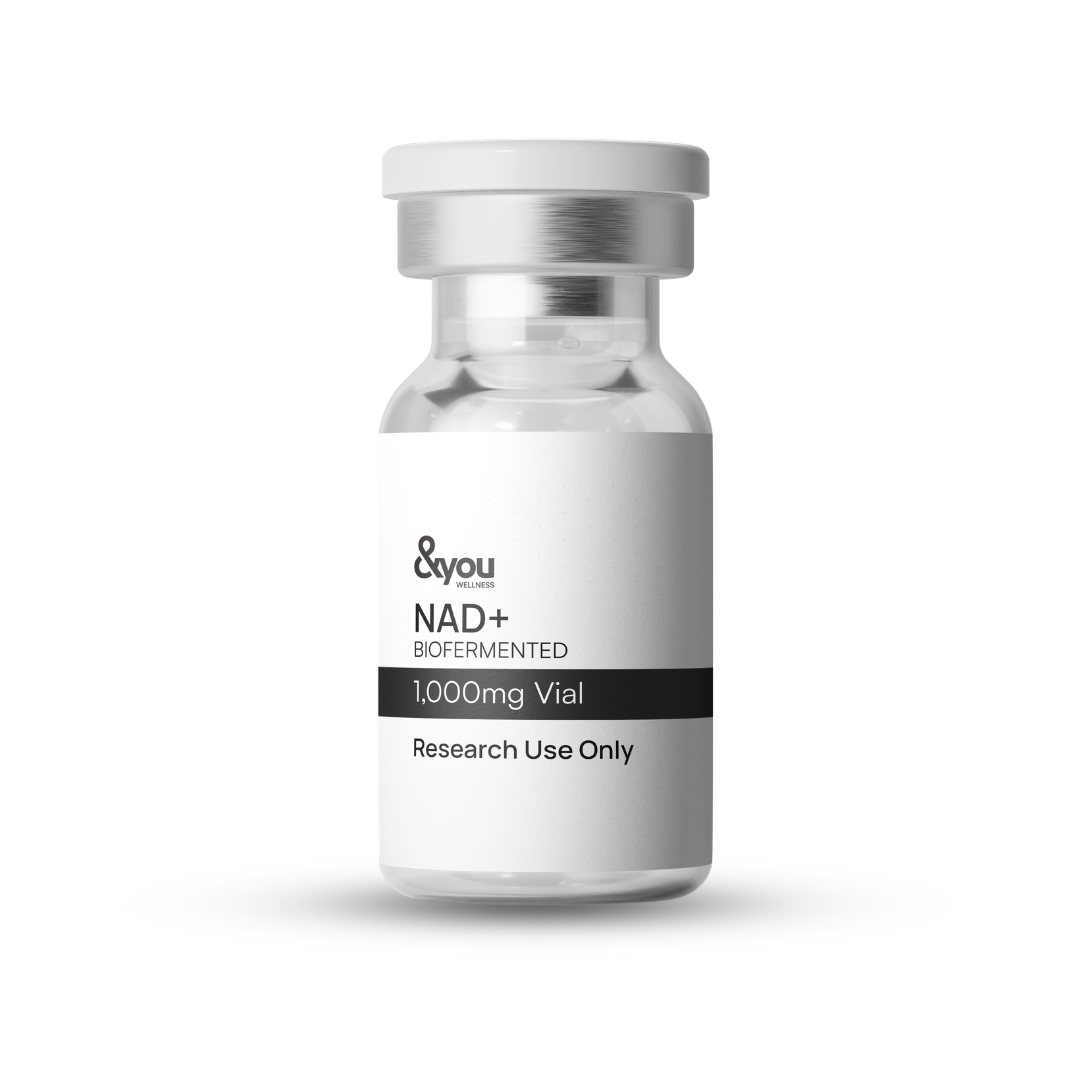
NAD+ is supplied as a lyophilized powder requiring reconstitution. Vial strengths vary considerably between suppliers, from 500 mg to 1000 mg and beyond, so always use the volume specified for your exact product.
What you will Need:
NAD+ vial
Bacteriostatic water
Appropriate syringe
Alcohol pads
Step 1: Prepare and Sanitize
Wash your hands and prepare a clean workspace.
Remove the caps from both the bacteriostatic water and the NAD+ vial.
Clean both stoppers with alcohol pads and allow them to dry.
Step 2: Reconstitute
Draw the volume specified for your vial strength.
Insert the needle and introduce the water slowly along the inside wall.
Avoid directing the stream forcefully onto the powder.
Step 3: Mix Gently
Important: Do not shake.
Gently swirl until fully dissolved. NAD+ takes longer to go into solution than most peptides given the quantity of powder involved. Be patient with it rather than agitating it.
Step 4: Storage after Reconstitution
Refrigerate immediately.
Keep protected from light.
Follow the manufacturer's stated window.
Do not freeze unless the manufacturer specifically indicates it.
Two Things Specific to This Compound
Volume: You are dissolving hundreds of milligrams, not single digits. That requires substantially more bacteriostatic water than a typical peptide vial, and the resulting solution volume is larger. Plan for it.
Injection comfort: Larger injection volumes are less comfortable subcutaneously than the small volumes most peptides require. Reconstitution volume is a trade-off here rather than a free choice: more water gives easier measurement and a bigger injection, less water gives a smaller injection and tighter measurement tolerances.
Important
Reconstitution volume determines concentration, and concentration determines every draw volume that follows. Because NAD+ vial strengths vary so widely, a figure copied from someone else's protocol is more likely to be wrong here than with any other compound in this library.
Measurement
Original classroom lesson. Preparation, measurement, sourcing, or protocol examples are source material, not verified instructions or clinical guidance.
NAD+ Measurement Guide
Learn how to convert your concentration into the correct syringe volume.
Calculator, pre-filled with NAD+ defaults:
https://peptidetrainings.com/tools/reconstitution-calculator?label=NAD%2B
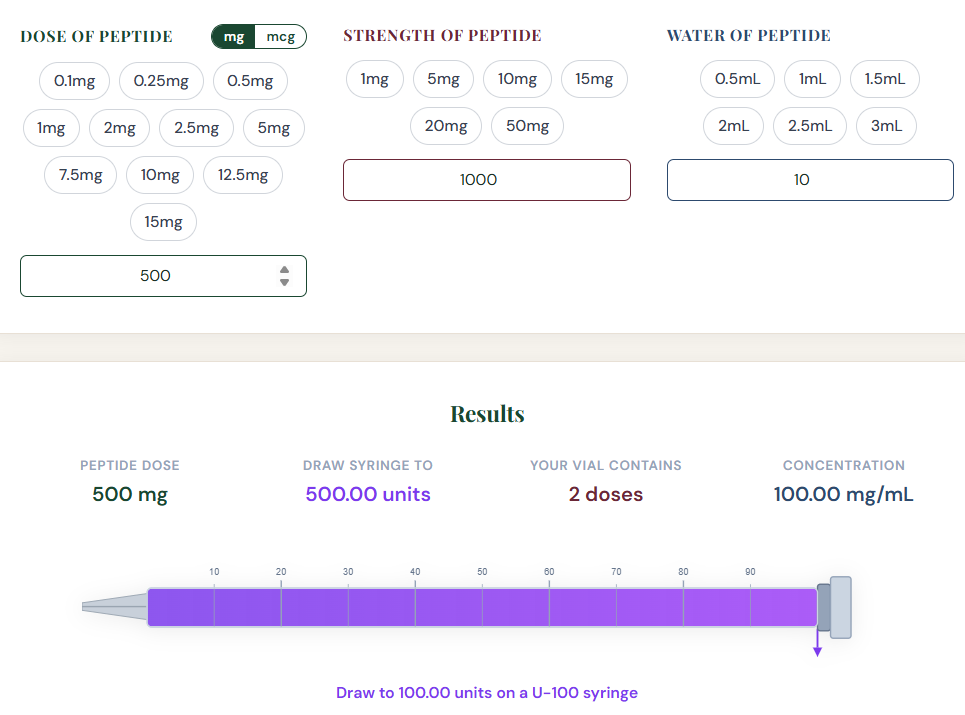
Draw Volume Reference
The correct syringe measurement depends on:
NAD+ amount in the vial
Volume of reconstitution solution used
Desired dose
Syringe type and size
Calculate Your Dosage
Need to work out the exact syringe measurement for your dose?
→ Click here to calculate your dosage
Enter your vial strength, reconstitution volume and desired dose.
Important: The Scale Problem
NAD+ measurement does not behave like peptide measurement, and this is where people get caught.
U-100 insulin syringes are calibrated for small volumes. A 500 mg NAD+ dose will frequently exceed the capacity of one, meaning a different syringe or multiple draws. Check this before dose day, not during it.
The dose range is four-fold. 250 mg to 1000 mg per session. That is a wider spread than most compounds here, and at a given concentration it is the difference between a manageable injection and one you will not want to repeat.
Vial strengths vary more than anywhere else in this library. 500 mg and 1000 mg vials look identical as powder. A draw volume worked out for one delivers double or half the intended dose from the other.
Always confirm your vial strength, your reconstitution volume and your syringe type before drawing.
Protocol
Original classroom lesson. Preparation, measurement, sourcing, or protocol examples are source material, not verified instructions or clinical guidance.
NAD+ Dosing Protocol
NAD+ protocols vary considerably by route, goal and tolerance. The following framework is provided for educational reference and should not be treated as an established clinical dosing guideline.
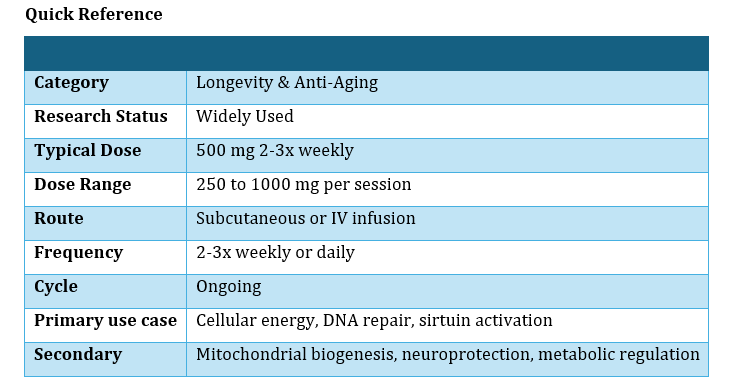
Typical Dose
Dose: 500 mg, 2 to 3 times weekly
Dose Range: 250 to 1000 mg per session
Frequency: 2 to 3 times weekly, or daily at lower doses
Route: Subcutaneous injection or IV infusion
Cycle Length: Ongoing
Ongoing is Not the Same ss Forever
NAD+ is one of the few compounds here without a defined cycle length, on the reasoning that it addresses an ongoing age-related decline rather than a discrete problem.
Read that as an absence of cycling data, not as evidence that indefinite use has been shown safe or beneficial. No long-term human trials establish what continuous injectable NAD+ does over years. Ongoing describes how people use it, not what has been studied.
Route Changes Everything
IV infusion: Highest bioavailability. Administered slowly, typically over an hour or more, because rate drives the side effects. Usually done in a clinical setting.
Subcutaneous injection: Lower bioavailability, far more practical, self-administered. The route most people use.
These are not interchangeable at equal doses. Bioavailability differs substantially, and a protocol written for one route does not transfer to the other.
Rate Matters More than Dose for Tolerability
The defining practical fact about NAD+. Flushing, nausea and headache are driven primarily by how fast it goes in, not how much.
This is why IV protocols run slowly, and it is why people who find NAD+ intolerable often find that the problem was administration speed rather than the compound.
Clinical Notes
IV infusion provides the highest bioavailability. Administer slowly to minimise flushing.
Start at the lower end of the dose range and establish tolerance before increasing.
Can be combined with NMN or NR, though note you are then supplying both the finished molecule and its precursors, which is a reasonable strategy but not additive in the way it is often presented.
Flushing is not a signal that it is working. It is a response to administration rate.
Consult a qualified healthcare professional before using experimental products.
Side Effects and Safety
Flushing, especially with rapid IV administration
Nausea
Headache
Transient fatigue
Injection site discomfort
Most of these are rate-dependent and dose-dependent rather than inherent. Slowing administration resolves the majority of them.
Research References
Stacking & Combinations
Original classroom lesson. Preparation, measurement, sourcing, or protocol examples are source material, not verified instructions or clinical guidance.
Understanding why compounds are combined is more useful than memorizing someone else's stack. The goal is to evaluate whether each addition has a clear purpose, a complementary mechanism and a place in the overall protocol.
The Rule
Compounds make sense in a stack when they work through different mechanisms toward the same outcome.
NAD+ is the clearest exception to how that rule usually gets applied, and it is worth understanding why.
NAD+ Is a Substrate, Not a Signal
Almost every other compound in this course is a signal. It instructs a cell to do something.
NAD+ is the material those instructions consume. That makes it foundational rather than parallel: it does not compete with other compounds for mechanism, it supplies something several of them depend on.
The strongest case for NAD+ in a stack is when something else in that stack is NAD+-dependent. Sirtuin-driven processes are the obvious example. Stimulating sirtuins while NAD+ is depleted is pressing an accelerator with an empty tank.
The weakest case is adding it to a stack where nothing is NAD+-limited, on the general reasoning that energy is good. That is not a mechanism, it is a vibe, and it is the most expensive vibe in this library.
What Pairs With NAD+, and Why
NAD+ + MOTS-c. High synergy. Both mitochondrial, and this is where the substrate framing earns its keep. NAD+ supplies the material. MOTS-c signals how it gets used through AMPK. Supply plus instruction, not two copies of the same thing.
NAD+ + Epitalon. High synergy. Different aging layers. NAD+ for cellular energy and DNA repair capacity. Epitalon for telomere biology. Minimal mechanistic overlap.
NAD+ + GHK-Cu. Complementary. GHK-Cu drives tissue repair and collagen synthesis, both energy-expensive processes. NAD+ supports the energy side. Reasonable rationale, and note it is an indirect one.
NAD+ + Methylene Blue. High synergy. Both touch mitochondrial electron transport, from different positions in the chain. Check this one carefully rather than accepting the label, since two compounds acting on the same system is exactly the situation where overlap can quietly become redundancy.
NAD+ + NMN or NR. Common, and worth thinking through. You are supplying the finished molecule and its precursors simultaneously. Defensible if you are hedging on delivery uncertainty. Redundant if you assume both work perfectly.
Four Questions Before Adding Anything
1. What specific mechanism does this add?
For NAD+, the sharper question is what in your stack is NAD+-dependent. If nothing is, the rationale is thin.
2. Does it overlap with something already in the stack?
Particularly relevant with mitochondrial compounds, where several share terminology without sharing mechanism.
3. Do I understand what it does independently?
Every compound should have a clear rationale before it becomes part of a combination.
4. Can I tell which compound produced the effect?
Difficult here. NAD+ produces a felt sensation during administration and largely invisible effects afterward. The sensation is not the effect, which makes self-assessment unusually unreliable.
The Question Specific to This Compound
Is anything in your stack actually limited by NAD+ availability?
That is the question that determines whether NAD+ belongs in your protocol or is simply the most expensive thing in it. Foundational is a real property, and it is also the easiest word in this field to use as a substitute for a reason.
A Word on Aggressive Stacking
Longevity stacks grow faster than any other category, because every compound has a plausible rationale and none produce an obvious signal telling you whether they are working.
More compounds do not automatically mean better results. More compounds mean more variables, more cost, more potential interactions and less clarity about what is producing an effect.
NAD+ deserves particular scrutiny on cost. At 500 mg two to three times weekly it is frequently the largest line item in a protocol, and it is often the component with the least direct evidence behind its route of administration.
The goal is not to build the biggest stack. The goal is to build one
Certificate of Analysis
Report concerns a submitted sample and identified lot only; authenticity has not been independently verified. A report covers a submitted sample or lot, not safety, sterility, effectiveness, or every product sold. Its provenance has not been independently authenticated.
Open attached COAAll classroom topics