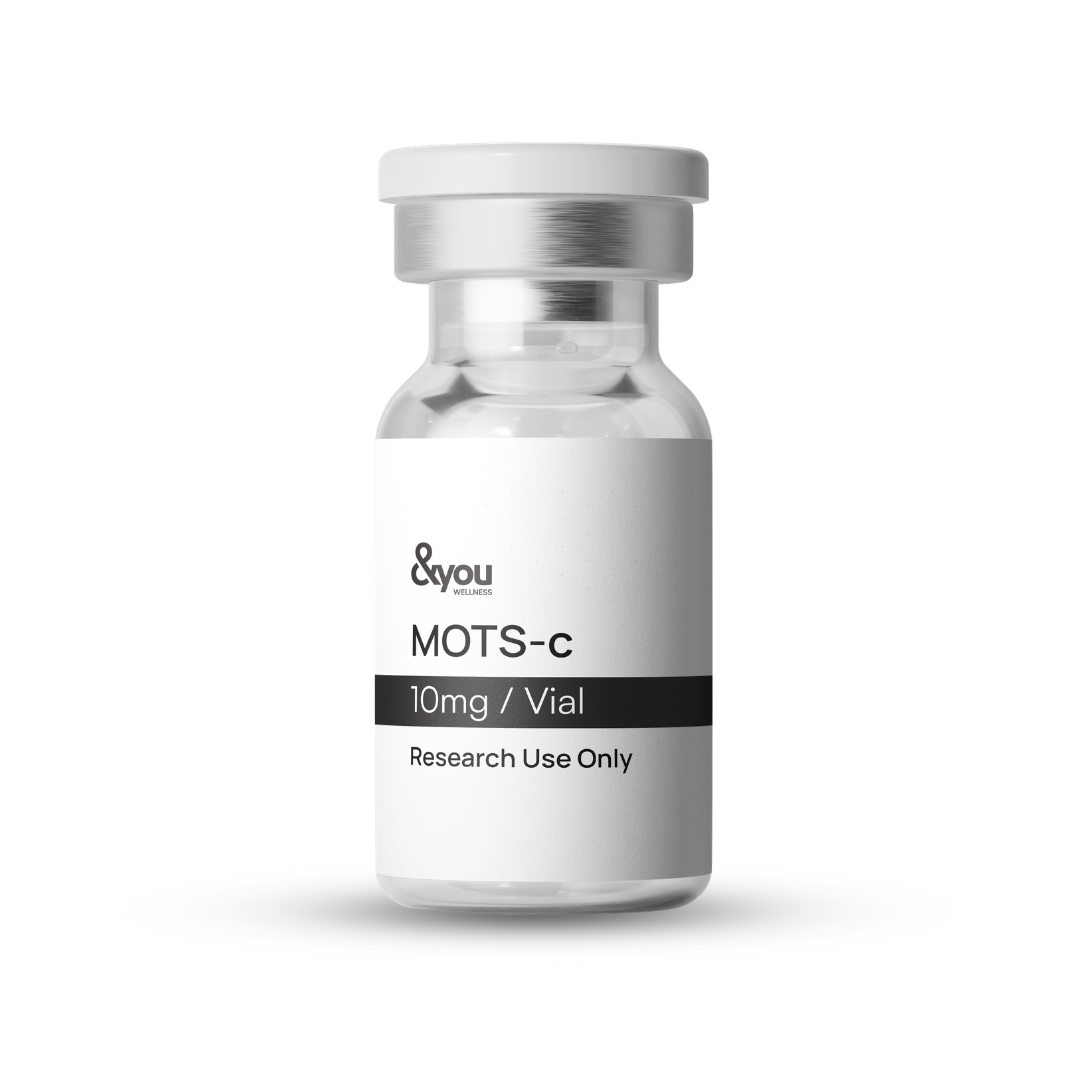
MOTS-c
A mitochondria-derived peptide studied in metabolic and aging-related research, mainly before human trials.
This material is educational, not medical advice or a treatment recommendation. Classroom claims and example protocols have not all been independently verified.
The Compound, Explained
Category: Longevity & Anti-Aging
Compound: MOTS-c (Mitochondrial Open Reading Frame of the 12S rRNA type-c)
Research Status: Preclinical
Regulatory Status: Recommended for compounding eligibility by the FDA Pharmacy Compounding Advisory Committee, July 23 2026. Non-binding. Not FDA approved.
What This Is
A peptide encoded by your mitochondria rather than by your cell nucleus.
That sentence is easy to skim past, so slow down on it. Almost every protein in your body is built from instructions in nuclear DNA. Mitochondria carry their own separate small genome, a leftover from their origin as independent organisms that were absorbed into our cells more than a billion years ago.
MOTS-c is coded in that genome. It is a signal your mitochondria produce and send out to the rest of the cell.
Why That Origin Matters
Mitochondria have been taught for decades as the powerhouse of the cell, a component that produces energy and does little else.
That framing is incomplete. Mitochondria also act as sensors and communicators. They monitor the cell's energy state and issue signals based on what they detect. MOTS-c is one of those signals, part of a class called mitochondrial-derived peptides.
The practical implication: MOTS-c is not a compound that pushes on metabolism from outside. It is a message your own mitochondria send under stress, and levels decline with age. The rationale for using it is restoration of a signal that has weakened, which is the same structural argument you saw with GHK-Cu.
What It Is Being Studied For
Insulin sensitivity and glucose handling
Exercise capacity and endurance
Inflammation
Lifespan extension, in animal models
Healthy aging more broadly
The Exercise Mimetic Framing
You will see MOTS-c described as an exercise mimetic, meaning it activates some of the same cellular pathways exercise activates.
Read that phrase precisely. It means a shared downstream pathway, primarily AMPK, is switched on. It does not mean it substitutes for training. Exercise produces mechanical loading, cardiovascular adaptation, neurological adaptation and hormonal responses that no peptide reproduces.
Sharing one pathway with exercise is not the same as replacing exercise, and the compounds most often oversold in this field are the ones where that distinction gets blurred.
Who This Is For
People building a longevity protocol who want the mitochondrial and metabolic layer covered.
People whose primary interest is glucose handling and metabolic health rather than body composition.
People who understand they are working with a preclinical compound with thin human data and are comfortable with that.
Inside the Mechanism
Origin
MOTS-c is encoded within the mitochondrial 12S rRNA gene. It is produced inside the mitochondria, then moves out into the cytoplasm and, under stress, translocate to the cell nucleus.
That movement is the mechanism. A signal generated in one organelle travels to the control center of the cell and changes what gets expressed there. Mitochondria are not just responding to the cell's demands, they are issuing instructions back.
The Trigger Is Stress
MOTS-c activity increases under metabolic stress: exercise, fasting, energy shortage. It is part of the cell's adaptive response to running low on fuel.
This matters for how you think about the compound. It is not a signal your body produces at rest. It is one it produces when challenged, which is why the pathways it touches overlap so heavily with the pathways exercise and caloric restriction touch.
Activates AMPK
AMP-activated protein kinase. The central mechanism, and worth understanding properly rather than accepting as a label.
AMPK is a cellular fuel gauge. It monitors the ratio of spent to available energy inside the cell. When energy runs low, AMPK activates and switches the cell's priorities:
Toward burning stored fuel, glucose uptake into muscle, fatty acid oxidation, mitochondrial biogenesis.
Away from energy-expensive building processes that can wait.
This is the same pathway metformin acts on, and the same pathway exercise and fasting activate. It is one of the most studied targets in longevity biology.
Practical consequence: improved glucose uptake by muscle, which is the basis of the insulin sensitivity findings, and increased mitochondrial biogenesis, which is the basis of the endurance findings.
Improves Glucose Handling
By promoting glucose uptake into skeletal muscle through AMPK, MOTS-c reduces the burden on insulin signaling. Muscle is the largest sink for blood glucose in the body, so changes in how efficiently it takes up glucose have systemic effects.
This is the most consistently reproduced finding across the animal work.
Anti-Inflammatory Effects
Reported across studies, with mechanism less clearly established than the AMPK pathway. Metabolic dysfunction and chronic inflammation are tightly linked, so improvement in one often shows up as improvement in the other. Which direction the causation runs is not settled here.
Endurance and Exercise Capacity
Animal studies report improved running capacity. Proposed mechanisms are increased mitochondrial biogenesis, meaning more mitochondria, and improved substrate utilization, meaning better fuel efficiency.
Note the population these results came from. Improvement in aged or metabolically impaired animals is not the same result as improvement in healthy trained ones, and those two get quoted interchangeably.
Lifespan
Extension has been reported in animal models. Every serious caveat about animal lifespan research applies, and the next tab covers them.
What the Research Actually Shows
Read the Status Tag First
MOTS-c is tagged Preclinical, and here that tag is doing heavy lifting.
The evidence base is animal studies and cell work. Human data exists but is limited, mostly observational and small. There are no large randomized controlled human trials.
MOTS-c was only identified in 2015. Compare that to BPC-157's roughly thirty years of research, which is itself still preclinical. MOTS-c is a young compound, and the enthusiasm around it currently runs well ahead of the evidence behind it.
Preclinical does not mean unproven or fake. It means the research is real and has not passed the stage where human safety and efficacy get established at scale.
The Evidence Hierarchy
In vitro. Cells in a dish. Tells you a mechanism is possible.
Animal model. Usually rodent. Tells you the mechanism operates in a living system.
Human observational. No control group. Confounded by everything.
Human randomized controlled trial. This is where "proven" becomes an appropriate word.
MOTS-c sits in the first two tiers, with some observational human work. Compare it against Retatrutide in this same course, which sits at the top tier with tens of thousands of participants. Both are in your peptide library. They are not the same kind of claim, and treating them as equivalent is the error this section exists to prevent.
The Specific Problem With Lifespan Studies
Lifespan extension is the headline claim, and it deserves the most scrutiny of anything in this module.
Species matters enormously. Lifespan extension in worms, flies and mice has a poor record of translating to humans. Many interventions extend rodent lifespan. Almost none have demonstrated the same in people.
Baseline health matters. Extension is easier to demonstrate in short-lived or metabolically impaired animals than in healthy ones. A result showing recovery from an impaired state is different from a result showing extension beyond a healthy baseline.
Timescale makes it hard to test. A human lifespan trial is impractical, which is why researchers use surrogate markers instead. Those markers are proxies, not the outcome.
None of this makes the research worthless. It means "extends lifespan" should be read as "extended lifespan in this species, under these conditions," which is a much narrower statement than the one usually repeated.
Sample Size and Duration
Find the n. Human MOTS-c studies to date are small.
Small studies produce dramatic effect sizes more often than large ones, and those effects usually shrink when repeated at scale. That is one of the most reliable patterns in science.
Also find the duration. A longevity compound assessed over eight weeks is being assessed on surrogate markers, not on longevity.
The July 2026 Committee Vote
On July 23 2026 the FDA's Pharmacy Compounding Advisory Committee voted on seven peptides.
Recommended: BPC-157, KPV, TB-500, MOTS-c, Epitalon, Semax
Not recommended: Emideltide, also known as DSIP
MOTS-c was recommended.
What it means. The committee found the evidence sufficient to recommend it be eligible for pharmacy compounding.
What it does not mean. FDA approval. The vote is non-binding, the FDA determines separately, and no compound on that list is approved to treat any condition.
Worth Noticing: The committee assessed each compound individually rather than as a block, and the compound it rejected, DSIP, has more consumer interest than several that passed. Popularity and evidence are separate variables.
Holding Both Facts
MOTS-c has a genuinely novel mechanism, a well-characterized pathway in AMPK, and a positive committee recommendation. It also has under a decade of research history, no large human trials, and its most quoted claim rests on animal lifespan data.
Hold both at once. That is what research literacy is, and it is more useful than either uncritical enthusiasm or blanket dismissal.
Sourcing & Verification
Original classroom lesson. Preparation, measurement, sourcing, or protocol examples are source material, not verified instructions or clinical guidance.
MOTS-c produces nothing you can feel. No appetite change, no energy shift, no physical signal of any kind. If your vial contained nothing at all, the experience would be roughly identical.
That is what makes sourcing different here. With most compounds a bad vial eventually announces itself through absent results you were expecting to notice. This one never will. A mislabeled, underdosed or contaminated vial produces nothing, and nothing is also what a correct vial feels like.
The COA is not a formality on this compound. It is the only feedback you get.
What to Verify on This Compound
Two things carry unusual weight with MOTS-c, and neither is purity.
Manufacturing history. MOTS-c was identified in 2015. Fewer suppliers have long track records with it than with compounds that have been in production for decades. A supplier's reputation is earned per compound, not transferred across a catalogue. Someone reliable on BPC-157 is unproven on this until their documentation says otherwise.
Identity over purity. Purity tells you how clean the material is. Identity tells you what it is. On a compound producing no felt signal, identity confirmation by mass spectrometry is the only thing standing between you and twelve weeks of injecting the wrong thing. Insist on it, on the same document as the purity figure.
The COA Standard
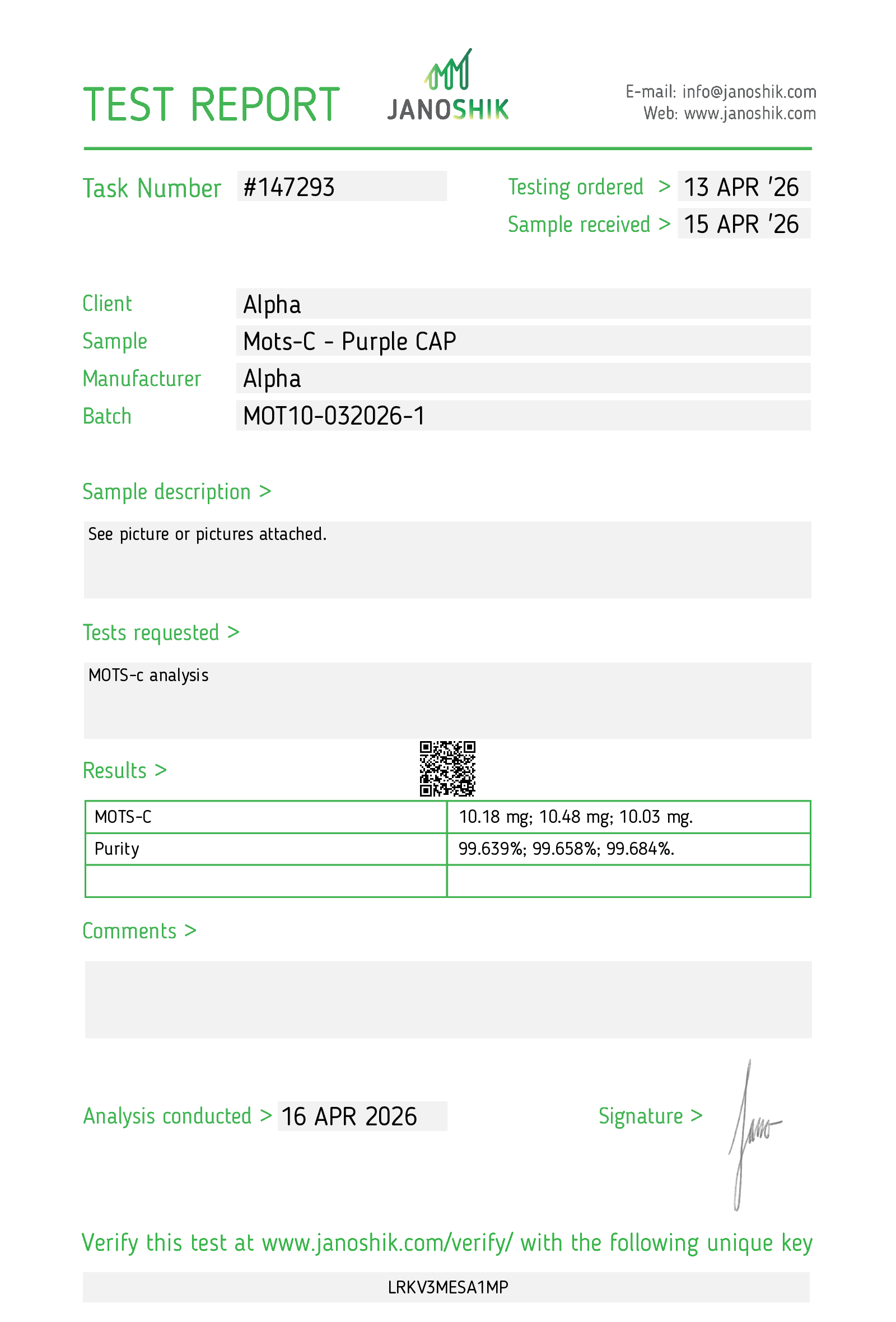
A valid COA names the testing laboratory, carries a batch number matching your vial, states a test date, gives purity with the method used, and confirms identity. Anything answering "available on request," or arriving as a screenshot with no traceable source, is not a COA.
Ask whoever you currently buy from for a COA on your specific MOTS-c batch. Whatever happens next tells you everything.
Storage
Lyophilized powder: cool, dry place. Reconstituted: refrigerate, use within 30 days.
That 30 day window is shorter than most peptides in this library and it collides with the dosing schedule. Once every five days gives you six doses in a month. At 1 mg from a 10 mg vial you will discard most of it. Decide your reconstitution volume around the window, not around the vial size.
Preparation
Original classroom lesson. Preparation, measurement, sourcing, or protocol examples are source material, not verified instructions or clinical guidance.
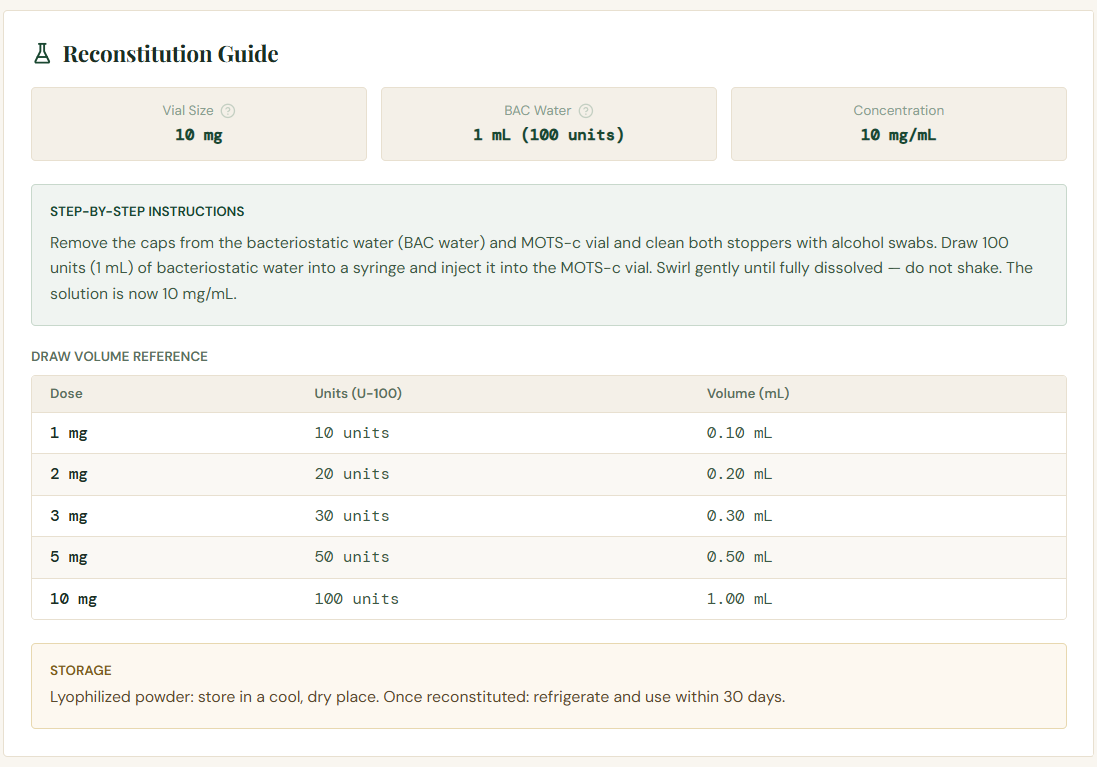
MOTS-c Reconstitution Guide
MOTS-c is supplied as a lyophilized powder requiring reconstitution. Vial strengths vary between suppliers, so always use the volume specified for your exact product.
The reference below reflects the most common configuration.
What you will Need:
MOTS-c peptide vial
Bacteriostatic water
Appropriate syringe
Alcohol pads
Step 1: Prepare and Sanitize
Wash your hands and prepare a clean workspace.
Remove the caps from both the bacteriostatic water and the peptide vial.
Clean both stoppers with alcohol pads and allow them to dry.
Step 2: Reconstitute
Draw 100 units (1 mL) of bacteriostatic water.
Insert the needle into the peptide vial and introduce the water slowly along the inside wall.
Avoid directing the stream forcefully onto the powder.
Step 3: Mix Gently
Important: Do not shake.
Gently swirl until fully dissolved. At the reference configuration the solution is now 10 mg/mL.
Step 4: Storage after Reconstitution
Refrigerate.
Use within 30 days.
Protect from heat and light.
Do not freeze unless the manufacturer specifically indicates it.
Important
The dosing interval interacts with the storage window here in a way it does not for daily compounds. Dosing once every five days means roughly six doses in a thirty day period. If your dose is small relative to vial size, you may not finish the vial before the solution should be discarded.
Work that out before you reconstitute rather than after.
Measurement
Original classroom lesson. Preparation, measurement, sourcing, or protocol examples are source material, not verified instructions or clinical guidance.
MOTS-c Measurement Guide
Learn how to convert your concentration into the correct syringe volume.
Calculator, pre-filled with MOTS-c defaults:
https://peptidetrainings.com/tools/reconstitution-calculator?label=MOTS-c
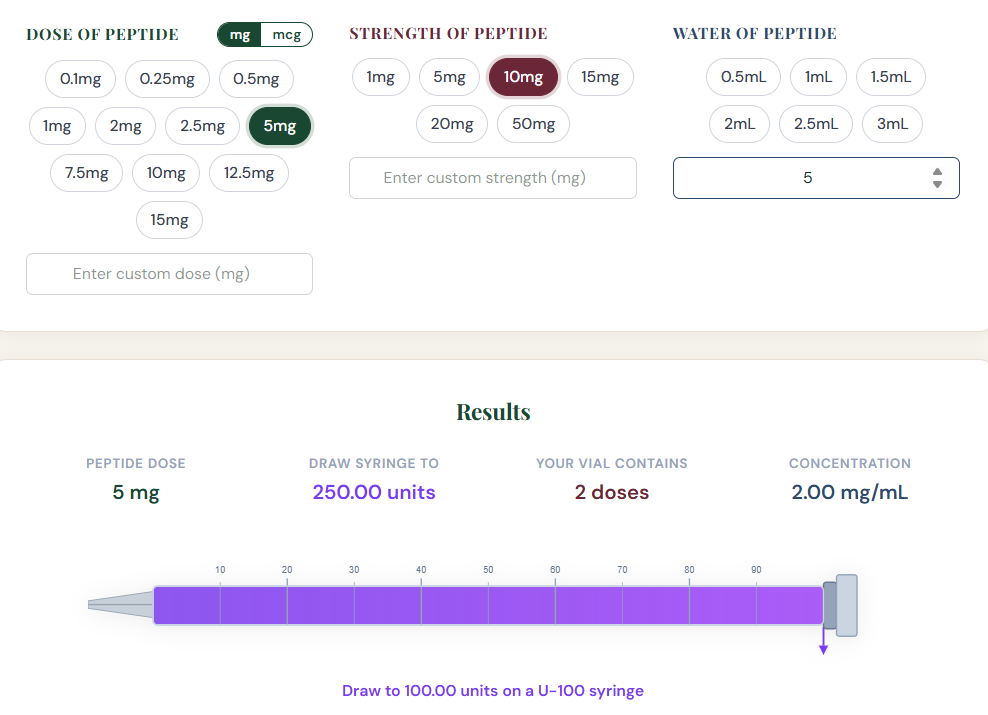
Draw Volume Reference
The correct syringe measurement depends on:
Peptide amount in the vial
Volume of reconstitution solution used
Desired dose
Syringe type and size
Calculate Your Dosage
Need to work out the exact syringe measurement for your dose?
→ Click here to calculate your dosage
Important
The table above is valid only at 10 mg/mL. Reconstitute the same 10 mg vial with 2 mL instead of 1 mL and every volume in that table doubles.
Note the range on this compound. 1 mg and 10 mg are both within the stated dose range, a tenfold spread, and at 10 mg/mL that is the difference between 10 units and the entire vial. Confirm which end of the range you are working at before you draw.
Always confirm your vial strength, your reconstitution volume and your syringe type.
Protocol
Original classroom lesson. Preparation, measurement, sourcing, or protocol examples are source material, not verified instructions or clinical guidance.
MOTS-c Dosing Protocol
MOTS-c protocols vary depending on individual goals, product concentration and response. The following framework is provided for educational reference and should not be treated as an established clinical dosing guideline.
Typical Dose
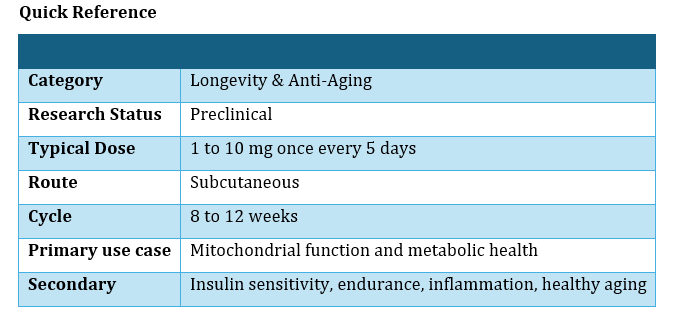
Dose: 1 to 10 mg once every 5 days
Dose Range: 1 to 10 mg per dose
Frequency: Once every 5 days
Route: Subcutaneous injection
Cycle Length: 8 to 12 weeks
The dosing Interval is Unusual
Once every five days does not align to a weekly calendar, which is the single most common practical failure with this compound. Your dose day moves through the week. Without something tracking it, adherence drifts within a fortnight.
Set a recurring reminder before you start, not after you have missed one.
Weeks 1 to 4: Initial Phase
Dose: Lower end of the range
Frequency: Once every 5 days
Purpose: Establish tolerance and observe response
Duration: 4 weeks
Weeks 5 to 12: Continuation
Dose: Maintained or adjusted upward within the stated range based on response
Frequency: Once every 5 days
Duration: To the end of the cycle
After the Cycle
Cycles typically run 8 to 12 weeks. Continuous indefinite use is not the standard framing. Time off allows assessment of what actually changed.
Clinical Notes
Start at the lower end of the range and adjust based on response rather than defaulting to the top of the range.
The range is wide, 1 to 10 mg, which reflects genuine uncertainty about optimal dosing rather than flexibility. There is no strong human data establishing where in that range the benefit sits.
Effects here are largely not subjective. Insulin sensitivity and mitochondrial function are not things you feel changing. If you want to evaluate this compound, decide in advance what you will measure, whether that is bloodwork, training metrics or something else, and take a baseline before you begin.
Relatively new peptide with limited long-term human data.
Consult a qualified healthcare professional before using experimental peptide products.
Side Effects and Safety
Limited data available
Injection site reactions
Generally appears well tolerated in studies
Read the first line as the most important one. A short side effect list on a compound identified in 2015 reflects a small amount of research, not an established safety record. Absence of reported effects and absence of effects are different statements, and with a young compound you cannot tell them apart.
Research References
1. MOTS-c: A Mitochondrial-Derived Peptide Regulating Metabolic Homeostasis, 2015
Stacking & Combinations
Original classroom lesson. Preparation, measurement, sourcing, or protocol examples are source material, not verified instructions or clinical guidance.
Understanding why compounds are combined is more useful than memorizing someone else's stack. The goal is to evaluate whether each addition has a clear purpose, a complementary mechanism and a place in the overall protocol.
The Rule
Compounds make sense in a stack when they work through different mechanisms toward the same outcome.
MOTS-c is a mitochondrial and metabolic compound, so the interesting pairings are ones addressing either a different aspect of mitochondrial function or a different layer of the aging process entirely.
Be careful with the word mitochondrial. Several longevity compounds carry that label while doing quite different things, and shared terminology is not the same as shared mechanism. Some of those pairings are complementary and some are redundant, and only reading the actual mechanism tells you which.
What Pairs With MOTS-c, and Why
MOTS-c + Epitalon. High synergy. Genuinely different layers. MOTS-c addresses mitochondrial and metabolic function. Epitalon addresses telomere biology. Two independent aging mechanisms, minimal overlap.
MOTS-c + NAD+. High synergy. Both act on cellular energy metabolism, so check for overlap. The distinction that justifies the pairing is that NAD+ is a substrate, the raw material for energy reactions, while MOTS-c acts on signalling that determines how that material is used. Supply plus instruction, not two copies of the same thing.
MOTS-c + SS-31. High synergy, and the cleanest example of complementary design in this course. SS-31 protects existing mitochondrial membranes from oxidative damage. MOTS-c drives biogenesis of new mitochondria. Protect what exists, build more. Neither does the other's job.
MOTS-c + Retatrutide. Complementary. Both metabolic, through unrelated pathways. Note that Retatrutide's effects will overwhelm and mask MOTS-c's entirely, so you will have no way to assess what MOTS-c contributed.
Four Questions Before Adding Anything
1. What specific mechanism does this add?
If you cannot identify what it contributes, there may not be a clear reason to add it.
2. Does it overlap with something already in the stack?
Especially relevant in longevity stacks, where several compounds carry the mitochondrial label while acting on different things. Read the mechanism, not the category.
3. Do I understand what it does independently?
Every compound should have a clear rationale before it becomes part of a combination.
4. Can I tell which compound produced the effect?
Sharpest here of anywhere in the course. MOTS-c produces effects you cannot feel. Add it to a four-compound longevity stack and you will never know whether it contributed anything at all.
The Question Specific to This Compound
How will you know it worked?
For most compounds there is a felt signal. Here there is not. If you cannot answer that question with a specific measurement and a baseline, adding MOTS-c to a stack means spending money on something you have no way to evaluate.
That is not an argument against the compound. It is an argument for running it deliberately.
A Word on Aggressive Stacking
Longevity stacks grow faster than any other category in this field, because every compound has a plausible-sounding rationale and none of them produce an obvious signal to tell you whether they are working.
More compounds do not automatically mean better results. More compounds mean more variables, more cost, more potential interactions and less clarity about what is producing an effect.
A smaller stack built around distinct mechanisms and a clear rationale is easier to understand and evaluate than a long list of overlapping compounds.
The goal is not to build the biggest stack. The goal is to build one that makes sense.
Certificate of Analysis
Report concerns a submitted sample and identified lot only; authenticity has not been independently verified. A report covers a submitted sample or lot, not safety, sterility, effectiveness, or every product sold. Its provenance has not been independently authenticated.
Open attached COAAll classroom topics