Melanotan II
An investigational melanocortin peptide with significant safety questions and no FDA-approved indication.
This material is educational, not medical advice or a treatment recommendation. Classroom claims and example protocols have not all been independently verified.
The Compound, Explained
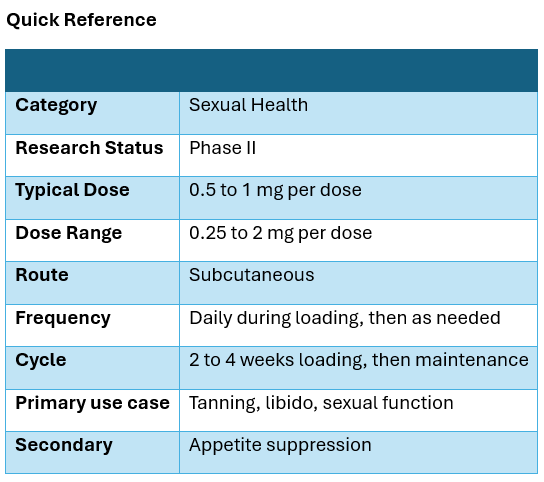
Category: Sexual Health
Compound: Melanotan II (MT-2)
Research Status: Phase II
Regulatory Status: Not FDA approved. Not approved in any major jurisdiction. Several national health agencies have issued consumer warnings about it.
Start With the Safety Issue
Most modules in this course put safety in the Protocol tab. This one leads with it, because the risk profile shapes every other decision about this compound.
Melanotan II darkens existing moles and may stimulate new ones.
That is not a cosmetic side effect. Changes in moles are precisely what dermatologists screen for as early signs of melanoma, and this compound acts directly on the cells involved in pigmentation.
The practical consequences:
Anyone with a personal or family history of melanoma or skin cancer should not use this compound.
Anyone with a significant number of atypical or unusual moles should not use this compound.
Anyone who does use it should have a full skin check before starting and monitor moles throughout.
There is also a second-order problem worth understanding. Even if the compound itself caused no increase in risk, darkening existing moles makes the visual screening that detects melanoma harder to interpret. You are altering the appearance of the exact thing that gets examined.
Everything else in this module is written on the assumption you have read this section.
What This Is
A synthetic analog of alpha-melanocyte-stimulating hormone, the hormone that regulates pigmentation.
It was developed as a sunless tanning agent. The sexual arousal effects were discovered during that research as an unintended finding, and for many users those became the primary reason to take it.
The PT-141 Relationship
Important context, and it runs the opposite direction to what people assume.
PT-141, covered in its own module, was developed from Melanotan II. Researchers isolated the sexual function effects and removed the pigmentation activity.
So PT-141 is the refined version. It is FDA approved, purpose-built for sexual dysfunction, and does not carry the tanning or mole-darkening effects.
Melanotan II is the original broad compound. It does more things and it does them less selectively.
That framing matters for the most common decision people face here: if what you want is the sexual function effect, PT-141 was specifically designed to deliver it without the part of this compound that carries the risk.
Broad Activation Is the Defining Feature
Melanotan II activates the melanocortin receptor family generally rather than selectively.
MC1R, in skin cells, drives melanin production. Tanning.
MC3R and MC4R, in the brain, influence sexual arousal and appetite. Libido and appetite suppression.
Everything this compound does, and everything it causes, comes from hitting all of these at once.
That breadth is why it has three distinct effects people want, and it is why the side effect profile is heavier than any targeted compound in this library. There is no way to get one effect without the others, because the mechanism does not separate them.
Who This Is For
Given the above, the honest answer is narrow.
People who want the tanning effect specifically, understand the mole risk, have no personal or family history of skin cancer, and have had a dermatological assessment.
People who have considered PT-141 for the sexual function effects and have a specific reason for choosing this instead.
If you have not had a skin check, you are not in a position to make this decision yet.
Inside the Mechanism
The Melanocortin Receptor Family
Five receptors, MC1R through MC5R, governing quite different things. Melanotan II activates several.
MC1R, in skin. Melanocytes are the cells that produce melanin. MC1R activation increases melanin production, which darkens skin.
Worth understanding how this works: the tan is real melanin, chemically the same as a sun-induced tan. This is why UV exposure is still needed to activate the effect, since the process is a pigmentation response rather than a dye.
It is also the mechanism behind the mole issue. Moles are concentrations of melanocytes. A compound that stimulates melanocytes stimulates the ones in moles too.
MC3R and MC4R, in the brain. Located in the hypothalamus and limbic system, involved in sexual arousal and in appetite regulation.
MC4R in particular is a well-established appetite pathway, which is why appetite suppression appears reliably rather than incidentally.
Why the Side Effects Are What They Are
Every listed effect traces to the same broad activation.
Nausea. Melanocortin receptors are present in regions involved in nausea signalling. Very common, and dose-related.
Facial flushing. Vascular effect of melanocortin activation.
Spontaneous erections. Direct consequence of MC3R and MC4R activation, listed as both a benefit and a side effect depending on context.
Fatigue and yawning. A distinctive and well-documented melanocortin effect.
Increased blood pressure. Melanocortin activation affects cardiovascular regulation.
Mole darkening. MC1R activation in existing melanocyte concentrations.
None of these are unpredictable reactions. They are the expected consequences of the mechanism, which is what non-selective activation means in practice.
Compare With PT-141
Placing them side by side makes the design decision clear.
PT-141 was engineered to reduce MC1R activity while retaining MC3R and MC4R activation. The result is sexual function effects with substantially less pigmentation activity.
Melanotan II retains full MC1R activity, which is the point if you want tanning and the liability if you do not.
The mechanism does not let you choose. If you are taking Melanotan II for libido, you are also taking a melanocyte stimulant.
UV Exposure Is Still Required
Worth being clear about, since it is often misunderstood.
Melanotan II increases your capacity to produce melanin. It does not produce a tan on its own. Some UV exposure is needed to trigger the response.
That creates a situation worth naming: people using a compound that stimulates melanocytes are also exposing themselves to UV, which is the primary environmental risk factor for skin cancer. Those two things are happening at the same time in the same tissue, and any protective effect against UV damage is not established well enough to offset that.
What the Research Actually Shows
Read the Status Tag First
Melanotan II is tagged Phase II. Human clinical work exists, primarily the 1999 and 2003 research on sexual function and melanocortin receptors.
What did not happen is the rest of the pathway. Melanotan II was never approved anywhere. Development moved toward PT-141, the refined derivative, which is what ultimately reached approval.
That is informative. A development programme that produced a compound, identified a problem with it, engineered a cleaner version and pursued that instead is telling you something about the original.
The Regulatory Position Is Worth Reading
Melanotan II is unapproved in every major jurisdiction, and several national health agencies have issued consumer warnings about unlicensed tanning injections.
Compare that against the rest of this library. Preclinical compounds like BPC-157 are unapproved because the trials have not been done. Melanotan II is unapproved in a context where regulators have actively commented on it.
Those are different situations, and the distinction is worth holding.
What Is and Is Not Established
Reasonably Established: The pigmentation effect works. The sexual arousal effect is real and was reproduced well enough to justify developing PT-141 from it. Appetite suppression occurs.
Not Established: Long-term safety. The magnitude of any melanoma risk. Whether the protective effect against UV damage is meaningful. Optimal dosing in any population.
The efficacy claims are better supported than the safety claims, which is the opposite of what you want in a compound with this side effect profile.
The Melanoma Question, Honestly
This is the question that matters and the honest answer is that it is not settled.
What is known: Melanotan II stimulates melanocytes. Mole darkening and new mole appearance are reported. Case reports exist in the dermatological literature describing changes in moles, and melanoma diagnoses, in Melanotan II users.
What is not known: Whether the compound causes melanoma, or whether it changes the appearance of existing lesions and brings people to a dermatologist who then finds something that was already there. Case reports establish that something was observed, not that a compound caused it.
Why the uncertainty does not resolve in the compound's favour. Establishing a causal link between an exposure and a cancer requires long-term population studies that have not been done and are unlikely to be. Absence of that evidence is not reassurance, particularly for a compound whose mechanism acts directly on the cell type involved.
The reasonable position: the risk is unquantified, the mechanism provides a plausible basis for concern, and the consequence if the concern is correct is severe. That combination justifies caution regardless of how the question eventually resolves.
The Screening Interference Problem
Separate from whether the compound causes anything, and arguably more immediate.
Melanoma is detected primarily by visual examination of moles, looking for changes in size, shape, colour and border.
Melanotan II changes the colour of moles. That makes the screening signal harder to read, for you and for a dermatologist.
This applies whether or not the compound carries any independent risk, and it is the strongest argument for the baseline skin check and ongoing monitoring in the Protocol tab.
The July 2026 Committee Vote
On July 23 2026 the FDA's Pharmacy Compounding Advisory Committee voted on seven peptides.
Recommended: BPC-157, KPV, TB-500, MOTS-c, Epitalon, Semax
Not recommended: Emideltide, also known as DSIP
Melanotan II was not among the seven assessed. Its absence carries no evaluative meaning on its own, and it should be read alongside its broader regulatory position rather than in isolation.
Holding Both Facts
Melanotan II does what people say it does. The tanning is real, the libido effect is real and well enough documented to have spawned an approved derivative, and the appetite suppression is consistent.
It is also unapproved everywhere, carries an unquantified melanoma question with a plausible mechanism behind it, interferes with the screening that detects melanoma, and was superseded by a refined version that removed the problematic part.
Hold both at once. This is a compound where the second list should carry more weight than it usually does, and where an honest read means the case for caution is stronger than for anything else in this library.
Sourcing & Verification
Original classroom lesson. Preparation, measurement, sourcing, or protocol examples are source material, not verified instructions or clinical guidance.
Melanotan II is unapproved everywhere, which means there is no legitimate pharmaceutical version to compare against. Everything available is research-grade.
What to Verify on This Compound
Identity, against PT-141 and Melanotan I. Three related melanocortin compounds share this market with different effects and different prices. Melanotan I, afamelanotide, is a different molecule with a different profile. Mass spectrometry identity confirmation distinguishes them, and a purity figure does not.
No pharmaceutical reference point. With tirzepatide or sermorelin you can compare a research-grade product against a known pharmaceutical standard. Here there is no approved product to benchmark against, which puts more weight on documentation than usual.
Blood pressure makes contamination consequential. This compound raises blood pressure on its own. Impurities in a product that already carries a cardiovascular effect are a different proposition from impurities in an inert one. Ask for the impurity profile rather than a headline number.
Before You Source At All
This compound has a prerequisite that no other module in this library has.
Get a full skin check first. A dermatological baseline before you start is not optional with a compound that alters the appearance of moles. Without it, any change you notice later has nothing to compare against.
If you have not done this, sourcing is premature.
The COA Standard
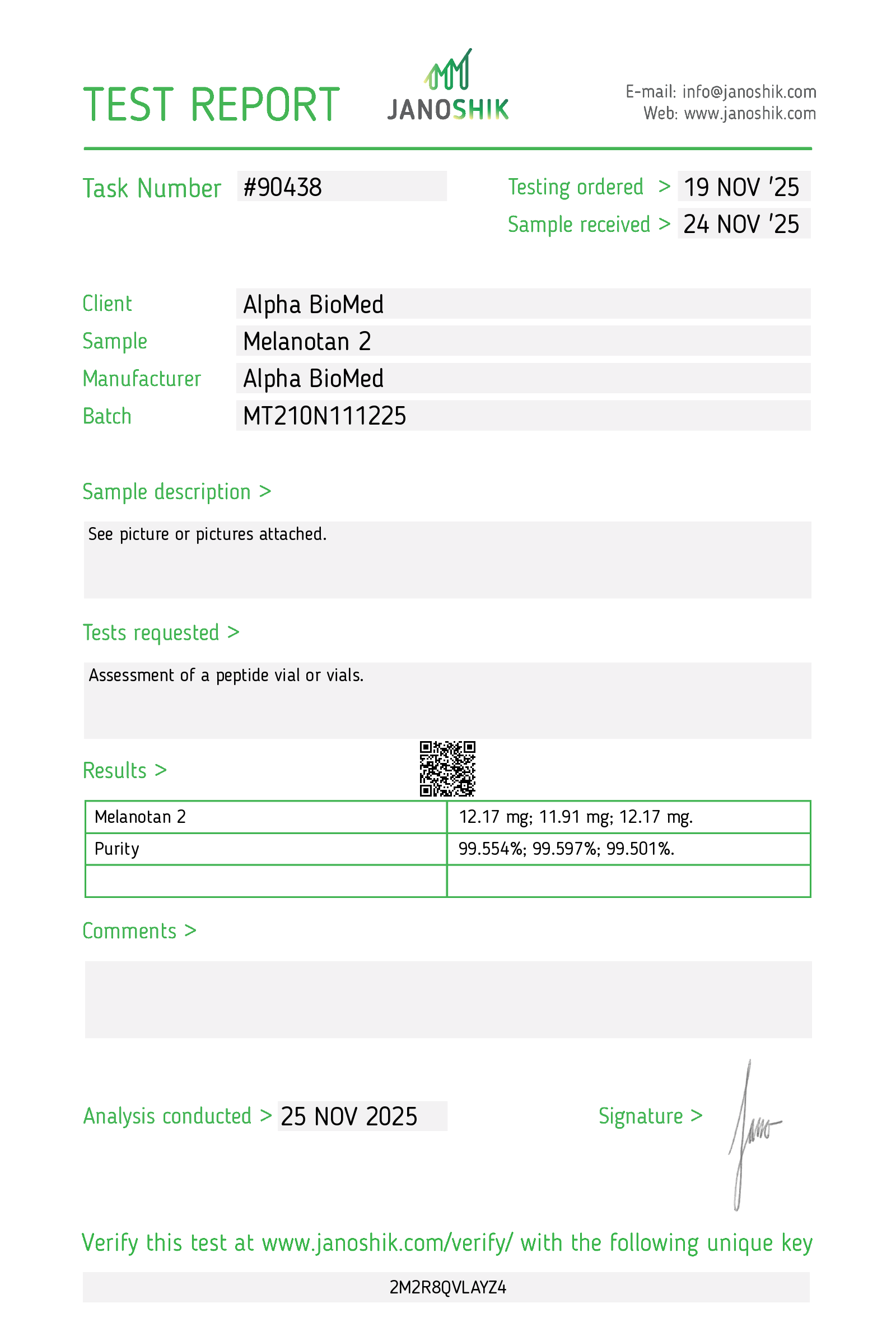
A valid COA names the testing laboratory, carries a batch number matching your vial, states a test date, gives purity with the method used, and confirms identity. Anything answering "available on request," or arriving as a screenshot with no traceable source, is not a COA.
Storage
Lyophilized Powder: Cool, dry, protected from light. Reconstituted: refrigerate, protect from light, follow the manufacturer's window.
The usage pattern shifts from daily during loading to as-needed afterward, which means a vial may sit for a long time. Write the reconstitution date on it, since you will not be prompted by running out.
Preparation
Original classroom lesson. Preparation, measurement, sourcing, or protocol examples are source material, not verified instructions or clinical guidance.
Melanotan II Reconstitution Guide
Vial strengths vary between suppliers, so always use the volume specified for your exact product.
Reference Configuration
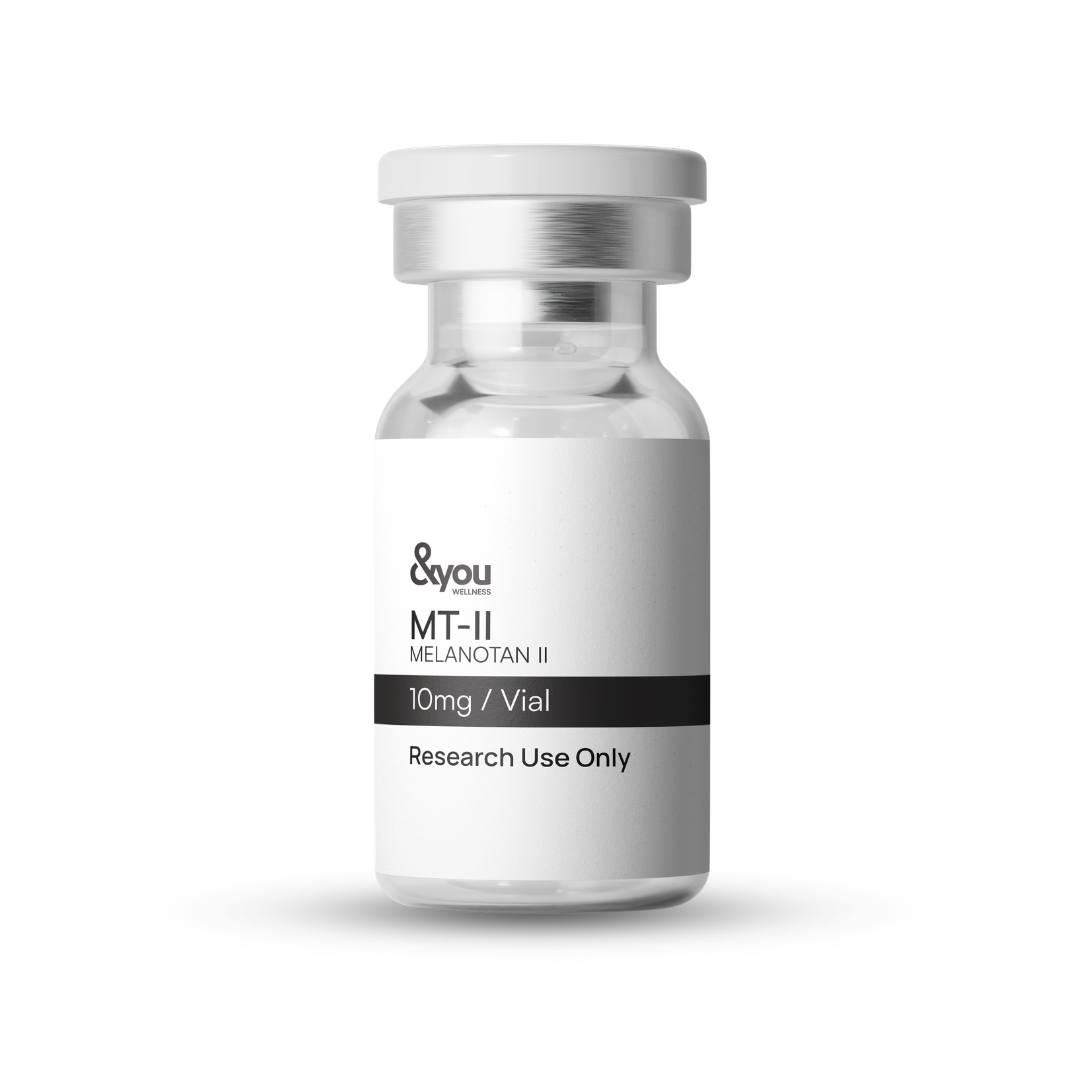
Vial Size: 10 mg
Bacteriostatic Water: 2 mL
Resulting Concentration: 5 mg/mL
What you will Need:
Melanotan II vial
Bacteriostatic water
U-100 insulin syringes
Alcohol pads
Step 1: Prepare and Sanitize
Wash your hands and prepare a clean workspace.
Remove the caps from both the bacteriostatic water and the peptide vial.
Clean both stoppers with alcohol pads and allow them to dry.
Step 2: Reconstitute
Draw 2 mL of bacteriostatic water.
Insert the needle and introduce the water slowly along the inside wall.
Avoid directing the stream forcefully onto the powder.
Step 3: Mix Gently
Do not shake. Swirl gently until fully dissolved.
Step 4: Storage after Reconstitution
Refrigerate.
Protect from light.
Follow the manufacturer's window.
Do not freeze unless specifically indicated.
The Concentration Problem Specific to This Compound
At 5 mg/mL, a starting dose of 0.25 mg is 5 units on a U-100 syringe.
Five units is at the low end of what an insulin syringe measures accurately. On a compound where nausea is dose-related and starting low is the standard advice, that is a real problem.
The fix is more water. Reconstituting the same 10 mg vial with 4 mL gives 2.5 mg/mL, and a 0.25 mg dose becomes 10 units, which is far easier to read.
This is one of the few places in this library where deviating from a reference reconstitution volume is the better choice. Work out your starting dose first, then choose a concentration that puts it in a readable range.
Measurement
Original classroom lesson. Preparation, measurement, sourcing, or protocol examples are source material, not verified instructions or clinical guidance.
Melanotan II Measurement Guide
Calculator, pre-filled with Melanotan II defaults: https://peptidetrainings.com/tools/reconstitution-calculator?label=Melanotan%20II
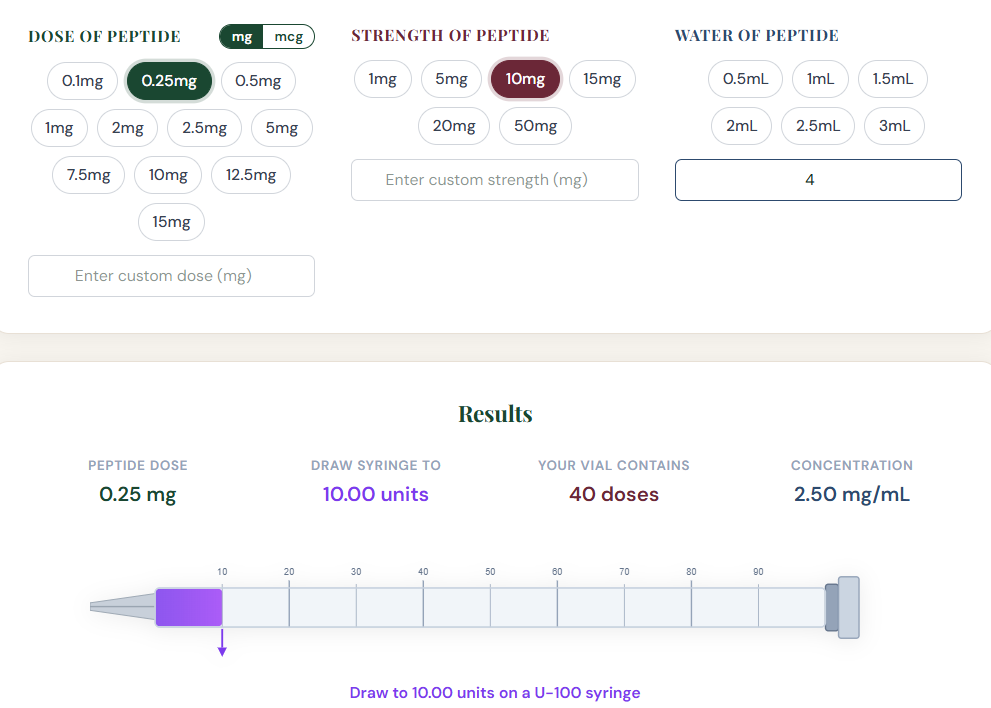
Draw Volume Reference
At 10 mg reconstituted with 2 mL, giving 5 mg/mL, on a U-100 syringe:
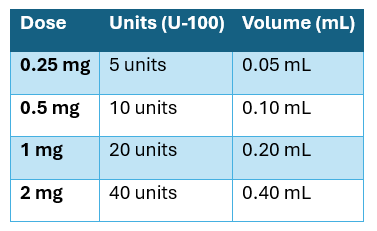
At 10 mg reconstituted with 4 mL, giving 2.5 mg/mL, every volume above doubles and the starting dose becomes much easier to measure.
Calculate Your Dosage
→ Click here to calculate your dosage
Important
Accuracy matters more here than almost anywhere in this library. Nausea is strongly dose-related on this compound, and the difference between a manageable dose and an unpleasant one is small. Overdrawing is not a minor error.
The range is eightfold. 0.25 to 2 mg. That is a wide spread, and the low end exists specifically so people can assess tolerance before committing.
Two different phases, two different patterns. Daily during loading, then as needed. The as-needed phase means infrequent draws with no muscle memory, so keep your figure written down rather than recalculating from memory weeks later.
Always confirm your vial strength, your reconstitution volume and your syringe type before drawing.
Protocol
Original classroom lesson. Preparation, measurement, sourcing, or protocol examples are source material, not verified instructions or clinical guidance.
Melanotan II Dosing Protocol
The following framework is provided for educational reference and should not be treated as an established clinical dosing guideline.
Typical Dose
Dose: 0.5 to 1 mg per dose
Dose Range: 0.25 to 2 mg per dose
Frequency: Daily during the loading phase, then as needed
Route: Subcutaneous injection
Cycle: 2 to 4 weeks loading, then maintenance as needed
Before You Start
Two things, and neither is optional.
Full skin check with a dermatologist. Baseline documentation of your moles before any change occurs. Without it, you cannot tell later whether something has changed.
Photograph your moles. Your own record, dated, in consistent lighting. This costs nothing and gives you something concrete to compare against.
If you have a personal or family history of melanoma or skin cancer, or a significant number of atypical moles, the correct decision is not to use this compound.
Start at 0.25 mg
Lower than the typical range, deliberately.
Nausea is very common and strongly dose-related. Starting at the bottom lets you establish tolerance before committing to a dose that might make the first week unpleasant enough to abandon.
There is no benefit to starting higher. The pigmentation effect builds cumulatively rather than arriving with a single large dose.
Evening Dosing
Dosing in the evening means the nausea, flushing and fatigue peak while you are winding down rather than during your day.
The yawning and fatigue effects are distinctive on this compound and often more noticeable than people expect. Evening dosing works with that rather than against it.
The Loading and Maintenance Structure
Loading, 2 to 4 weeks daily: Building the pigmentation response.
Maintenance, as needed: Once the desired level is reached, less frequent dosing sustains it.
The logic is that pigmentation accumulates and then needs topping up rather than continuous driving. It also reduces total exposure, which matters on a compound with this profile.
UV Exposure
The tanning effect requires some UV to activate. It does not happen without it.
Two points worth being direct about. Sun protection still applies, and any protective effect against UV damage is not established well enough to treat as one. And the combination of a melanocyte stimulant plus UV exposure is worth sitting with, given everything in the research tab.
Ongoing Monitoring
This is the part most protocols skip and it is the part that matters.
Re-photograph your moles monthly, in consistent lighting.
Watch for changes in size, shape, colour or border, and for new moles appearing.
If anything changes, stop and see a dermatologist. Do not assume it is just the peptide.
Continue skin checks after you stop. Pigmentation changes and their implications do not end when the cycle does.
Clinical Notes
Start at 0.25 mg to assess tolerance due to nausea.
Administer in the evening to minimise side effects.
Tanning requires some UV exposure to activate.
Not recommended for anyone with a history of melanoma.
Blood pressure increase means anyone with cardiovascular disease or hypertension should have a clinical conversation before use.
If your goal is sexual function rather than tanning, PT-141 was specifically developed to deliver that without the pigmentation effects. Read that module before choosing this one.
Consult a qualified healthcare professional before use.
Side Effects and Safety
Nausea, very common, especially at higher doses
Facial flushing
Spontaneous erections in men
Darkening of existing moles
Fatigue and yawning
Increased blood pressure
The mole item is not in the same category as the others. Nausea is unpleasant and passes. Mole changes are the thing dermatologists screen for.
Research References
Stack Logic
Original classroom lesson. Preparation, measurement, sourcing, or protocol examples are source material, not verified instructions or clinical guidance.
Melanotan II already activates several receptors across multiple systems. Adding compounds to something this broad is usually adding overlap.
The Pairing That Does Not Make Sense
Melanotan II + PT-141: Listed as complementary, and it is worth correcting directly.
PT-141 was derived from Melanotan II by removing the pigmentation activity. They act on the same receptor family toward the same sexual function outcome.
Running both is duplication on MC3R and MC4R, plus you are reintroducing the exact MC1R activity PT-141 was engineered to remove. You get more nausea, more blood pressure effect, and no additional mechanism.
These are alternatives, not a stack. Choose one based on whether you want the pigmentation effect or specifically want to avoid it.
The Pairing With a Weak Rationale
Melanotan II + BPC-157: Listed on the grounds of managing injection site reactions and GI side effects.
The GI part has more to it than the injection site part, given BPC-157's gut research and how common nausea is here. It is still a thin reason to add a second compound.
The better response to dose-related nausea is a lower dose. Adding a compound to tolerate a dose you could simply reduce is solving the wrong problem, and it is worth recognizing that pattern generally.
The Question Specific to This Compound
Which effect are you actually after?
Melanotan II delivers three things and you cannot separate them. That makes the question unusually consequential.
If you want sexual function, PT-141 was built to deliver it without the pigmentation risk. That is the better-matched tool and it is FDA approved.
If you want appetite suppression, there are compounds in this library with vastly better evidence and no melanocyte activity.
If you specifically want the tanning, this is the compound that does it, and that is the use where you are accepting the risk for the thing the risk is attached to.
The most common pattern is people taking Melanotan II for one effect while carrying the risk of another. If the tan is incidental to why you are using it, you are taking the mole risk for no reason.
Where This Leaves You
Melanotan II works. That is not in question, and it is the reason it has stayed popular despite being unapproved everywhere.
It is also the compound in this library where the gap between what is established about its effects and what is established about its safety is widest, and where the potential consequence sits at the serious end.
If you use it: get the skin check first, start at 0.25 mg, dose in the evening, photograph your moles, and keep checking after you stop. And if what you actually wanted was the sexual function effect, read the PT-141 module before you decide, because that compound exists precisely because someone looked at this one and concluded the pigmentation activity was worth engineering out.
Certificate of Analysis
Report concerns a submitted sample and identified lot only; authenticity has not been independently verified. A report covers a submitted sample or lot, not safety, sterility, effectiveness, or every product sold. Its provenance has not been independently authenticated.
Open attached COAAll classroom topics