KPV
A short peptide fragment studied for its activity in inflammation-related laboratory models.
This material is educational, not medical advice or a treatment recommendation. Classroom claims and example protocols have not all been independently verified.
The Compound, Explained
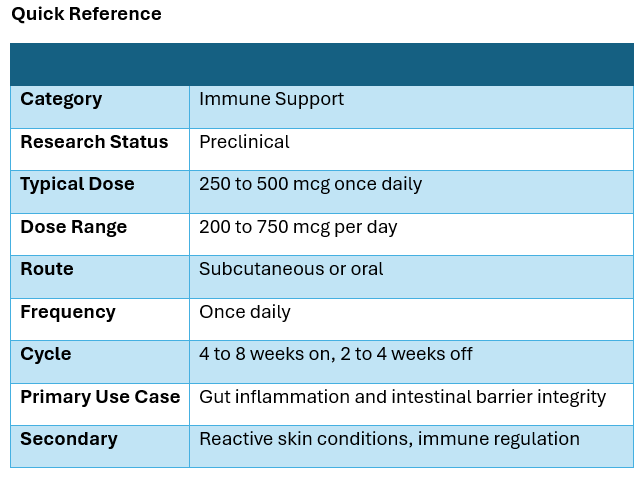
Category: Immune Support
Compound: KPV (Lys-Pro-Val), the C-terminal tripeptide fragment of alpha-MSH
Research Status: Preclinical
Regulatory Status: Recommended for compounding eligibility by the FDA Pharmacy Compounding Advisory Committee, July 23 2026. Non-binding. Not FDA approved.
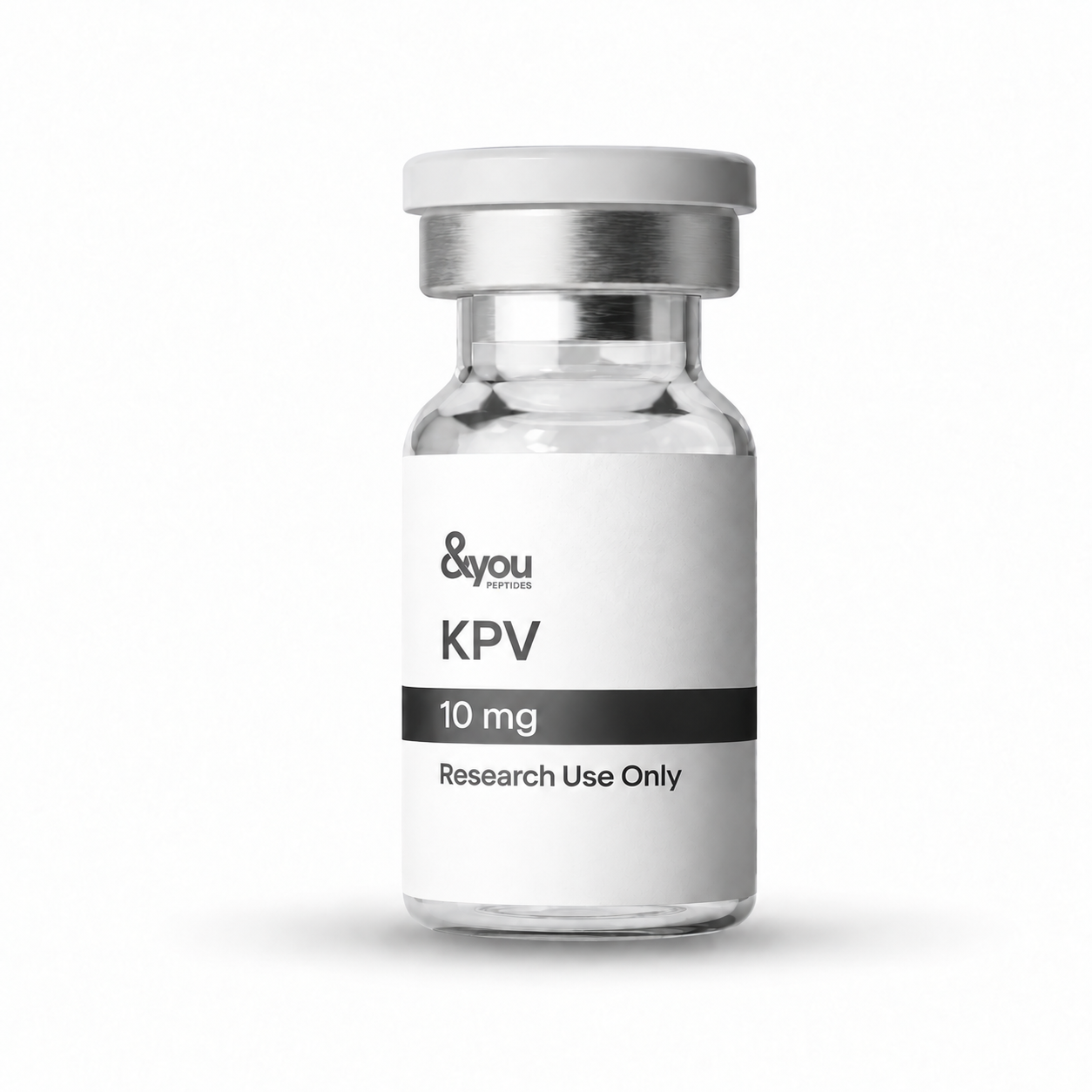
What This Is
Three amino acids. Lysine, proline, valine. That is the entire molecule.
KPV is the smallest compound in this library by a wide margin, and the size is not incidental. It is the C-terminal fragment of alpha-melanocyte-stimulating hormone, a hormone your body produces to regulate inflammation, and it is the smallest piece of that hormone that still carries the full anti-inflammatory activity.
The Fragment Logic, Done Well
You have now seen this design pattern three times in this course. BPC-157 is a fragment of a gastric protein. Semax is a fragment of ACTH. KPV is a fragment of alpha-MSH.
Each time the goal is the same: isolate the piece that does the useful thing and leave behind the parts that do other things. KPV is the cleanest example of it working.
Full alpha-MSH activates melanocortin receptors, which is what drives pigmentation. That is the same receptor family melanotan acts on, and it is why alpha-MSH is associated with tanning.
KPV does not activate those receptors. You get the anti-inflammatory activity with none of the pigmentation. That is not a side effect that happens to be absent, it is a different mechanism entirely, and it is the reason this fragment exists as a compound rather than as a curiosity.
It Stops Damage, It Does Not Repair
The most important framing for this compound, and the thing that determines whether it belongs in your protocol.
KPV is an inflammation brake. It reduces the signaling that keeps inflammation running. It does not rebuild tissue, does not drive collagen synthesis, and does not accelerate healing directly.
The Clearest Way to Hold it: KPV stops the fire, other compounds rebuild the house. Both jobs are necessary in chronic inflammatory conditions, and neither substitutes for the other. This is also why KPV and BPC-157 appear together so often, and why that pairing is one of the better-reasoned ones in this field.
If your problem is an acute injury with no inflammatory component, KPV is not the compound for it.
The Oral Route Is Real Here
Worth flagging early because it is unusual.
Most peptides are destroyed by digestion, which is why nearly everything in this library is injected. Claims that a peptide works orally are usually marketing.
KPV is a genuine exception, and for a specific mechanistic reason covered in the next tab: it is absorbed through a transporter that already exists in your gut lining for the purpose of absorbing small peptides from food.
That makes oral administration not just viable but arguably preferable for gut-focused use, since it delivers the compound directly to the tissue you are targeting.
Who This Is For
People with chronic gut inflammation, where this compound has its most specific research.
People with reactive or inflamed skin conditions tied to immune dysregulation.
People whose repair protocols keep stalling, where persistent inflammation may be the reason.
Inside the Mechanism
The PepT1 Transporter
This is the most elegant mechanism in this course, and it is worth slowing down for.
PepT1 is a transporter embedded in the lining of your intestine. Its normal job is absorbing di- and tripeptides from digested food, meaning fragments two and three amino acids long. It exists in everyone, it is always running, and it is not something KPV creates or hijacks.
KPV is a tripeptide. It fits the transporter exactly.
So KPV is taken up into intestinal epithelial cells through a channel that was already there for molecules of precisely its size. The compound is not fighting the digestive system, it is using it.
Two consequences follow, and both matter.
Oral administration works: Not as a compromise but as a designed-in property.
Uptake is concentrated where PepT1 is expressed, meaning the intestinal lining. This is the basis of the minimal systemic absorption point: KPV acts substantially where it is taken up rather than distributing broadly through the body.
There is also research interest in PepT1 expression increasing in inflamed intestinal tissue, which would mean uptake concentrating further in exactly the tissue that needs it. Treat that as an interesting research direction rather than an established fact.
Inhibits NF-kB
Once inside the cell, this is what KPV does:
NF-kB is a transcription factor, and it is close to the master switch for inflammatory gene expression. When activated it moves into the cell nucleus and turns on the genes that produce inflammatory signaling molecules.
KPV inhibits that translocation. NF-kB does not reach the nucleus, and the inflammatory genes downstream are not switched on.
Note where in the chain this acts. KPV is not mopping up inflammatory molecules after they exist. It is reducing their production at the point of transcription. That is upstream intervention, and it is why a three-amino-acid molecule can have an effect disproportionate to its size.
The measured downstream result is reduction in pro-inflammatory cytokines: TNF-alpha, IL-6 and IL-8, locally in the colon.
Modulation, Not Immunosuppression
This claim gets made constantly about anti-inflammatory compounds and is usually loose. Here it has a mechanistic basis worth stating precisely, along with its limits.
Immunosuppressants broadly reduce immune function, which is why they increase infection risk. KPV acts on a specific inflammatory signaling pathway rather than suppressing immune function globally, and it is described as bringing inflammation toward a normal range rather than switching it off.
That distinction matters because inflammation is a necessary process. It is how your body responds to infection and how repair begins. A compound that eliminated it entirely would impair healing, which is part of why long-term broad anti-inflammatory use can slow tendon healing.
The Honest Caveat: This is preclinical characteriZation, not a clinical safety finding. It describes the mechanism, not a demonstrated absence of immune consequences in humans over time. Anyone on immunosuppressant medication should treat KPV as a prescriber conversation rather than a safe addition.
Supports Barrier Integrity
The intestinal lining is a single cell layer thick, held together by tight junctions between cells. When those junctions loosen, material passes through that should not, which drives further immune activation and further inflammation.
That is a self-reinforcing loop: inflammation damages the barrier, the damaged barrier drives more inflammation. KPV's reported effects on barrier integrity work against that cycle, which is mechanistically why an anti-inflammatory compound can produce structural improvement without being a repair compound.
Skin
The same NF-kB mechanism operates in skin. Reactive and inflamed skin conditions frequently involve immune dysregulation with the same inflammatory signaling underneath, which is why KPV appears in skin formulations and in blends like KLOW.
What the Research Actually Shows
Read the Status Tag First
KPV is tagged Preclinical. Animal models and cell work, primarily in colitis models. No large human trials.
The research is smaller in volume than BPC-157's and more focused. That focus is a genuine strength: the work points at one mechanism in one tissue, rather than scattering across a dozen claimed applications. A small pointed literature is often more informative than a large diffuse one.
The Research Is About Colitis
Look at what the studies actually examined. Chemically induced colitis in animal models. Intestinal inflammation. Cytokine levels in colonic tissue.
That is where the evidence lives, and it is genuinely good preclinical work with a clearly described mechanism.
Everything else, skin conditions, general immune regulation, systemic inflammation, is mechanistic extrapolation. The NF-kB pathway operates throughout the body, so the reasoning is sound. Sound reasoning is not the same as tested.
Be clear which you are relying on when you decide.
The Claim to Watch
You will see KPV described as treating IBD, Crohn's disease or ulcerative colitis.
Studied in colitis models is accurate. Treats inflammatory bowel disease is a clinical claim, and no preclinical compound has earned it.
This matters more here than with most compounds in this library, for a reason worth stating plainly. These are serious conditions with real prescribed treatments and real consequences for undertreatment. Someone reducing their prescribed medication because a peptide sounded promising is taking a risk that has nothing to do with whether KPV works.
The Honest Position: KPV is a reasonable thing to discuss with a gastroenterologist as an addition. It is not a substitute for anything, and the evidence does not currently support treating it as one.
The Attribution Problem With Inflammatory Conditions
Specific to this compound and worth understanding before you evaluate your own results.
Inflammatory conditions relapse and remit naturally. IBD in particular runs in flares and remissions, sometimes over weeks, driven by factors nobody has fully characterized.
People start a compound during a flare, because that is when the problem is most pressing. Flares subside. The compound gets credit.
That does not mean KPV does nothing, and the mechanism work is genuinely strong. It means personal improvement during a KPV cycle is weak evidence on its own, and the enthusiastic reports this compound generates should be weighted with that in mind.
If you want to know whether it works for you, track over multiple cycles rather than one, and compare against your own history of flare duration.
Sample Size and Model
Find the n, and also find the model. Chemically induced colitis in rodents is a standard research tool and it is not the same thing as human inflammatory bowel disease. The induction is artificial, the timeline is compressed, and the animal's immune system is not yours.
Useful model, real findings, meaningful gap between that and a human clinical outcome.
The July 2026 Committee Vote
On July 23 2026 the FDA's Pharmacy Compounding Advisory Committee voted on seven peptides.
Recommended: BPC-157, KPV, TB-500, MOTS-c, Epitalon, Semax
Not recommended: Emideltide, also known as DSIP
KPV was recommended.
The committee found the evidence sufficient to recommend it be eligible for pharmacy compounding. That is not FDA approval, the vote is non-binding, and no compound on that list is approved to treat any condition.
Worth noting what this vote says about KPV specifically. It is not a widely known compound, it has a much smaller public profile than several compounds that were not on the list at all, and it was recommended anyway. The committee assessed evidence rather than popularity, which is exactly the distinction this course keeps returning to.
Holding Both Facts
KPV has an unusually well-described mechanism, a specific and coherent research base, a genuine oral route with a mechanistic explanation behind it, and a positive committee recommendation. It also has no human trials, evidence concentrated in animal colitis models, and applications beyond the gut that rest on extrapolation rather than data.
Sourcing & Verification
Original classroom lesson. Preparation, measurement, sourcing, or protocol examples are source material, not verified instructions or clinical guidance.
KPV is three amino acids long, which makes it cheap to synthesize and easy to get wrong in ways that do not show up anywhere except a lab report.
What to Verify on This Compound
Sequence, not just purity. A tripeptide has three positions. A synthesis error produces a different tripeptide of almost identical molecular weight, and a purity figure will happily report 99% of the wrong molecule. Identity confirmation is what catches this, and on a molecule this small it is the line item that matters most.
Which product you are buying. KPV is sold as injectable vials, as oral capsules and as topical preparations. These are not interchangeable, and the oral form in particular is a formulated product where what surrounds the peptide affects whether it survives to reach PepT1. Confirm the format matches your intended route before ordering.
Watch for alpha-MSH confusion. KPV is sold in the same space as melanotan and other alpha-MSH-related compounds, which do activate melanocortin receptors and do cause pigmentation. The whole point of KPV is that it does not. Identity confirmation is what separates them on paper.
Oral formulations need more scrutiny, not less. An injectable vial is a peptide and water. An oral capsule involves a delivery approach designed to get the peptide to the intestine intact. That is a formulation choice a supplier made, and it is reasonable to ask what it is rather than assuming a capsule is just powder in a shell.
The COA Standard
A valid COA names the testing laboratory, carries a batch number matching your product, states a test date, gives purity with the method used, and confirms identity. Anything answering "available on request," or arriving as a screenshot with no traceable source, is not a COA.
For KPV, ask specifically for identity confirmation by mass spectrometry. On a three-amino-acid molecule, purity without identity tells you very little.
Storage
Lyophilized Powder: Cool, dry, away from light. Reconstituted: refrigerate at 2 to 8 degrees C and use within 30 days.
Note the 30 day window against the protocol. A 5 mg vial at 250 mcg daily runs twenty doses, comfortably inside it. At the same dose from a larger vial you may not finish before the solution should be discarded, so size your reconstitution around the window.
Preparation
Original classroom lesson. Preparation, measurement, sourcing, or protocol examples are source material, not verified instructions or clinical guidance.
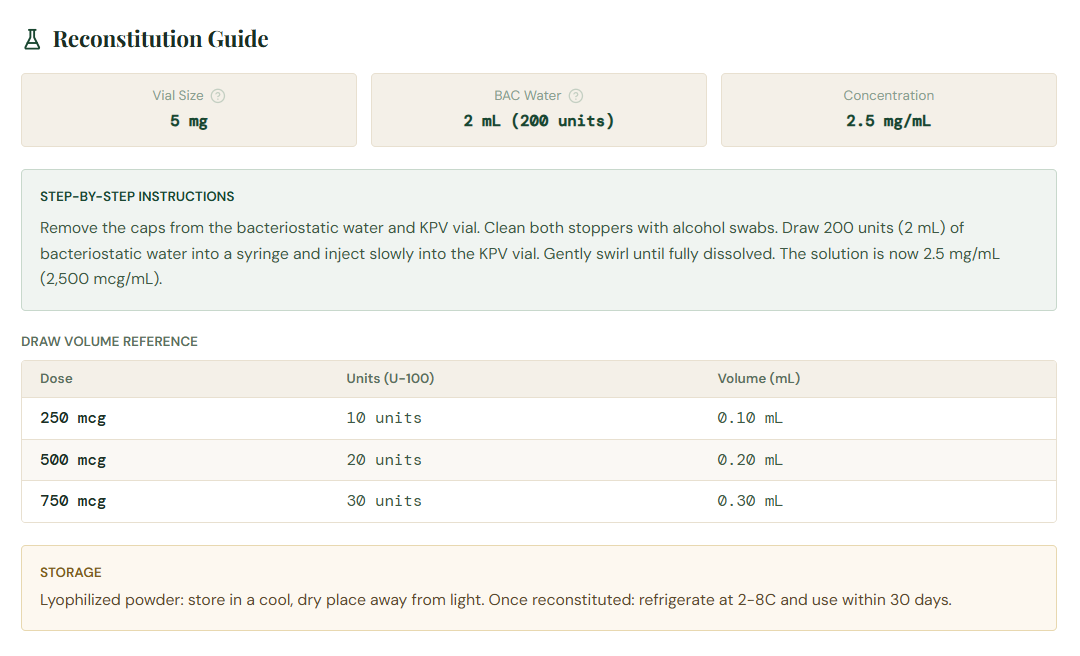
KPV Reconstitution Guide
If you are using oral capsules, no preparation is required and this tab does not apply.
For lyophilized powder, reconstitute as follows. Vial strengths vary, so use the volume specified for your exact product.
What you will Need:
KPV vial
Bacteriostatic water
U-100 insulin syringes
Alcohol pads
Step 1: Prepare and Sanitize
Wash your hands and prepare a clean workspace.
Remove the caps from both the bacteriostatic water and the KPV vial.
Clean both stoppers with alcohol pads and allow them to dry.
Step 2: Reconstitute
Draw 200 units (2 mL) of bacteriostatic water.
Insert the needle into the KPV vial and introduce the water slowly along the inside wall.
Avoid directing the stream forcefully onto the powder.
Step 3: Mix Gently
Do not shake. Swirl gently until fully dissolved.
Step 4: Storage after Reconstitution
Refrigerate at 2 to 8 degrees C.
Use within 30 days.
Protect from light.
Do not freeze unless the manufacturer specifically indicates it.
Important
Note the concentration this produces: 2.5 mg/mL, not 5 or 10. Several compounds in this library reconstitute to 10 mg/mL at 1 mL, and carrying that habit across gives you a figure four times off.
KPV is also dosed in micrograms while the vial is labelled in milligrams. Read both the unit and the number.
Measurement
Original classroom lesson. Preparation, measurement, sourcing, or protocol examples are source material, not verified instructions or clinical guidance.
KPV Measurement Guide
Calculator, pre-filled with KPV defaults:
https://peptidetrainings.com/tools/reconstitution-calculator?label=KPV
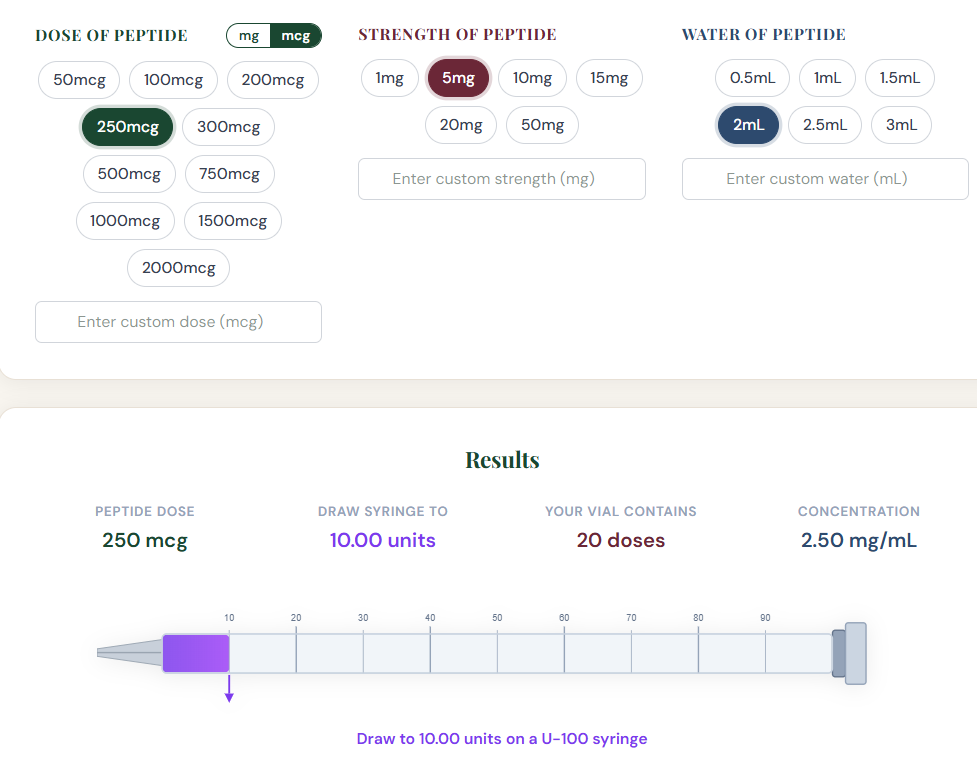
Draw Volume Reference
At 5 mg reconstituted with 2 mL, giving 2500 mcg/mL, on a U-100 syringe:
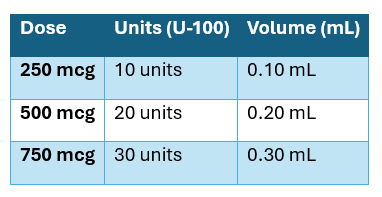
The correct measurement depends on vial strength, reconstitution volume, desired dose and syringe type.
Calculate Your Dosage
→ Click here to calculate your dosage
Important
Micrograms, not milligrams. KPV is dosed in the hundreds of micrograms. A 5 mg vial contains 5000 mcg, so a single 250 mcg dose is one twentieth of it. Reading a microgram figure as a milligram figure is a thousandfold error and will not look wrong in the syringe.
Oral dosing is a separate calculation. If you are using capsules, you are not measuring at all, and the dose is whatever the capsule contains. Do not assume an oral dose and an injectable dose are equivalent. Absorption differs by route, and the figures in the table above are for injection.
If you are also running KLOW, that blend delivers 400 mcg of KPV per dose. Count it before adding a standalone KPV protocol on top.
Always confirm your vial strength, your reconstitution volume and your syringe type before drawing.
Protocol
Original classroom lesson. Preparation, measurement, sourcing, or protocol examples are source material, not verified instructions or clinical guidance.
KPV Dosing Protocol
The following framework is provided for educational reference.
Typical Dose
Dose: 250 to 500 mcg once daily
Dose Range: 200 to 750 mcg per day
Frequency: Once daily
Route: Subcutaneous injection, or oral capsule for gut-specific targeting
Cycle: 4 to 8 weeks on, 2 to 4 weeks off
Route Follows Target
The defining decision with this compound, and the one most worth getting right.
Gut-focused use: oral. KPV is absorbed through PepT1 in intestinal epithelial cells, which delivers it directly to the tissue you are targeting. This is not a convenience compromise, it is the mechanistically appropriate route.
Skin or systemic use: subcutaneous. Oral delivery concentrates uptake in the gut, which is exactly wrong if the gut is not your target.
Decide what you are treating before you decide how to take it. For this compound that question has a real answer rather than a default.
Weeks 1 to 4: Initial Phase
Dose: 250 mcg daily, the lower end
Purpose: Establish response
Duration: 4 weeks
Weeks 5 to 8: Continuation
Dose: Maintained, or adjusted upward within range on response
Duration: To the end of the cycle
The off-period
Cycles run 4 to 8 weeks on with 2 to 4 weeks off. The reasoning is that a compound acting on immune signaling is one where continuous long-term use has not been characterized, so the break is a hedge against an unknown.
It also serves a practical purpose. Inflammatory conditions relapse and remit on their own, and the off-period is where you find out whether the improvement was the compound or the cycle of the condition. Use it as information rather than treating it as downtime.
Clinical Notes
For gut applications, oral administration may be preferred given PepT1 uptake.
Often combined with BPC-157 for a dual anti-inflammatory plus repair approach. Covered in the Stack Logic tab.
Does not cause tanning or pigmentation, unlike full alpha-MSH or melanotan.
KPV reduces inflammation, which reduces symptoms. In an inflammatory condition, feeling better is not the same as the underlying condition resolving. Keep clinical monitoring in place rather than substituting how you feel for it.
If you are managing a diagnosed inflammatory bowel condition, this is an addition to discuss with your gastroenterologist. It is not a replacement for prescribed treatment.
Anyone on immunosuppressant medication should speak to their prescriber before use.
Consult a qualified healthcare professional before using experimental peptide products.
Side Effects and Safety
Generally very well tolerated
Mild injection site irritation, rare
No significant side effects reported in preclinical studies
Does not cause tanning or pigmentation
Read the third line accurately. No significant effects reported in preclinical studies means animal studies of limited duration. It is a smaller claim than an established human safety record, and the two get conflated constantly. A clean short list on a preclinical compound reflects limited scrutiny as much as it reflects safety.
Research References
Stack Logic
Original classroom lesson. Preparation, measurement, sourcing, or protocol examples are source material, not verified instructions or clinical guidance.
KPV does one job: It reduces inflammation. It does not repair tissue. That single limitation is what makes it one of the most sensibly stackable compounds in this library, because the gap it leaves is obvious and specific.
KPV + BPC-157
The definitive pairing, and one of the best-reasoned combinations in the field.
The two halves of a chronic inflammation problem. KPV stops the inflammatory signaling that is causing ongoing damage. BPC-157 rebuilds what was damaged, through angiogenesis and repair signaling.
Neither does the other's job, and in a chronic inflammatory condition both jobs need doing. Repairing tissue while inflammation continues to damage it is working against a headwind. Removing the inflammation without rebuilding leaves you with a quiet but still-damaged system.
The gut case is the cleanest version. BPC-157 has its own gastric-origin gut research, KPV has PepT1 uptake in intestinal cells, and they arrive at the same tissue from different directions.
KPV in KLOW
KPV is the fourth component of the KLOW blend, and it is the component that distinguishes KLOW from GLOW.
Worth understanding as a design decision rather than an ingredient list. GLOW is a repair blend. Adding KPV converts it into a repair blend that also addresses the inflammation preventing repair from working, which is why KLOW is pointed at reactive skin and gut conditions while GLOW is pointed at general skin and recovery.
If you are running KLOW, you are already getting 400 mcg of KPV daily. Account for that before adding more.
Where KPV Fits Generally
The useful way to think about it: KPV is what you add when a repair protocol is not working and chronic inflammation is the likely reason.
That is a diagnostic judgement rather than a default addition. Inflammation is not present in every situation, and adding an anti-inflammatory to an acute injury with no inflammatory component addresses a problem that is not there.
What Does Not Make Sense
Other anti-inflammatory compounds without a reason. Stacking multiple compounds acting on overlapping inflammatory pathways is redundancy, and it also makes it impossible to tell which is doing anything.
Running it alongside broad immunosuppressants casually. KPV acts on immune signaling. Combined with immunosuppressant medication the interaction is uncharacterized, and that is a prescriber conversation rather than a stacking decision.
The Design Principle Worth Keeping
KPV is the clearest illustration in this course of why mechanism matters more than category.
Both KPV and BPC-157 get filed under healing. They do entirely different things, and that difference is precisely why they work well together. Two compounds sharing a category label frequently do not share a mechanism, and two compounds in different categories frequently belong in the same protocol.
Read what a compound does, not what shelf it sits on. That is the habit that makes the rest of this course useful.
Certificate of Analysis
No COA attachment was available for this course when checked.
All classroom topics