KLOW
Explore the ingredients of a four-compound blend. Evidence for an ingredient is not evidence for the blend.
This material is educational, not medical advice or a treatment recommendation. Classroom claims and example protocols have not all been independently verified.
The Blend, Explained
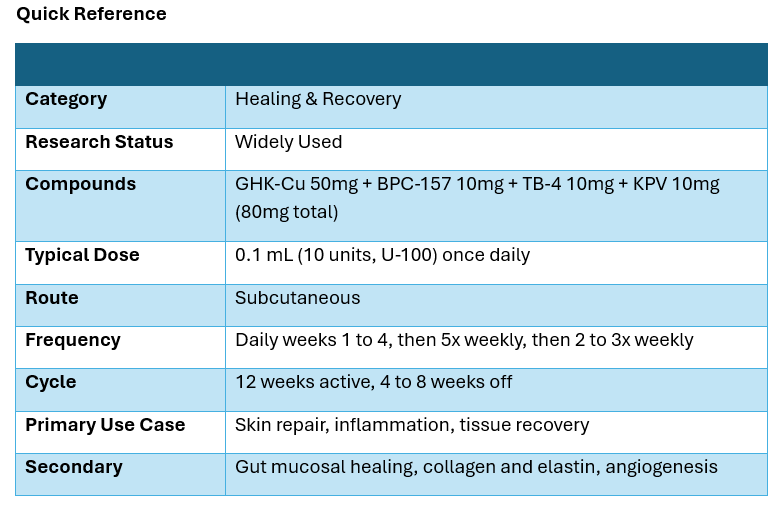
Category: Healing & Recovery
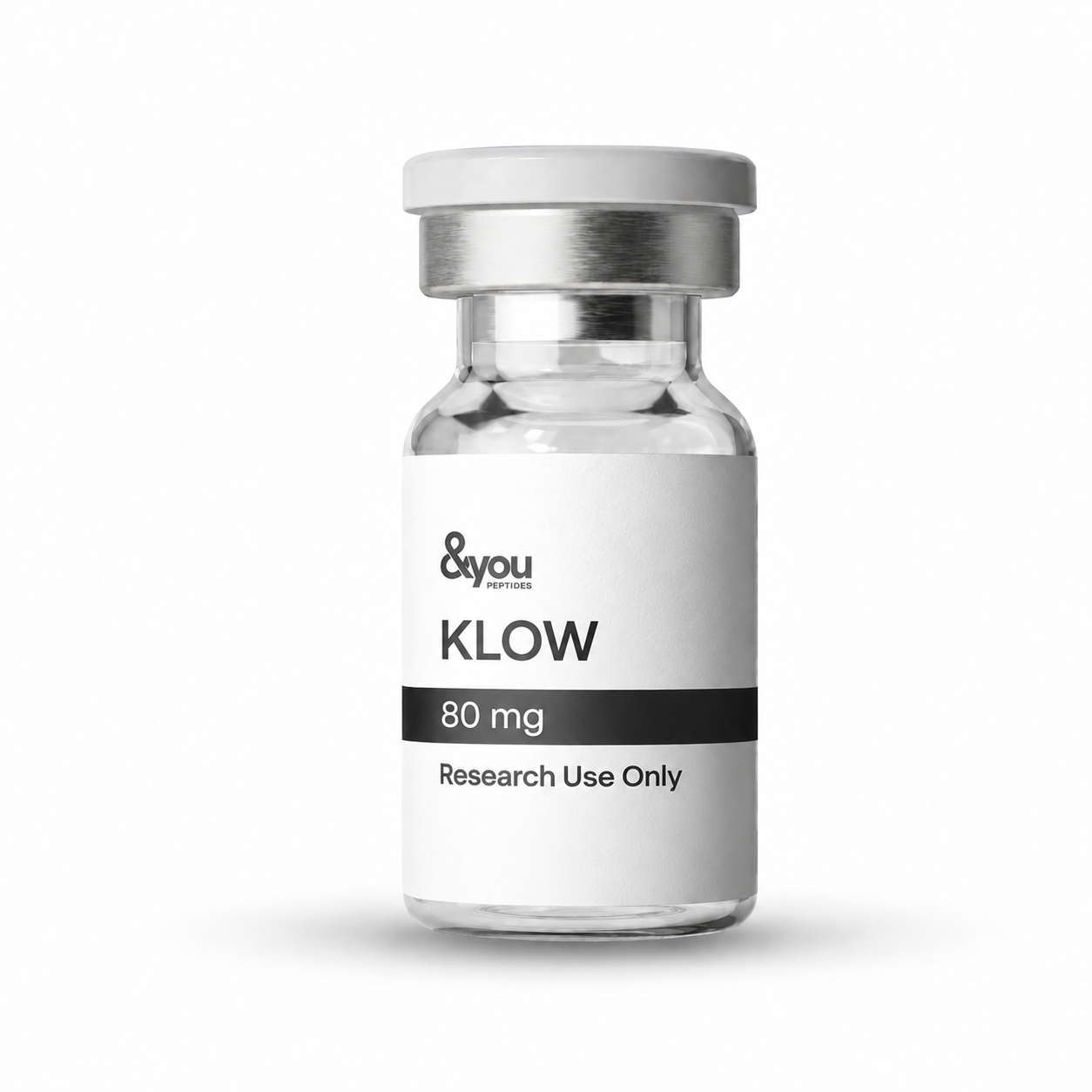
Compounds: GHK-Cu 50mg + BPC-157 10mg + TB-4 10mg + KPV 10mg. 80mg total in one vial.
Research Status: Widely used. All four components preclinical.
Regulatory Status: Not FDA approved. Three of the four components, BPC-157, TB-500 and KPV, were recommended for compounding eligibility by the FDA Pharmacy Compounding Advisory Committee on July 23 2026. Non-binding. GHK-Cu was not assessed at that meeting.
What This Is
Four peptides in fixed proportions in a single vial. Add water, draw one volume, inject.
GHK-Cu, 50mg. Skin, collagen and elastin. The bulk of the vial.
BPC-157, 10mg. Local tissue repair and angiogenesis.
TB-4, 10mg. Systemic repair signalling and cell migration.
KPV, 10mg. Inflammation control.
The convenience is real. One reconstitution, one draw, one injection instead of four of each. For a daily protocol over twelve weeks that difference compounds into something meaningful.
What the Ratio Actually Gives You
This is the most important thing on this page, and it is not printed on the vial.
Reconstituted with 2.5 mL, the 80mg vial gives 32 mg/mL. A 0.1 mL dose is 3.2 mg of total peptide, split by the blend ratio:
GHK-Cu: 2 mg
BPC-157: 0.4 mg (400 mcg)
TB-4: 0.4 mg (400 mcg)
KPV: 0.4 mg (400 mcg)
Now compare those to the standalone protocols taught elsewhere in this course.
GHK-Cu's typical range is 1 to 2 mg daily. At 2 mg, the blend sits at the top of it. BPC-157's typical range is 500 mcg to 1 mg daily. At 400 mcg, the blend sits below it.
That is not a criticism of the product. It is what a fixed ratio means: the blend is GHK-Cu-led, with the other three as supporting doses. If your problem is primarily skin and collagen, the ratio is pointed at you. If your problem is primarily a tendon injury, you are getting a sub-protocol dose of the compound that addresses it.
Run this calculation on any blend before you buy it. Total milligrams on a label tells you nothing until you divide it by the ratio and the dose.
KLOW Versus GLOW
GLOW Contains Three Peptides: GHK-Cu, BPC-157 and TB-500. KLOW adds KPV.
That single addition is the whole distinction, and it points the blend at a different problem. KPV is an anti-inflammatory peptide with research specifically in gut inflammation and immune-driven skin conditions.
The Decision Rule: If chronic inflammation is part of what you are dealing with, reactive skin, gut issues, immune flare-ups, KLOW is the one aimed at it. If you want skin and recovery support with no inflammatory component, GLOW is the simpler product and you are not paying for a peptide you do not need.
The Trade-Off Nobody Prints on the Label
Fixed blends buy convenience with control, and you should make that trade knowingly.
You Cannot Adjust One Component: If KPV suits you and you want more, the only way to get it is more of everything, including 2 mg of GHK-Cu you did not ask for.
You Cannot Attribute Anything: Four compounds starting simultaneously means any result, good or bad, has four candidate causes. If you react badly, you will not know to which.
You Cannot Drop One: Standalone vials let you stop one component and keep three. A blend is all or nothing.
Convenience is a legitimate reason to choose this, particularly for a daily twelve-week protocol. Just know what you traded for it.
Who This Is For
People dealing with skin issues that have an inflammatory component: reactive skin, rosacea, conditions tied to immune dysregulation.
People with gut inflammation alongside tissue repair needs.
People who want a repair protocol they will actually stick to daily, where four separate vials would mean they do not.
Inside the Mechanism
Four peptides, four distinct jobs. The case for the blend is that these mechanisms do not overlap.
GHK-Cu: Structure
The largest component by a wide margin, and the one that defines the blend's character.
A naturally occurring copper tripeptide. Its research includes shifting gene expression in aging fibroblasts toward a younger profile, and it drives synthesis of collagen, elastin and glycosaminoglycans, the three components that give skin its strength, recoil and cushioning.
The copper is functional, not decorative. It is a cofactor for lysyl oxidase, which cross-links collagen fibers, and for superoxide dismutase, an antioxidant enzyme.
This is also the source of two things you will notice directly. The blue tint in the vial is the copper-peptide complex and is correct, not contamination. The 30 to 60 second sting on injection is the same complex, and it is the most commonly reported effect of this blend.
BPC-157: Supply
Derived from a protein in gastric juice. Two mechanisms matter here.
It promotes angiogenesis through VEGF, building new blood vessels into healing tissue. That matters most in poorly vascularized tissue like tendon, where inadequate blood supply is the reason healing is slow.
It also upregulates growth hormone receptors on tendon fibroblasts, improving reception of growth signals already circulating rather than adding new ones.
In this blend, think of it as the supply line. GHK-Cu drives building, BPC-157 makes sure materials can reach the site.
TB-4: Mobilization
Thymosin Beta-4, present in nearly every human cell and concentrated in wound fluid. Your native repair response uses it.
It upregulates actin expression, the structural protein cells use to move. More actin means greater cell motility, which means repair cells can migrate to damaged tissue from elsewhere in the body.
That is why TB-4 is systemic while BPC-157 is local. It is not acting at a site, it is mobilizing the repair system generally.
The other reported effect worth naming: TB-4 is associated with laying down organized tissue rather than scar tissue. Scar is functional but structurally inferior, so the distinction matters for anything you want to work properly afterward.
KPV: Regulation
The differentiator, and the least familiar of the four.
KPV is a tripeptide fragment of alpha-MSH, a hormone involved in inflammation control and pigmentation. As with BPC-157 and Semax, the fragment carries the useful activity without the rest of the parent hormone's effects.
It acts on inflammatory signaling, interfering with pathways that keep inflammation switched on. Research interest has concentrated on inflammatory bowel conditions and immune-driven skin conditions.
One Property is Genuinely Unusual: KPV retains activity when taken orally, which most peptides do not. That is why it appears in gut protocols specifically, where oral delivery reaches the target tissue directly.
Why Four Rather Than One
Chronic non-healing has a recognizable pattern: inflammation stuck on, poor supply to the site, repair cells not arriving, structural material not being laid down.
Each peptide addresses a different point in that chain. KPV releases the inflammatory brake, BPC-157 builds the supply route, TB-4 brings the workforce, GHK-Cu supplies materials.
That is a coherent design rather than four repair peptides thrown together, and it is the strongest argument for the blend existing.
What The Research Actually Shows
Read the Status Tag First
KLOW is tagged Widely Used. That is a usage statement, not an evidence statement.
Every component is preclinical. Animal models, cell work, some observational human data. No large human trials on any of the four, and none at all on the combination.
The Blend Itself Has Never Been Studied
The most important sentence in this module.
Research exists on GHK-Cu. Research exists on BPC-157, on TB-4 and on KPV. Research on this specific combination at this specific ratio does not exist.
That is not unusual for blends and it is not a scandal. It is a gap you should know is there. When you read that KLOW is supported by research, what is being cited is research on the parts, assembled into a claim about a product nobody has tested as a product.
Four compounds with individual mechanistic support is a reasonable basis for a formulation. It is not the same as evidence the formulation works, and the difference is worth holding.
Component Evidence Varies
Treating "all preclinical" as one tier flattens real differences.
BPC-157. Roughly thirty years of research, the largest body of any of the four. Recommended by the July 2026 committee.
TB-4. Substantial research, native to human tissue, recommended by the committee.
KPV. Specific published work in gut inflammation, including the Dalmasso and Brzoska work from 2008. Smaller body than the first two, and pointed. Recommended by the committee.
GHK-Cu. Decades of research and the only one of the four with human trial data, though that data is topical cosmetic work rather than injectable. It was not assessed by the committee.
Note that last point carefully, since it is easy to misread. GHK-Cu has the most human data of the four and the least applicable human data, because it was generated by a route this product does not use.
The Claims to Watch
Three appear in marketing for this blend and each needs correcting.
"Supports healing of IBD, Crohn's and colitis." KPV has been studied for gut inflammation, mostly in animal models. Studied for is accurate. Heals is a clinical claim no preclinical compound has earned. These are serious conditions with prescribed treatments, and this is an addition to discuss with a gastroenterologist rather than a substitute for anything.
"The peptides work better together than alone." Plausible from the mechanisms and untested. Nobody has run the blend against the components separately, which is the study that would establish it.
"Improves skin conditions linked to immune dysregulation." Mechanistically reasonable, with the same preclinical caveat. Watch the verb.
The Attribution Problem Is Structural Here
With a single compound you at least have a chance of attributing an effect. With four started simultaneously in fixed proportions, you have none.
This cuts both ways and the second way matters more. If the blend works well, you do not know which component did it, which means you cannot simplify later or buy that component alone. If you react badly, you do not know which caused it, which means your only option is stopping all four.
The reported timelines make it harder still. Skin texture at weeks three to four, inflammation effects possibly within one to two weeks, structural change at eight to twelve. Those windows overlap with natural recovery and with the ordinary variation in skin and gut symptoms.
Holding Both Facts
KLOW combines four peptides with genuine individual mechanistic support, assembled with a logic that holds together rather than at random, with three of four carrying a positive committee recommendation. It also has no research on the blend itself, no human trials on any component by this route, a ratio heavily weighted to one compound, and a structure that makes evaluating any of it nearly impossible.
Hold both at once.
Sourcing & Verification
Original classroom lesson. Preparation, measurement, sourcing, or protocol examples are source material, not verified instructions or clinical guidance.
A blend hides its own problems. One vial, one label, one COA, four chances for something to be wrong, and no way to tell which from the outside.
What to Verify on This Compound
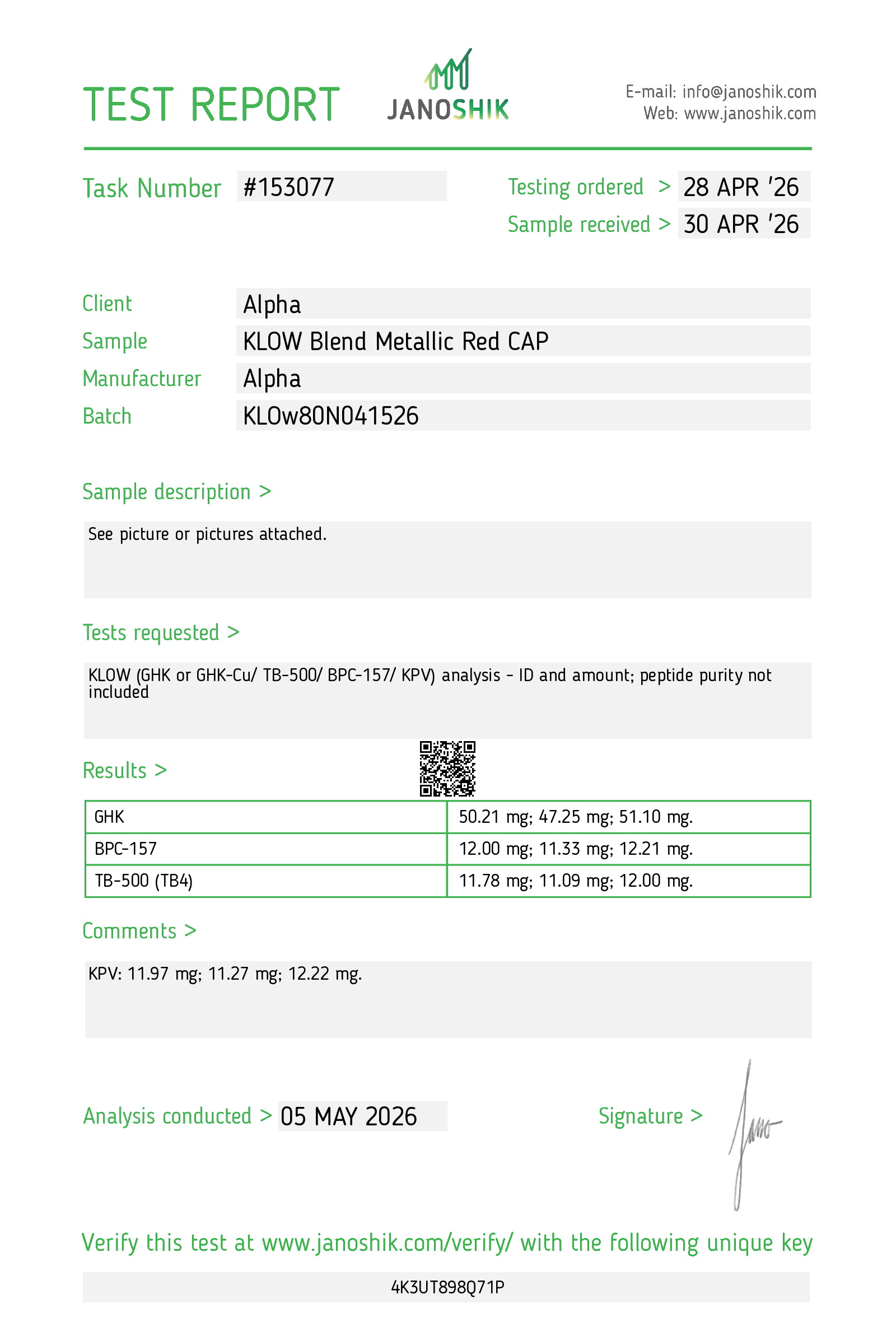
Ask for the ratio, in writing. The label says 80mg. That number is meaningless without the split. A vial with 65mg GHK-Cu and 5mg each of the others is also 80mg, and it is a different product. If a supplier cannot state the breakdown, they are selling you a total rather than a formulation.
A COA should cover each component. Four peptides means four identity confirmations and four purity figures. A single purity number for a blend does not tell you that the KPV is present, correct or at the stated amount. This is the question most suppliers of blends cannot answer, and asking it narrows the field fast.
Blue tint is expected, and it is not verification. The colour comes from the copper-peptide complex in GHK-Cu, and its presence tells you copper peptide is in there. It tells you nothing about the other three, nothing about the ratio, and nothing about purity. A correctly blue vial can still be missing its KPV entirely.
Under-dosing is the specific risk with blends. The expensive component is the one to short. Verification per component is the only defence, and it is why blend sourcing deserves more scrutiny than single-compound sourcing, not less.
The COA Standard
A valid COA names the testing laboratory, carries a batch number matching your vial, states a test date, gives purity with the method used, and confirms identity. Anything answering "available on request," or arriving as a screenshot with no traceable source, is not a COA.
For KLOW, ask for identity and quantity confirmation on all four components. One number for the vial is not enough.
Storage
Lyophilized Powder: Cool, dry, protected from direct sunlight, humidity and heat.
Reconstituted: refrigerate, protect from light, follow the manufacturer's window. Note that a 2.5 mL reconstitution at 0.1 mL daily runs 25 days, so the vial is in use for most of a month. It needs to hold up for that whole period, not just the first week.
Preparation
Original classroom lesson. Preparation, measurement, sourcing, or protocol examples are source material, not verified instructions or clinical guidance.
KLOW Reconstitution Guide
Reference Configuration
Vial Size: 80mg total (GHK-Cu 50mg, BPC-157 10mg, TB-4 10mg, KPV 10mg)
Bacteriostatic water: 2.5 mL
Resulting Concentration: 32 mg/mL total peptide
Doses per VIal: 25 at 0.1 mL
What you will Need:
KLOW vial
Bacteriostatic water
U-100 insulin syringes
Alcohol pads
Step 1: Prepare and Sanitize
Wash your hands and prepare a clean workspace.
Remove the caps from both the bacteriostatic water and the KLOW vial.
Clean both stoppers with alcohol pads and allow them to dry.
Step 2: Reconstitute
Draw 2.5 mL of bacteriostatic water.
Insert the needle into the KLOW vial and introduce the water slowly along the inside wall.
Avoid directing the stream forcefully onto the powder.
Step 3: Mix Gently
Important: Do not shake.
Gently roll or swirl until fully dissolved. Be patient, as 80mg of powder takes longer to go into solution than a small single-compound vial.
The solution will have a blue tint. That is the copper-peptide complex in GHK-Cu and it is correct.
Step 4: Storage after Reconstitution
Refrigerate.
Protect from light.
Follow the manufacturer's window.
Do not freeze unless the manufacturer specifically indicates it.
Why 2.5 mL Specifically
Worth understanding rather than following blindly, because the number is doing real work.
2.5 mL makes the standard dose land on exactly 10 units of a U-100 syringe, which is the easiest measurement to read accurately on that syringe. It also makes the vial last exactly 25 doses, which maps cleanly to a daily protocol.
Deviating changes both. More water makes the injection volume larger and the ratios per unit smaller. Less water concentrates it and makes the dose land somewhere harder to read. The blend is calibrated around this figure, so use it.
Reducing the Sting
The 30 to 60 second sting from the copper-peptide complex is the most commonly reported effect of this blend. Three things reduce it:
Warm the vial in your hands for a few minutes before drawing.
Inject slowly, over roughly five seconds.
Rotate injection sites rather than using the same spot daily.
Measurement
Original classroom lesson. Preparation, measurement, sourcing, or protocol examples are source material, not verified instructions or clinical guidance.
KLOW Measurement Guide
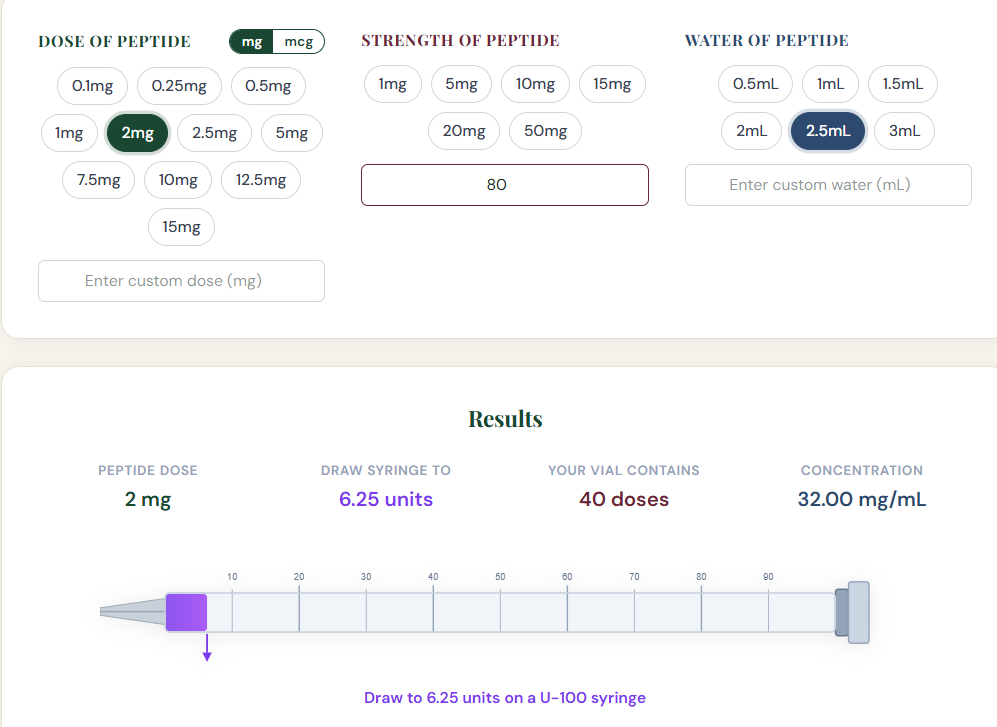
Calculator, pre-filled with KLOW defaults:
https://peptidetrainings.com/tools/reconstitution-calculator
Draw Volume
At 80mg reconstituted with 2.5 mL, giving 32 mg/mL, on a U-100 syringe:
DoseUnits (U-100)Volume (mL)Standard dose10 units0.10 mL
One dose, one volume. This is the simplest measurement in the entire library, and that simplicity is most of what you are buying.
What Is Actually in That 0.1 mL
Worth knowing, because a number of practical questions depend on it:
GHK-Cu: 2 mg
BPC-157: 0.4 mg (400 mcg)
TB-4: 0.4 mg (400 mcg)
KPV: 0.4 mg (400 mcg)
Keep these figures if you are running anything else alongside the blend. Adding a standalone GHK-Cu protocol on top of this means 2 mg from the blend plus whatever you add, and the combined total is what matters.
Calculate Your Dosage
→ Click here to calculate your dosage
Important: Do Not Adjust the Volume
The most common instinct with this blend is to draw a bit more for a stronger effect. Resist it, for a specific reason rather than a general one.
The ratio is fixed. Increasing the volume increases all four components proportionally, which means chasing more of one compound drags the other three up with it. Drawing 0.2 mL to get 800 mcg of KPV also delivers 4 mg of GHK-Cu, which is above its stated standalone range.
You cannot titrate one component in a blend. If you need a different amount of a specific compound, that is an argument for running that compound separately, not for changing the draw.
Always confirm your vial strength and reconstitution volume before drawing.
Protocol
Original classroom lesson. Preparation, measurement, sourcing, or protocol examples are source material, not verified instructions or clinical guidance.
KLOW Dosing Protocol
The following framework is provided for educational reference and should not be treated as an established clinical dosing guideline.
Typical Dose
Dose: 0.1 mL (10 units on a U-100 syringe), once daily
Dose Range: 0.1 mL per injection. Do not adjust the volume, the blend is calibrated.
Route: Subcutaneous. Abdomen, thigh or upper arm. Rotate sites.
Cycle: 12 weeks active, then 4 to 8 weeks off
The Tapering Schedule
Unusual among the compounds in this course, and worth following as written.
Weeks 1 to 4: Daily
Weeks 5 to 8: 5 days per week
Weeks 9 to 12: 2 to 3 times per week, continuing as maintenance
The logic is front-loading. Early repair work benefits from consistent signaling, and maintaining a result requires less than producing one. It also reduces total exposure across the cycle, which matters more with four compounds than with one.
Timelines
Weeks 1 to 2: Inflammation effects may appear, KPV-driven. The fastest-acting element.
Weeks 3 to 4: Skin texture changes commonly reported.
Weeks 4 to 6: Fine lines and tone.
Weeks 8 to 12: Structural changes, firmness and scar remodeling.
Treat these as reported patterns rather than a schedule. Structural tissue change is slow in every context, and nothing here overrides that.
Clinical Notes
Reconstitute with 2.5 mL, draw 0.1 mL, 25 doses per vial.
The blue tint is the copper complex and is normal.
Expect a 30 to 60 second sting. Warm the vial, inject slowly, rotate sites.
Mild fatigue 12 to 24 hours post-dose is commonly reported in the first week, attributed to TB-4, and typically resolves.
If you are running GHK-Cu, BPC-157 or TB-500 separately, account for what the blend already provides before adding more.
Consult a qualified healthcare professional before use.
Side Effects and Safety
30 to 60 second sting at the injection site from the copper-peptide complex. The most common effect, fades within a minute.
Mild fatigue 12 to 24 hours post-dose, TB-4-driven, typically resolving after the first week.
Local injection site redness, temporary.
Occasional brief flushing, less common.
Potential immune modulation. Caution if taking immunosuppressant medication.
Hard Contraindications
These are not cautions. Each has a specific mechanistic reason behind it.
Active malignancy. GHK-Cu and BPC-157 are angiogenic, meaning they promote new blood vessel growth. Tumors require blood supply to grow. This is the most important line on the page.
Wilson's disease or any copper-handling disorder. The blend delivers 2 mg of copper peptide per dose.
Pregnancy.
WADA-tested competition. TB-4 is on the prohibited list.
Surgery within the past two weeks.
Immunosuppressant medication warrants a specific conversation with your prescriber. KPV affects immune signaling, and the interaction with immunosuppressants is not characterized.
Research References
Stack Logic
Original classroom lesson. Preparation, measurement, sourcing, or protocol examples are source material, not verified instructions or clinical guidance.
KLOW is already a stack. Someone else built it, chose the ratio, and fixed it in a vial. The useful question is not what to add but whether the stack you have been handed is the one you would have built.
The Design, Assessed
The four components address four different points in the repair chain: inflammation, blood supply, cell mobilization, structural material. That is genuine mechanistic separation rather than four repair peptides thrown together, and it is why this blend holds up better than most.
The ratio is where the design gets opinionated. 50mg of the 80mg is GHK-Cu, so this is a skin and collagen product with repair and inflammation support attached. Read that as the product's point of view on what you need.
Where that matches your problem, the blend is efficient. Where it does not, you are paying for a large dose of something adjacent to what you came for.
Adding to a Blend
Most stacking additions do not make sense here, because the blend already covers four mechanisms.
The exception is topping up a single component. If you need a full 1 mg of BPC-157 for a specific injury, the blend's 400 mcg falls short, and adding standalone BPC-157 alongside is reasonable. Count the blend's contribution rather than starting from zero.
What does not make sense is adding compounds that duplicate what is already in there. TB-500 alongside KLOW is TB-4 twice. A separate GHK-Cu protocol on top of 2 mg daily is more copper peptide than the standalone range calls for.
Know what is in the vial before adding anything, which is the practical reason the per-dose breakdown in the Measurement tab matters.
When the Blend Is the Wrong Choice
Three situations where standalone compounds serve you better.
One specific problem. A single tendon injury needs a full BPC-157 dose placed near the site. The blend gives a partial dose distributed systemically, plus three compounds you did not need.
Any component you react to. A blend cannot be unbundled. If one of four causes a problem, all four stop.
Wanting to learn what works for you. Four simultaneous variables teach you nothing transferable. Running compounds individually is slower and tells you something you keep.
The Case For It
Set against all of that, one advantage is real and often decisive.
A protocol you follow daily for twelve weeks beats a better protocol you abandon in week three because four vials, four reconstitutions and four draws each morning became too much. Adherence is a legitimate input, not a soft one.
If the ratio points at your problem and the convenience is what makes the protocol happen at all, the blend is the right tool. If your problem is specific and you want to understand what is working, build it yourself from parts.
Either answer is defensible. What matters is that you have looked at what is in the vial and chosen it, rather than buying a total on a label.
Certificate of Analysis
Report measures selected blend components, not sterility or clinical safety. A report covers a submitted sample or lot, not safety, sterility, effectiveness, or every product sold. Its provenance has not been independently authenticated.
Open attached COAAll classroom topics