Ipamorelin
A growth hormone secretagogue studied in early clinical work; it is not FDA approved as a medicine.
This material is educational, not medical advice or a treatment recommendation. Classroom claims and example protocols have not all been independently verified.
The Compound, Explained
Category: Muscle Growth & Performance
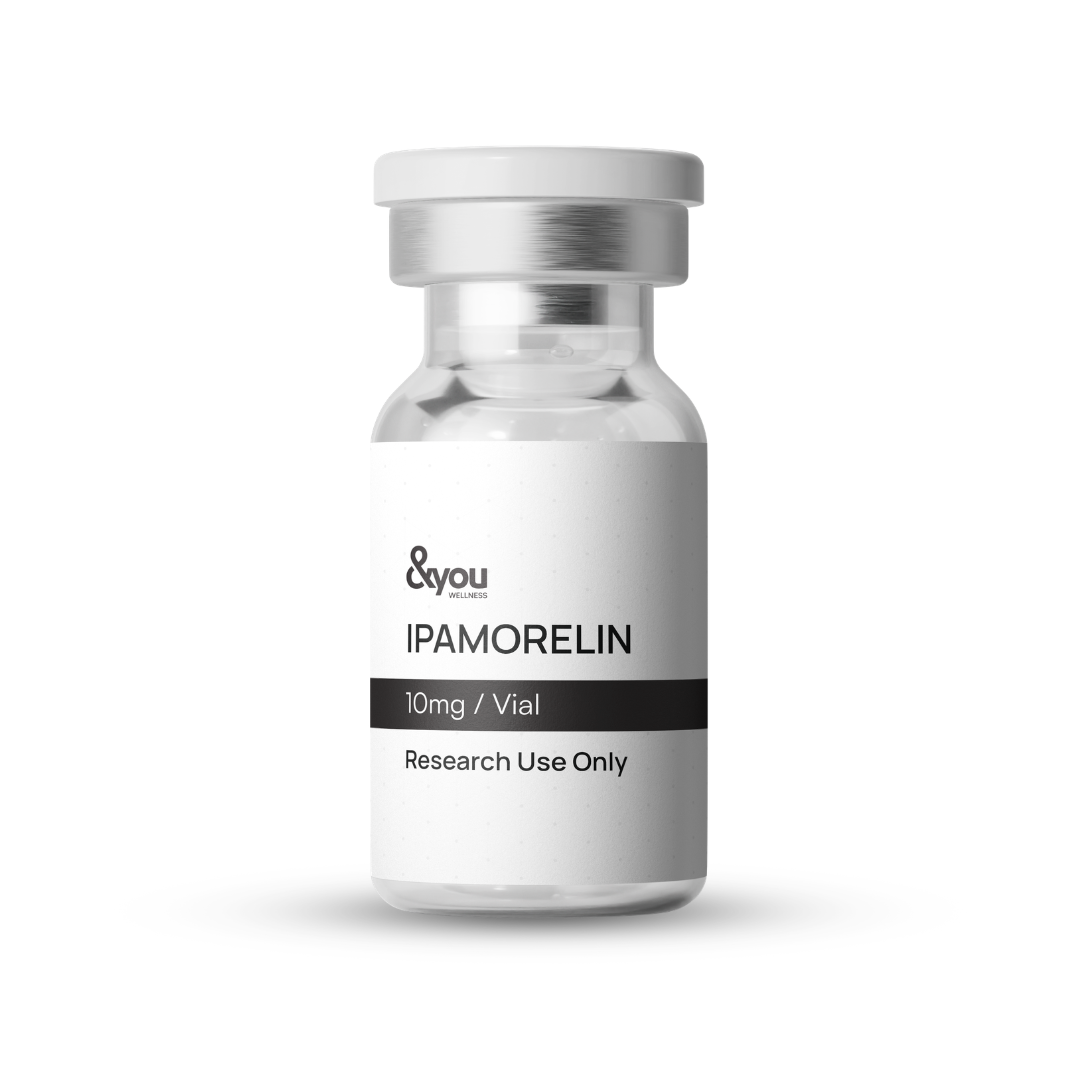
Compound: Ipamorelin. A GHRP, or growth hormone releasing peptide.
Research Status: Phase II
Regulatory Status: Not FDA approved. Was not among the seven peptides voted on by the FDA Pharmacy Compounding Advisory Committee on July 23 2026.
What This Is
A growth hormone secretagogue. It prompts your pituitary to release growth hormone.
If you have read the Tesamorelin module, you already know half of this. There are two separate routes to a GH pulse:
GHRH analogs, including tesamorelin and sermorelin, act on GHRH receptors.
GHRPs, including ipamorelin, act on the ghrelin receptor.
Different receptors, same outcome. That is why the two classes combine, and why almost every GH protocol you encounter contains one of each.
Ipamorelin is the GHRP most people use, for one reason covered below.
Selectivity Is the Whole Story
Older GHRPs, GHRP-6 in particular, prompt GH release and also raise cortisol and prolactin, and produce significant hunger.
That matters. Cortisol is catabolic, which means an older GHRP was partly working against the outcome people wanted. Raised prolactin has its own unwanted effects. Hunger is an obvious problem for anyone using the compound for body composition.
Ipamorelin is selective. It activates the GH pathway while leaving cortisol and prolactin largely untouched.
That selectivity is the entire reason it displaced the older compounds, and it is why it appears in almost every GH stack rather than its predecessors.
It Mimics Ghrelin
Ghrelin is the hormone your stomach releases when empty. You know it as the hunger signal, and it also prompts GH release.
Ipamorelin binds the same receptor. It is copying one of ghrelin's two jobs.
Worth noting why this is interesting: selectivity here operates within a receptor's own downstream effects, not just across receptors. Ipamorelin reproduces ghrelin's GH signaling with much less of its appetite signaling than older compounds in its class, which is a finer distinction than it first sounds.
Your Feedback Loop Stays Intact
Same structural advantage as tesamorelin and worth repeating, because it is the reason people choose secretagogues over injecting HGH.
Injecting growth hormone adds hormone from outside. Levels rise and stay elevated, and your own production downregulates in response.
Ipamorelin prompts your pituitary to release its own GH in a pulse. Your regulatory systems stay in the loop. If GH and IGF-1 climb, your own feedback mechanisms push back.
That means the ceiling on the effect is partly set by your physiology rather than by the syringe, which is a real safety property and not a marketing one.
Who This Is For
People pursuing body composition change, recovery or sleep quality through the GH axis.
People running a GHRH analog who want the second half of the classic stack.
People who want GH support with the least hormonal noise, which is what selectivity buys.
Inside the Mechanism
The Ghrelin Receptor
Formally the growth hormone secretagogue receptor. It sits in the pituitary and the hypothalamus, and its natural ligand is ghrelin.
Ipamorelin binds it and triggers GH release.
Because this receptor is separate from the GHRH receptor, the two pathways can run at once. That is the mechanistic basis for the GHRH plus GHRP combination, and it is one of the few places in this field where synergy is used with a real basis behind it.
The Cascade
Three steps, and everything follows from them.
Step One: Ipamorelin binds the ghrelin receptor on the pituitary.
Step Two: The pituitary releases a GH pulse.
Step Three: GH acts on tissue directly and prompts the liver to produce IGF-1.
Body composition, recovery, bone density and the side effects all come from that cascade. You are working one step upstream of the hormone.
What Selectivity Actually Means
Worth being precise, because the word does a lot of work in this compound's marketing.
What it does Mean: Ipamorelin does not meaningfully raise cortisol or prolactin, and produces less appetite stimulation than older GHRPs.
What it does Not Mean: That there are no GH-related effects. Water retention, tingling and joint discomfort come from raising growth hormone, and any compound raising GH produces them at sufficient dose. Selectivity is about which hormones are affected, not about escaping the consequences of the one you are deliberately raising.
A cleaner signal is still a signal, and it still has downstream effects.
Why Before Bed
Your largest natural GH pulse occurs during early deep sleep. Dosing 30 to 60 minutes before bed aligns an induced pulse with the one your body was going to produce anyway.
Two reasons this matters. Working with the natural rhythm rather than against it, and GH itself influences sleep quality, which is part of why improved sleep is a commonly reported effect rather than a marketing addition.
Why Not After Eating
Elevated blood glucose and insulin blunt GH release. Food raises both.
Dosing on a relatively empty stomach, roughly two hours after eating, gives the pulse a clearer run. This is the same principle as tesamorelin's empty-stomach guidance, and it is mechanism rather than preference.
Bone Density
GH and IGF-1 both influence bone remodelling. This is a slower effect than body composition change and it is one of the more interesting long-term rationales for GH-axis work, particularly with age.
What the Research Actually Shows
Read the Status Tag First
Ipamorelin is tagged Phase II. Human clinical trials assessing efficacy, above animal work, below the Phase III trials that establish effect at scale.
Its position in this library: above the preclinical compounds like BPC-157 and MOTS-c, below tirzepatide and tesamorelin, roughly alongside Selank.
The primary reference dates to 1998. Ipamorelin was developed as a pharmaceutical candidate and did not complete the path to approval, which is a common outcome and not by itself an indictment. Compounds are discontinued for commercial reasons as often as scientific ones.
What it does mean is that the large trials that would settle the questions here were never run.
The Selectivity Claim Is the Best-Supported Part
Unusual for this library, so worth saying plainly: the core claim about Ipamorelin is the one with the best evidence behind it.
The research specifically characterized its selectivity, comparing GH release against cortisol and prolactin response. That is a direct mechanistic comparison rather than an extrapolation, and it is why Ipamorelin displaced the older GHRPs in practice.
What is less established is the downstream outcome data. That Ipamorelin releases GH selectively is well supported. What that produces in body composition, recovery or aging over months in healthy adults is much less studied.
Mechanism established, outcomes assumed. That gap is where most of the marketing lives.
GH Does Not Equal Results
The most important interpretive point here.
Raising growth hormone is not the same as achieving what people want from raising it. GH influences body composition, recovery and tissue maintenance, and those outcomes also depend on training, protein intake, sleep and total energy balance.
A GH pulse in someone not training and not eating adequately has very little to work with. The hormone is permissive rather than sufficient.
This is also why GH-axis results are frequently overstated. Someone starts ipamorelin, simultaneously starts training more seriously and sleeping better because they have decided to take their health seriously, and attributes the result to the peptide.
The Measurable Advantage
Ipamorelin shares one useful property with Tesamorelin: IGF-1 is measurable.
If the compound is working, IGF-1 responds. That gives you an objective check on whether your product is active and whether your protocol is doing anything, available through ordinary bloodwork.
Very few compounds in this library offer that. Take a baseline before starting.
What Is Not Established
Long-Term Use: Cycles of 8 to 12 weeks are standard practice rather than a studied duration. What continuous GH-axis stimulation does over years is not something anyone has data on.
Optimal Dosing: The 100 to 500 mcg range is a fivefold spread derived from practice, not from dose-finding trials in healthy adults.
The GH and Cancer Question: GH and IGF-1 have growth-promoting effects, and the discussion in endocrinology about GH therapy and malignancy risk is long-running and unsettled. Worth knowing the question exists, and a prescriber conversation for anyone with relevant history.
The July 2026 Committee Vote
On July 23 2026 the FDA's Pharmacy Compounding Advisory Committee voted on seven peptides.
Recommended: BPC-157, KPV, TB-500, MOTS-c, Epitalon, Semax
Not recommended: Emideltide, also known as DSIP
Ipamorelin was not assessed at that meeting. Not recommended and not rejected, and its absence carries no evaluative meaning.
Holding Both Facts
Ipamorelin has a well-characterized mechanism, genuine research support for its central selectivity claim, a preserved feedback loop, and an objective marker you can track.
It also never completed clinical development, has outcome data that is much thinner than its mechanism data, operates in a domain where lifestyle changes routinely get credited to the compound, and has no long-term safety data in healthy adults.
Hold both at once.
Sourcing & Verification
Original classroom lesson. Preparation, measurement, sourcing, or protocol examples are source material, not verified instructions or clinical guidance.
Ipamorelin sits in the most crowded corner of this market. Half a dozen GH-axis compounds, similar names, similar appearance, very different prices.
What to Verify on This Compound
Identity, against a long list of relatives. Ipamorelin shares its market with CJC-1295, sermorelin, tesamorelin, GHRP-2 and GHRP-6. Several are cheaper. GHRP-6 in particular is the compound Ipamorelin displaced, and receiving it instead means receiving the cortisol, prolactin and hunger effects you chose Ipamorelin to avoid.
Mass spectrometry identity confirmation is what distinguishes them. A purity figure does not.
Blend products need extra scrutiny. Ipamorelin is frequently sold pre-blended with CJC-1295. Apply the same method as the KLOW module: ask for the ratio in writing, work out what each dose actually delivers, and require identity confirmation on both components rather than one purity figure for the vial.
Micrograms mean small margins. At 200 to 300 mcg per dose, a vial contains many doses and small errors in stated content translate into meaningful dosing errors. Ask for the impurity profile rather than accepting a headline number.
The COA Standard
A valid COA names the testing laboratory, carries a batch number matching your vial, states a test date, gives purity with the method used, and confirms identity. Anything answering "available on request," or arriving as a screenshot with no traceable source, is not a COA.
The Verification You Actually Have
Worth naming, because it is unusual.
IGF-1 bloodwork tells you whether your product is active. If you dose ipamorelin for several weeks and IGF-1 has not moved, either the protocol is not working or the vial is not what it claims.
Very few compounds here give you an objective check on your supplier. Use it.
Storage
Lyophilized Powder: Cool, dry, protected from light. Reconstituted: refrigerate, protect from light, follow the manufacturer's window.
On a daily protocol a vial empties predictably, so storage is less of a constraint here than with as-needed compounds.
Preparation
Original classroom lesson. Preparation, measurement, sourcing, or protocol examples are source material, not verified instructions or clinical guidance.
Ipamorelin Reconstitution Guide
Vial strengths vary between suppliers, so always use the volume specified for your exact product.
Reference Configuration
Vial Size: 2 mg
Bacteriostatic Water: 2 mL
Resulting Concentration: 1 mg/mL, which is 1000 mcg/mL
What you will Need:
Ipamorelin vial
Bacteriostatic water
U-100 insulin syringes
Alcohol pads
Step 1: Prepare and Sanitize
Wash your hands and prepare a clean workspace.
Remove the caps from both the bacteriostatic water and the peptide vial.
Clean both stoppers with alcohol pads and allow them to dry.
Step 2: Reconstitute
Draw 2 mL of bacteriostatic water.
Insert the needle and introduce the water slowly along the inside wall.
Avoid directing the stream forcefully onto the powder.
Step 3: Mix Gently
Do not shake. Swirl gently until fully dissolved.
Step 4: Storage after Reconstitution
Refrigerate.
Protect from light.
Follow the manufacturer's window.
Do not freeze unless specifically indicated.
If You Are Running a GHRH Alongside
Most people run ipamorelin with CJC-1295, sermorelin or tesamorelin, which means two vials.
Two practical points:
Reconstitution volumes differ between compounds. Do not apply one compound's figure to another. This is the most common error in multi-vial GH protocols and it produces a concentration wrong by a factor of two or more without looking wrong.
Label both vials clearly. Compound, concentration, date. Two small identical vials in a fridge door, drawn at night before bed, is exactly the setup where a mix-up happens.
Measurement
Original classroom lesson. Preparation, measurement, sourcing, or protocol examples are source material, not verified instructions or clinical guidance.
Ipamorelin Measurement Guide
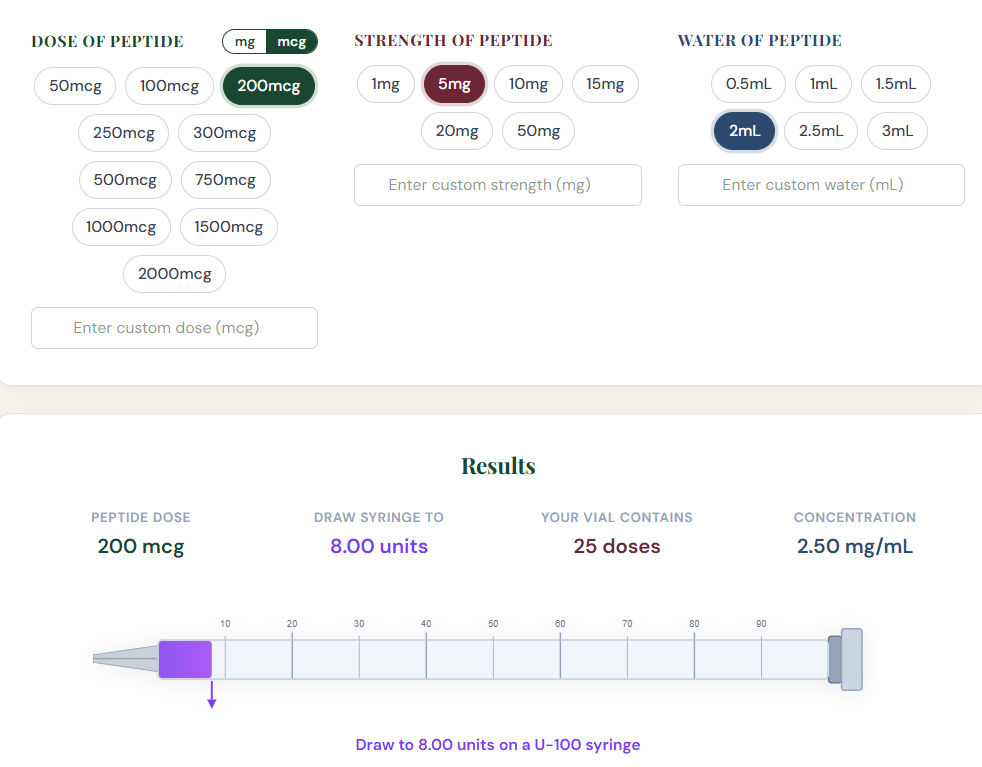
Calculator, pre-filled with Ipamorelin defaults: https://peptidetrainings.com/tools/reconstitution-calculator?label=Ipamorelin
Draw Volume Reference
At 2 mg reconstituted with 2 mL, giving 1000 mcg/mL, on a U-100 syringe:
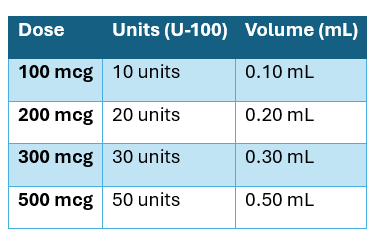
The correct measurement depends on vial strength, reconstitution volume, desired dose and syringe type.
Calculate Your Dosage
→ Click here to calculate your dosage
Important
Micrograms, not milligrams. A 2 mg vial holds 2000 mcg. A 200 mcg dose is one tenth of it. Misreading the unit is a tenfold error here and a thousandfold error if you confuse the units entirely.
Multiple daily doses add up. Dosing three times daily at 300 mcg is 900 mcg per day, which is well above the per-dose range and worth being deliberate about rather than arriving at by accident. Track the daily total.
You are dosing at night. A practical point specific to this compound. Drawing in a dim bedroom before bed is where misreads happen. Draw in good light, or prepare earlier.
Check what a blend delivers. If you are using a pre-blended CJC-1295 and ipamorelin vial, your draw volume delivers both compounds at a fixed ratio. Work out what each dose actually contains before comparing it to standalone figures.
Always confirm your vial strength, your reconstitution volume and your syringe type before drawing.
Protocol
Original classroom lesson. Preparation, measurement, sourcing, or protocol examples are source material, not verified instructions or clinical guidance.
Ipamorelin Dosing Protocol
The following framework is provided for educational reference and should not be treated as an established clinical dosing guideline.
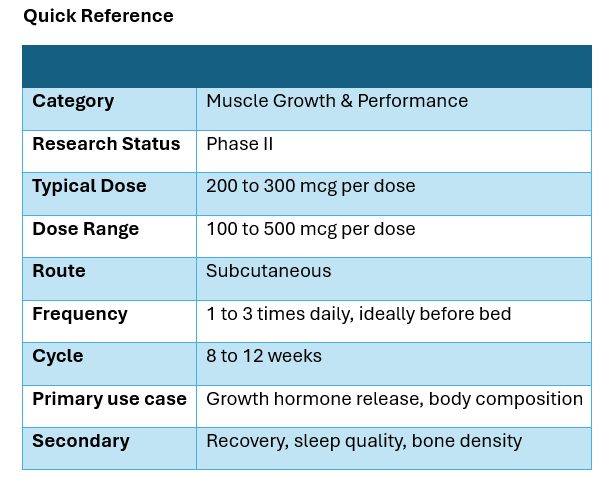
Typical Dose
Dose: 200 to 300 mcg per dose
Dose Range: 100 to 500 mcg per dose
Frequency: 1 to 3 times daily, ideally before bed
Route: Subcutaneous injection
Cycle: 8 to 12 weeks
Timing Is Mechanism
Two rules, both derived from how GH release works.
30 to 60 minutes before bed. Aligns the induced pulse with your natural nocturnal GH release.
Avoid eating for about 2 hours beforehand. Elevated glucose and insulin blunt GH release, so dosing on a relatively empty stomach gives the pulse a clearer run.
Getting these wrong does not make the compound dangerous. It makes it less effective, which on a compound with no felt signal means you may never know.
One Dose or Three?
Once daily before bed is the simplest protocol and the one most people run. It aligns with the natural pulse and it is sustainable over twelve weeks.
Multiple daily doses aim for more pulses across the day. The trade is a higher daily total, more injections, and more difficulty keeping each dose away from food.
Start with one. Adding frequency is easy later, and starting at three teaches you nothing about what one would have done.
Cycling
8 to 12 weeks, with time off afterward.
The reasoning is that continuous stimulation of any receptor system tends to reduce its responsiveness, and the off-period allows that to reset. This is standard practice rather than a studied protocol, which is worth knowing.
The break also serves a practical purpose: whether anything changes when you stop is useful information about whether the compound was doing anything.
Track IGF-1
Given that the effects here are slow and largely invisible, this is the single most useful thing you can do.
Take a baseline before you start. Retest partway through the cycle. If IGF-1 has not moved, something is wrong with the product, the dose or the timing, and you would otherwise have no way to know.
Set Expectations Properly
GH-axis compounds are slow. Recovery and sleep changes are commonly reported within weeks. Body composition change takes months, and it depends heavily on training and nutrition being in place.
If those are not in place, the hormone has very little to act on. A GH pulse does not build tissue on its own.
Clinical Notes
Best taken 30 to 60 minutes before bed to align with the nocturnal GH pulse.
Avoid eating for around 2 hours before dosing.
Selectivity means minimal cortisol and prolactin impact. It does not mean no GH-related effects.
Water retention and tingling are GH effects, are dose-related, and reducing the dose is a legitimate response to them.
GH raises blood glucose. Anyone with insulin resistance, prediabetes or diabetes should treat this as a prescriber conversation, and glucose is worth tracking on a longer protocol.
Consult a qualified healthcare professional before using experimental peptide products.
Side Effects and Safety
Mild water retention
Tingling sensation
Injection site reactions
Increased hunger, though notably less than with older GHRPs such as GHRP-6
All of these trace to the mechanism. Water retention and tingling are growth hormone effects. Any appetite effect comes from acting on the ghrelin receptor, and the whole point of Ipamorelin's selectivity is that this effect is substantially smaller than with its predecessors.
They are dose-related, which means adjusting downward is a legitimate response rather than an admission of failure.
Research References
Stack Logic
Original classroom lesson. Preparation, measurement, sourcing, or protocol examples are source material, not verified instructions or clinical guidance.
Ipamorelin is half of a pairing by design. It is a GHRP, and the GH axis has two doors, so the obvious partner is a GHRH analog.
The GHRH Plus GHRP Structure
Two separate receptors, one outcome.
GHRH analogs, meaning CJC-1295, sermorelin and tesamorelin, act on GHRH receptors.
GHRPs, meaning ipamorelin, act on the ghrelin receptor.
Combining them produces a larger pulse than either alone, because you are opening both doors rather than pushing harder on one. This is one of the few places in this field where synergy has a genuine mechanistic basis.
What Pairs With Ipamorelin, and Why
Ipamorelin + CJC-1295. The most common GH stack. CJC-1295 provides sustained GHRH signalling while ipamorelin triggers the pulse. Two receptors, complementary timing, and the pairing most protocols are built around.
Ipamorelin + Sermorelin. The milder version of the same structure. Sermorelin is shorter-acting than CJC-1295 with a longer clinical history, which makes this the more conservative choice. Frequently where providers start.
Ipamorelin + Tesamorelin. Same GHRH plus GHRP logic, with tesamorelin adding specific visceral fat targeting and FDA approval behind its own indication. Covered from the other side in the Tesamorelin module.
Ipamorelin + BPC-157. Mechanistically neat and not a GH-axis pairing at all. Ipamorelin raises GH and IGF-1. BPC-157 increases growth hormone receptor density on tendon fibroblasts. More signal plus better reception, which is two halves of one system.
What Does Not Belong
A second GHRP. GHRP-2, GHRP-6 or hexarelin alongside ipamorelin means two compounds on the same receptor. That is duplication, and with the older GHRPs it also reintroduces the cortisol, prolactin and hunger effects ipamorelin exists to avoid.
HGH itself. Using a secretagogue alongside exogenous growth hormone defeats the reason for choosing a secretagogue, and suppresses the natural production you were stimulating.
More than one GHRH. Same logic as the GHRP point. CJC-1295 and sermorelin together is one receptor, twice.
The Question Specific to This Compound
How big a GH pulse are you aiming for, and what is measuring it?
This is the stack where escalation happens quietly. Every addition amplifies the same output, and the side effects, water retention, tingling, joint discomfort, glucose, all scale with that output. Stacking GH-axis compounds stacks their consequences, not only their benefits.
The preserved feedback loop that makes secretagogues attractive becomes less protective the harder the system is pushed from multiple directions at once.
IGF-1 is what turns this from guesswork into a measurable protocol. If you are running two or three GH-axis compounds without tracking it, you have no idea where you are.
Where This Leaves You
Ipamorelin is one of the better-reasoned compounds in this library. Its central claim, selective GH release without cortisol and prolactin, is the part of its research with the strongest support, and the GHRH pairing has real mechanism behind it rather than marketing.
What is much thinner is what it produces. Mechanism established, outcomes assumed, and no long-term data in healthy adults.
Run one GHRH and one GHRP, dose at night away from food, track IGF-1, and have training and nutrition in place before you start. That protocol uses what this compound actually does well and does not ask it to do the work that belongs to everything else.
Certificate of Analysis
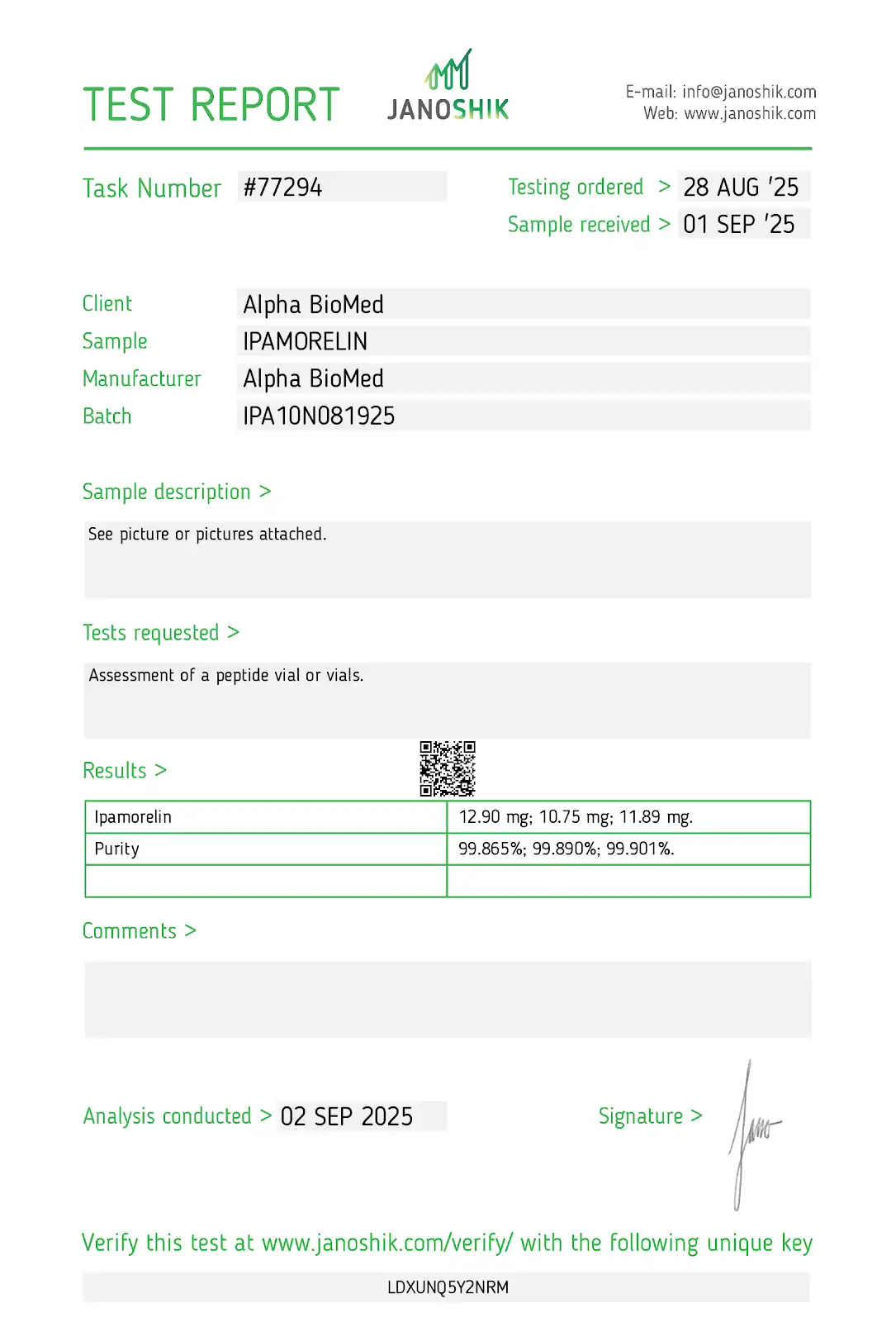
Report 77294, with analysis conducted September 2, 2025, identifies Ipamorelin and reports purity results of 99.865%, 99.890%, and 99.901% for three submitted samples. A report covers a submitted sample or lot, not safety, sterility, effectiveness, or every product sold. Its provenance has not been independently authenticated.
Open attached COAAll classroom topics