IGF-1 LR3
A modified IGF-1 analogue used in cell and animal research. Explore its biology, the limits of human evidence, and what the attached COA does and does not show.
These eight sections are an editorial research review of IGF-1 LR3, updated November 4, 2026. They replace unverified classroom claims with cited evidence and research-literacy guidance. The original Skool lessons remain linked for context and are not the source of this new writing. For educational and research purposes only. Not medical advice.
The Compound, Explained
What is IGF-1 LR3?
IGF-1 LR3 is a modified version of insulin-like growth factor 1, a protein involved in growth signaling. It is used as a laboratory reagent, including in cell culture. That role does not establish a treatment benefit in people. [1] [7]
The molecule has an arginine substitution at position 3 of the IGF-1 sequence and a 13-amino-acid extension at its amino end. It is 83 amino acids long. The extension is not simply an “arginine extension.” [1]
Commonly discussed uses and claims
Outside the lab, IGF-1 LR3 is sometimes discussed or used in bodybuilding. Goals associated with IGF-1 use include building muscle, improving recovery and reducing body fat. The detailed claims often draw on IGF-1 generally, rather than human LR3 studies. These are reported nonmedical aims, not approved uses or proven LR3 benefits. [8] [9]
Muscle growth
The claim: adding lean muscle by stimulating growth signaling. Why people discuss it: IGF-1 is involved in growth biology, and LR3 has activity in laboratory cells. The evidence limit: cell activity does not show that LR3 produces muscle gains in people. In the reviewed guinea-pig study, overall growth and carcass composition did not improve significantly, even though some organs grew relatively larger. [2] [7] [8]
Recovery and tissue repair
The claim: faster recovery after training or an injury. This aim is reported for nonmedical IGF-1 use, but it is not evidence that LR3 heals a human injury or shortens recovery time. The LR3 studies reviewed here do not establish those outcomes. General growth-factor biology and personal reports are not substitutes for human LR3 recovery studies. [7] [8] [9]
Fat loss and body recomposition
The claim: less body fat while retaining or adding muscle, sometimes called body recomposition. This is another aim associated with nonmedical IGF-1 use, not an established LR3 result. Reduced food intake and weight gain in a pig experiment do not prove healthy fat loss or better body composition in people. [2] [3] [8]
What about testimonials? A change in physique or recovery does not show that LR3 caused it. Training, nutrition and other compounds can affect the same outcomes. These claimed uses should not be read as a recommendation to self-experiment. Research-use-only compounds are not intended for human consumption.
Where does the evidence stand?
The studies reviewed here are laboratory and animal studies. They do not establish that LR3 builds muscle, improves recovery, reduces body fat, or slows aging in people. “Preclinical” means studied before established clinical use, not proven safe for self-experimentation. [2] [3] [4] [7]
For educational and research purposes only. Not medical advice. Research-use-only compounds are not intended for human consumption.
Inside the Mechanism
Binding proteins help regulate availability
IGF-binding proteins attach to IGF-1 and help control its availability. LR3 binds less strongly to these proteins than native IGF-1. Repligen describes stronger activity in certain cell-culture settings. That comparison is about laboratory conditions, not a promised increase in human muscle growth. [1]
Direct signaling is not a safety guarantee
LR3 is an IGF-1 analogue, not a growth hormone secretagogue. Research on its cell-growth activity cannot establish a safe dose or show that it selectively grows the tissue a person wants. In a guinea-pig experiment, some organs grew relatively larger without significant improvement in overall growth or carcass composition. [2] [7]
What about its half-life?
A validated human plasma half-life was not established by the sources reviewed. The often-repeated 20 to 30 hour claim should not be treated as proven human pharmacokinetics. The animal study found sustained glucose-lowering effects despite faster clearance of low-binding IGF-I variants. How long an effect lasts is not the same as how long a molecule remains in plasma. [4]
What the Research Actually Shows
Cell research
A 2023 study produced IGF-1 and LR3 IGF-1 using a yeast expression system and assessed cell-proliferation activity. It studied laboratory production and biological activity, not outcomes in people seeking muscle gain. [7]
Guinea-pig research
A 1995 experiment used continuous infusion for seven days. LR3 increased the relative weights of the adrenal glands, gut, kidneys, and spleen. Overall growth and carcass composition did not improve significantly. This is not evidence of selective muscle building in humans. [2]
Pig research
A 1997 study in finisher pigs found reduced daily weight gain and food intake, along with changes in growth hormone, endogenous IGF-I, IGF-binding protein 3, and insulin. Glucose was unchanged in that particular infusion experiment. Results vary with the animal model and experimental setup. [3]
A separate acute study found stronger and more sustained glucose lowering with LR3 and other low-binding IGF-I variants in pigs. The marmoset arm tested a different variant, des-1-3 IGF-I, not LR3. The direct LR3 low-blood-sugar result is from pigs, not both species. [4]
What remains unknown?
These results do not supply a reliable human benefit estimate, adverse-event rate, safe dose, treatment schedule, or long-term safety profile. General IGF-1 biology and personal testimonials cannot fill those gaps. [2] [3] [4] [7]
Sourcing & Verification
Reviewed research education, not original Skool lesson text. Preparation, measurement, protocol, and stack discussions do not provide human-use instructions.
Preserve the exact COA, without overstating it
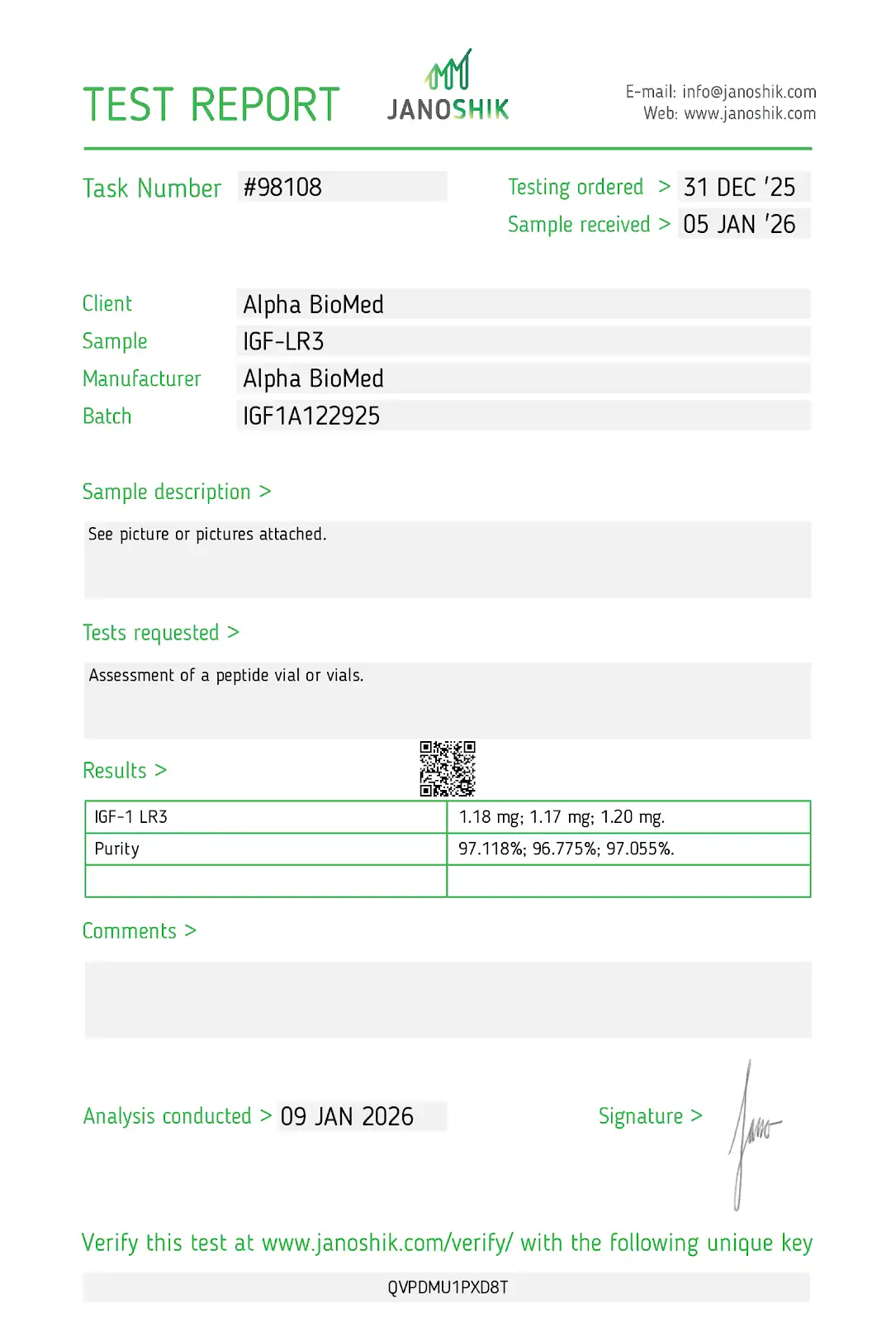
The existing profile has an attached report identified in its supplied records as Janoshik report 98108, lot IGF1A122925. Its recorded analysis date is January 9, 2026, with purity results of 97.118%, 96.775%, and 97.055% for three submitted samples.
The report and its provenance have not been independently authenticated. It applies to the submitted samples or lot, not every product sold. A purity result is not proof of sterility, clinical safety, or effectiveness.
Ask what was actually tested
Does the molecule name match LR3 rather than another IGF variant? Does the lot match the material being discussed? What method and measurement does the report describe? Do not infer that an unreported test was passed.
A change in someone's bloodwork is not, by itself, a laboratory authentication of a vial. It cannot replace analysis of the material or establish safe human use.
Preparation
Reviewed research education, not original Skool lesson text. Preparation, measurement, protocol, and stack discussions do not provide human-use instructions.
Laboratory preparation is not an injection guide
Cell-culture instructions describe a specific laboratory reagent and experimental setting. They cannot be converted into a human reconstitution or administration recommendation. Follow the documentation for the exact reagent within a qualified laboratory's procedures. [1]
This profile does not recommend a diluent, syringe type, vial concentration, injection route, or storage window for human use. The original classroom preparation lesson remains linked for context, not as verified instructions.
Measurement
Reviewed research education, not original Skool lesson text. Preparation, measurement, protocol, and stack discussions do not provide human-use instructions.
Keep the units and the setting clear
A mass, a concentration, and a delivered volume are different measurements. Correct arithmetic cannot establish that an experimental compound is safe to administer to a person.
The reviewed evidence does not provide an evidence-based human target dose. This profile therefore does not give a draw-volume table or a syringe-unit example. Animal doses, cell-culture concentrations, and prescribing instructions for a different medicine are not validated LR3 dose references. [1] [2] [3] [4] [5]
Protocol
Reviewed research education, not original Skool lesson text. Preparation, measurement, protocol, and stack discussions do not provide human-use instructions.
No validated human protocol is provided
The sources reviewed do not establish a safe human dose, injection schedule, workout timing, cycle length, or receptor “reset” interval. No numerical dosing or cycling advice is provided. [2] [3] [4] [7]
Low blood sugar is a safety concern
The acute pig study found sustained glucose lowering with LR3. It does not define a reliable onset time, frequency, or severity in people. Do not assume that post-workout timing, food, glucose monitoring, or a smaller dose makes LR3 safe. [4]
Mecasermin is a different medicine
INCRELEX contains mecasermin, recombinant human IGF-1. Its FDA label covers particular pediatric growth-failure conditions. That approval does not cover LR3, and its dosing instructions cannot be transferred to LR3. [5]
The mecasermin label warns about severe hypoglycemia and other adverse effects. It also reports malignant neoplasia and states that the relationship between treatment and new neoplasia is unknown. These warnings provide context for IGF-pathway concerns. They are not measured LR3 adverse-event rates or proof that LR3 causes cancer. [5]
Tested sport
WADA prohibits IGF-1 and its analogues at all times under S2.3. LR3 is an IGF-1 analogue. Athletes should check the current list and their governing body's rules. [6]
Stack Logic
Reviewed research education, not original Skool lesson text. Preparation, measurement, protocol, and stack discussions do not provide human-use instructions.
A plausible pathway is not a validated combination
The reviewed sources do not establish a safe or effective human LR3 stack with growth hormone secretagogues, BPC-157, PEG-MGF, MOTS-C, or GLP-1 medicines. A mechanistic explanation or a popular pairing is not a combination trial. [2] [3] [4] [7]
In particular, this profile does not present MOTS-C as protection against LR3-related low blood sugar. It also does not claim that PEG-MGF timing, post-workout use, or combining growth signals improves human outcomes.
Instead of a stack recipe, ask three questions: Was the exact combination studied? Were the subjects humans, animals, or cells? Were the claimed benefits and risks actually measured?
Sources used in this editorial review
[1] Repligen LONG R3 IGF-I molecular modifications and cell-culture applications
[2] Conlon et al. 1995, organ growth and circulating IGFs in guinea pigs
[3] Dunaiski et al. 1997, reduced growth and endocrine changes in pigs
[4] Tomas et al. 1997, hypoglycemic action of IGF-I variants in animal models
[5] FDA INCRELEX mecasermin prescribing information revised July 2025
[6] WADA Prohibited List, IGF-1 and its analogues under S2.3
[7] Lu et al. 2023, expression and cell activity of IGF-1 and LR3 IGF-1
[8] Dopinglinkki: IGF-1 and Long R3 IGF-1, reported bodybuilding uses
[9] Anderson et al. 2017, IGF-I use for anabolic purposes and evidence limits
Certificate of Analysis
Report 98108, with analysis conducted January 9, 2026, identifies IGF-1 LR3 and reports purity results of 97.118%, 96.775%, and 97.055% for three submitted samples. This certificate applies to IGF-1 LR3, not other IGF variants. A report covers a submitted sample or lot, not safety, sterility, effectiveness, or every product sold. Its provenance has not been independently authenticated.
Open attached COAAll classroom topics