GLOW
Explore the ingredients of a three-compound blend. The combination has not been established as a treatment.
This material is educational, not medical advice or a treatment recommendation. Classroom claims and example protocols have not all been independently verified.
The Blend, Explained
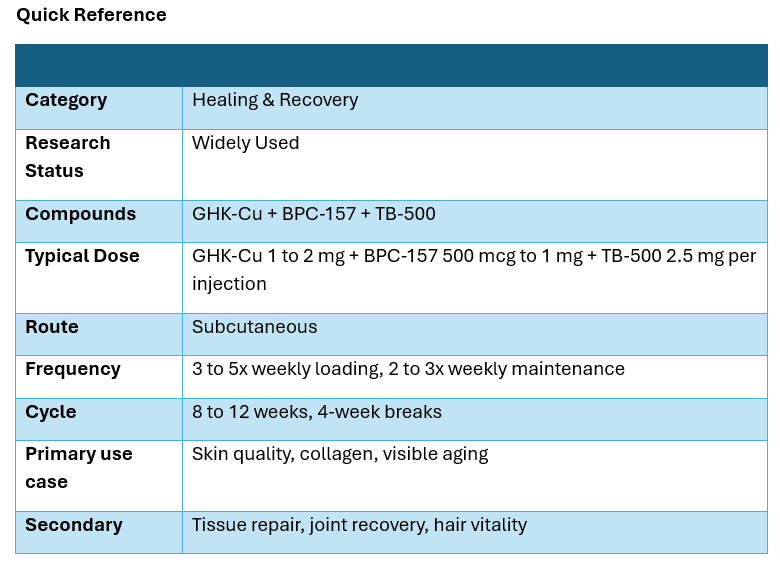
Category: Healing & Recovery
Compounds: GHK-Cu + BPC-157 + TB-500
Research Status: Widely used. All three components preclinical.
Regulatory Status: Not FDA approved. BPC-157 and TB-500 were recommended for compounding eligibility by the FDA Pharmacy Compounding Advisory Committee on July 23 2026. Non-binding. GHK-Cu was not assessed at that meeting.
What This Is
Three peptides run together for skin, collagen and tissue repair.
GHK-Cu. Collagen, elastin and skin structure. The component that defines the blend.
BPC-157. Local tissue repair and angiogenesis.
TB-500. Systemic repair signaling and cell migration.
The Simplest Way to Understand It
GLOW is the Wolverine Stack plus GHK-Cu.
BPC-157 and TB-500 together are the classic healing pairing, covered in its own module: local repair signal plus systemic repair environment. That combination is built for injury.
Adding GHK-Cu redirects it. You keep the full repair engine and gain collagen, elastin and skin structure on top. The stack stops being purely about fixing damage and starts being about visible aging as well.
If you have read the Wolverine module, you already understand two thirds of this one. The question worth asking is what the third component changes, and the answer is that it changes what the stack is for rather than making it stronger at what it already did.
The Important Difference From KLOW
Both are multi-peptide products and they are built differently, which affects how you use them.
KLOW is a fixed blend. One vial, pre-set ratio, one draw volume. Its BPC-157 content works out below the standalone range because the ratio is weighted heavily to GHK-Cu.
GLOW is usually a protocol, not a single vial. The stated doses are full standalone doses: GHK-Cu 1 to 2 mg, BPC-157 500 mcg to 1 mg, TB-500 2.5 mg. Each component is dosed as it would be on its own.
That difference matters more than the ingredient lists. With GLOW you can adjust one component without moving the others, drop one entirely, or change the ratio as your goals shift. With a fixed blend you cannot.
Pre-blended GLOW vials do exist. If you buy one, you are trading that flexibility for convenience and you should check what the fixed ratio actually delivers per dose, using the method in the KLOW module.
GLOW Versus KLOW, Practically
The distinction is one compound: KLOW adds KPV, an anti-inflammatory tripeptide.
Choose GLOW if your target is skin quality, collagen, hair and recovery, with no significant inflammatory component.
Choose KLOW if chronic inflammation is part of the problem, meaning reactive skin, rosacea, gut conditions, immune-driven flare-ups.
GLOW is the simpler product, and where inflammation is not part of the picture you are not paying for a peptide you do not need.
Who This Is For
People whose primary goal is skin quality and visible aging, who also want tissue repair.
People running an injury recovery protocol who want the aesthetic side covered at the same time.
People who want control over individual component doses rather than a fixed ratio.
Inside the Mechanism
Three peptides, three jobs. The case for the combination is that these mechanisms are genuinely separate.
GHK-Cu: Structure and Signaling
A naturally occurring copper tripeptide, present in human plasma, with levels declining substantially with age.
It drives synthesis of collagen, elastin and glycosaminoglycans, which is three components rather than one. Collagen gives tensile strength, elastin gives recoil, glycosaminoglycans hold water and provide cushioning. Skin loses all three with age at different rates, which is why approaches targeting collagen alone plateau.
The copper is functional. It is a cofactor for lysyl oxidase, which cross-links collagen fibers into a working matrix, and for superoxide dismutase, an antioxidant enzyme.
GHK-Cu is also the source of two things you will notice: a warmth or flushing sensation on injection, and any blue tint in a pre-blended vial, which is the copper-peptide complex and is correct.
The gene expression research attached to this compound is covered in the GHK-Cu module, including what that widely quoted figure actually represents. The short version: it is cell-culture work, and it is more interesting as mechanism than as a number.
BPC-157: Local Repair
Derived from a protein found in gastric juice.
It promotes angiogenesis through VEGF, building new blood vessels into healing tissue. That matters most in poorly vascularized tissue like tendon, where inadequate blood supply is the reason healing is slow.
It also upregulates growth hormone receptors on tendon fibroblasts, improving reception of growth signals already in circulation rather than adding new ones.
BPC-157 acts where it is placed, which is why injection site selection matters more for this component than the others.
TB-500: Systemic Mobilization
A synthetic fragment of Thymosin Beta-4, present in nearly every human cell and concentrated in wound fluid. Your native repair response uses it.
It upregulates actin expression, the protein cells use to move. Greater cell motility means repair cells can migrate to damaged tissue from elsewhere in the body.
That single mechanism is why TB-500 is systemic while BPC-157 is local. It is not acting at a site, it is mobilizing the repair system generally.
How the Three Fit Together
The cleanest way to hold it:
BPC-157 builds the supply route into the tissue.
TB-500 brings the repair workforce to it.
GHK-Cu supplies the structural material they build with.
Route, workforce, materials. Three different points in one process, which is what genuine mechanistic separation looks like as opposed to three compounds that all sound like healing.
Where the Overlap Sits
Worth being honest about, since no blend is perfectly clean.
BPC-157 and GHK-Cu both influence collagen. Both BPC-157 and TB-500 touch angiogenesis, through separate signaling. There is some redundancy in this stack.
That is not a flaw. Reinforcement at a shared step from different directions is a reasonable design. It does mean the components are not fully independent, and anyone describing them as three completely separate mechanisms is simplifying.
What the Research Actually Shows
Read the Status Tag First
GLOW is tagged Widely Used, which is a usage statement rather than an evidence statement.
All three components are preclinical. Animal models, cell work, some human data on GHK-Cu topically. No large human trials on any of the three by injection, and none on the combination.
The Blend Has Not Been Studied
Same point as KLOW and it applies equally here.
Research exists on GHK-Cu, on BPC-157 and on TB-500 individually. Research on the three together, at these doses, does not.
When you read that GLOW is backed by research, what is being cited is research on the parts. That is a reasonable basis for a formulation and it is not evidence the formulation works. Three compounds with individual support is a hypothesis about a combination, not a tested one.
The Synergy Claim
"The three compounds reinforce each other" and "work synergistically" appear throughout the marketing for this blend.
Synergy has a specific meaning: the combination produces more than the sum of the parts. Demonstrating it requires testing the combination against each component alone, which nobody has done here.
What is actually true is that the mechanisms are complementary, meaning they address different steps without duplicating each other. Complementary is a reasonable claim from the mechanisms. Synergistic is a stronger claim that has not been tested.
The distinction is worth carrying beyond this module, because synergy is the most overused word in blend marketing.
Component Evidence Is Not Equal
BPC-157. The largest research body of the three, roughly thirty years. Recommended by the July 2026 committee.
TB-500. Substantial research, native to human tissue, recommended by the committee.
GHK-Cu. Decades of research and the only one with human trial data, though that data is topical cosmetic work rather than injectable. Not assessed by the committee.
That last point needs care. GHK-Cu has the most human evidence of the three and the least transferable human evidence, because it was generated by a route this protocol does not use. Do not let topical results be quoted in support of injection.
The Timelines, Read Properly
Reported: energy and inflammation at 2 to 3 weeks, skin at 6 to 8 weeks, hair at 10 to 12 weeks.
Two things worth noticing.
The longer timelines are more credible than the shorter ones. Hair growth cycles are measured in months, and 10 to 12 weeks is consistent with actual follicle biology. Skin turnover at 6 to 8 weeks is similarly plausible.
"Improved energy within 2 to 3 weeks" is the softest claim on the page. Energy is subjective, fluctuates constantly, and is highly responsive to expectation and to the act of starting a health protocol. Treat the early reports as the least reliable and the slow structural ones as the most.
The Attribution Problem
Three compounds started simultaneously means any result has three candidate causes. If the blend works well you will not know which component did it, so you cannot simplify later. If you react badly you will not know which caused it.
GLOW is better placed here than KLOW, because the components are typically dosed separately. That means you can introduce them in sequence rather than all at once, and if you want to learn anything transferable about your own response, that is how to do it.
Holding Both Facts
GLOW combines three peptides with real individual mechanistic support, arranged with a logic that holds together, two of which carry a positive committee recommendation. It also has no research on the combination, no human trials on any component by this route, and a marketing vocabulary that claims synergy nobody has tested.
Hold both at once.
Sourcing & Verification
Original classroom lesson. Preparation, measurement, sourcing, or protocol examples are source material, not verified instructions or clinical guidance.
GLOW comes in two forms, and they carry completely different sourcing risks. Work out which you are buying before anything else.
If You Are Buying Separate Vials
You are sourcing three compounds, which means three COAs, three batch numbers and three suppliers' worth of risk. Apply the standard from each component's own module.
The upside is real: each vial is a single compound, so identity and purity are straightforward to verify and to interpret.
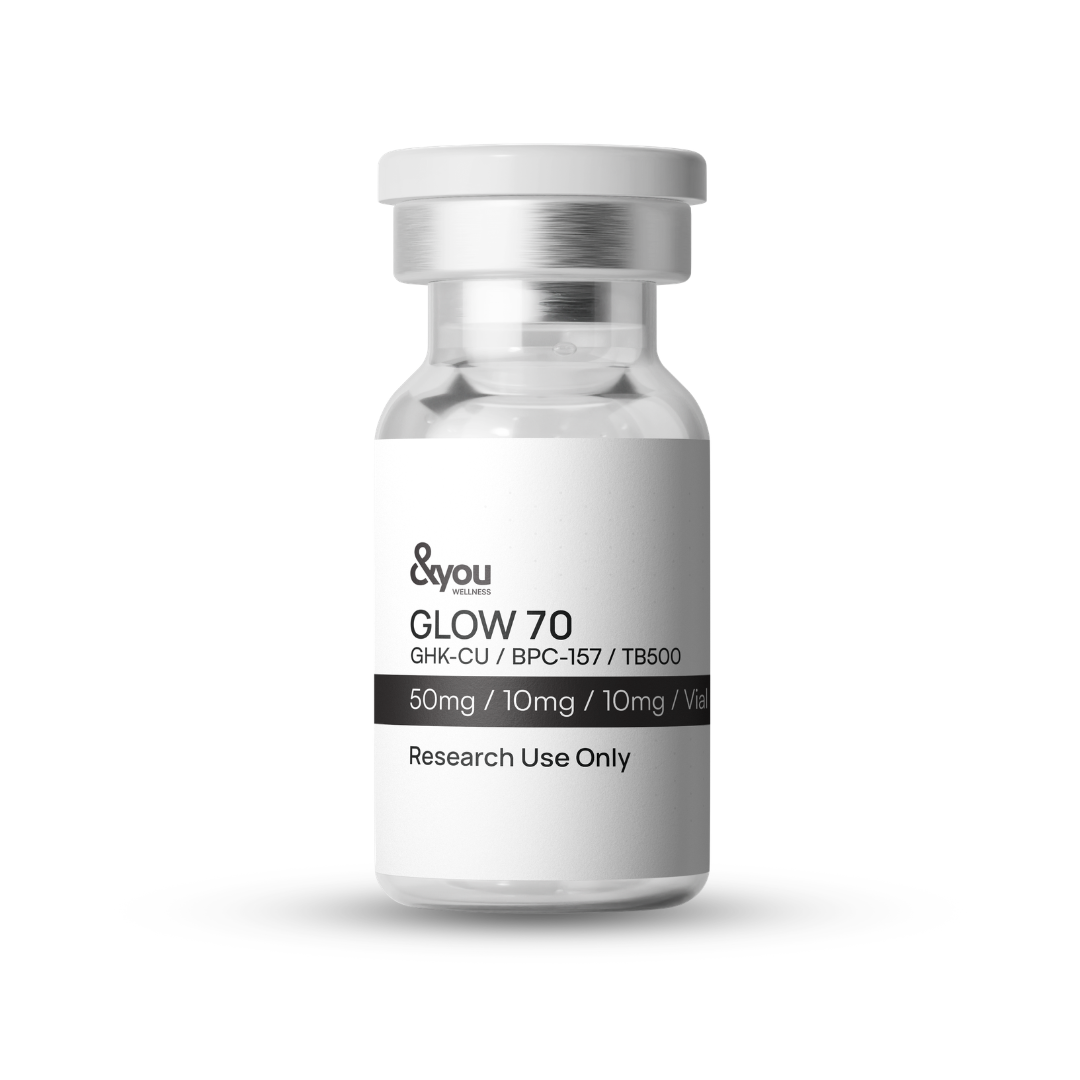
If You Are Buying a Pre-Blended Vial
Harder, and this is where most of the risk sits.
Ask for the ratio in writing. A total milligram figure on a label tells you nothing without the split. Two vials with identical totals can be different products.
Run the per-dose calculation before you buy. Divide by the ratio and the draw volume to find what each injection actually delivers, then compare against the standalone ranges in the GHK-Cu, BPC-157 and Wolverine modules. This is how you find out whether a blend is delivering real doses or a token amount of the expensive component. The KLOW module works a full example if you want the method.
The COA should cover each component. Three peptides means three identity confirmations and three purity figures. A single purity number for a blend does not tell you the BPC-157 is present at the stated amount.
Blue tint is expected and is not verification. The colour is the copper-peptide complex in GHK-Cu. It confirms copper peptide is present. It says nothing about the other two, nothing about the ratio, nothing about purity.
The COA Standard
A valid COA names the testing laboratory, carries a batch number matching your vial, states a test date, gives purity with the method used, and confirms identity. Anything answering "available on request," or arriving as a screenshot with no traceable source, is not a COA.
Storage
Lyophilized Powder: Cool, dry, protected from direct sunlight, humidity and heat. Reconstituted: refrigerate, protect from light, use within 30 to 60 days depending on the product.
If you are running separate vials, note that they will not all expire together. Track them individually rather than assuming one date covers the set.
Preparation
Original classroom lesson. Preparation, measurement, sourcing, or protocol examples are source material, not verified instructions or clinical guidance.
GLOW Reconstitution Guide
Which set of instructions applies depends on what you bought.
Option A: Separate Vials
Reconstitute each component according to its own module, since the correct volume differs for each. In brief:
GHK-Cu. Follow the volume specified for your vial strength.
BPC-157. Commonly 10 mg with 2 mL, giving 5 mg/mL.
TB-500. Follow the volume specified for your vial strength.
Do not apply one compound's reconstitution volume to another. This is the most common error in multi-vial protocols, and it produces a concentration that is wrong by a factor of two or more without looking wrong.
Label each reconstituted vial with the compound, the concentration and the date. Three identical-looking vials in a fridge door is a mix-up waiting to happen.
Option B: Pre-Blended Vial
Add bacteriostatic water according to the label, typically 1 to 2 mL for a standard vial. Use the manufacturer's figure rather than a number from another product.
General Steps
Step 1: Prepare and Sanitize
Wash your hands and prepare a clean workspace.
Clean all stoppers with alcohol pads and allow them to dry.
Step 2: Reconstitute
Draw the specified volume of bacteriostatic water.
Introduce it slowly along the inside wall of the vial.
Avoid directing the stream forcefully onto the powder.
Step 3: Mix Gently
Do not shake. Swirl gently until fully dissolved. Any solution containing GHK-Cu will show a blue tint, which is correct.
Step 4: Storage
Refrigerate.
Protect from light.
Use within the manufacturer's window, typically 30 to 60 days.
Do not freeze unless specifically indicated.
Can You Combine Them in One Syringe?
The question everyone asks. Drawing multiple compounds into one syringe is common practice and it introduces a real consideration worth knowing.
GHK-Cu is a copper complex, and copper is chemically reactive. Mixing it with other peptides in a syringe is not the same as injecting them separately, and the stability of such mixtures is not well characterized.
The conservative approach is separate injections at separate sites, which also lets you place BPC-157 near a target area while placing the others elsewhere. If you combine, draw immediately before injecting rather than preparing in advance.
Measurement
Original classroom lesson. Preparation, measurement, sourcing, or protocol examples are source material, not verified instructions or clinical guidance.
GLOW Measurement Guide
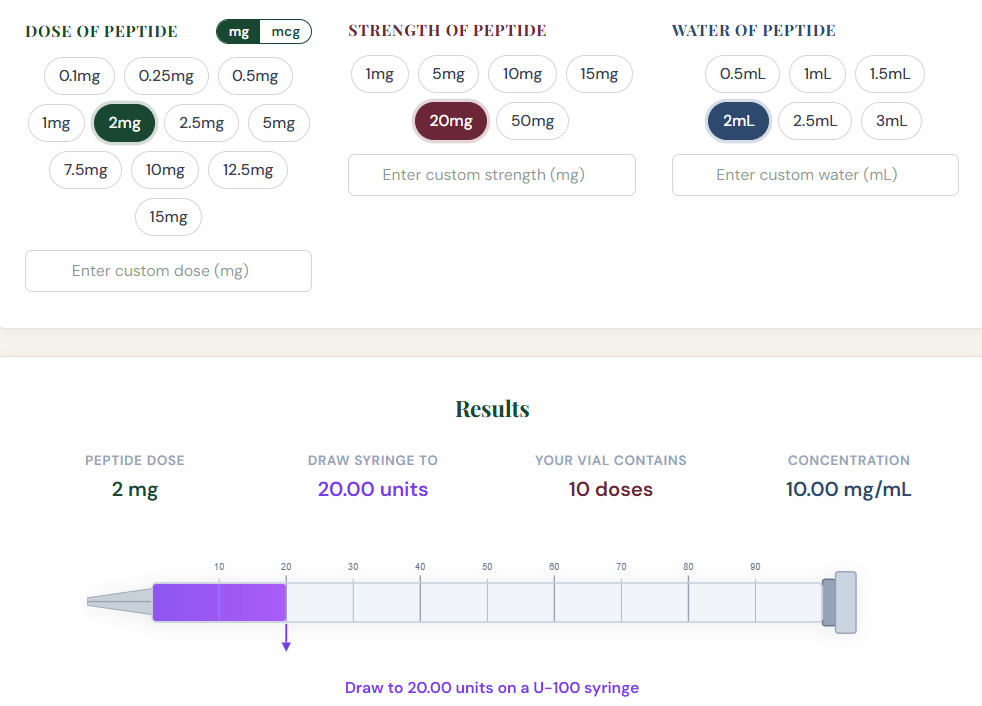
Calculator, pre-filled with GLOW defaults:
https://peptidetrainings.com/tools/reconstitution-calculator
Three Compounds, Three Calculations
If you are running separate vials, each has its own concentration and its own draw volume. There is no single reference table, and a number that works for one vial will be wrong for the others.
Typical doses per injection:
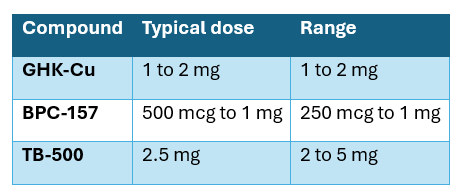
Work out each draw volume from that compound's actual vial strength and reconstitution volume.
Calculate Your Dosage
→ Click here to calculate your dosage
Important
Write your three volumes down. Three compounds, three concentrations, three unit figures, dosed several times a week for twelve weeks. Recalculating from memory each session is how a protocol drifts. Work them out once and keep them with your supplies.
Units differ between components. BPC-157 is dosed in micrograms while GHK-Cu and TB-500 are in milligrams. Reading a microgram figure as a milligram figure is a thousandfold error that will not look wrong in the syringe.
A pre-blend gives you one volume, not three. If you have a blended vial you draw a single volume, and the trade is that you cannot adjust any component independently. Do not increase the draw to get more of one compound, since that raises all three proportionally.
Count what you are already taking. If you run KLOW, or standalone GHK-Cu, BPC-157 or TB-500 alongside this, add the totals before deciding your doses.
Protocol
Original classroom lesson. Preparation, measurement, sourcing, or protocol examples are source material, not verified instructions or clinical guidance.
GLOW Dosing Protocol
The following framework is provided for educational reference and should not be treated as an established clinical dosing guideline.
Typical Dose per Injection
GHK-Cu: 1 to 2 mg
BPC-157: 500 mcg to 1 mg
TB-500: 2.5 mg
Dose ranges
GHK-Cu: 1 to 2 mg
BPC-157: 250 mcg to 1 mg
TB-500: 2 to 5 mg
Frequency
Loading Phase: 3 to 5 times per week
Maintenance: 2 to 3 times per week
Route: Subcutaneous. Abdomen, thigh, or near a target area. Rotate sites.
Cycle: 8 to 12 weeks, followed by a 4 week break.
The Loading Phase
Many protocols run 4 weeks at the higher frequency before dropping to maintenance.
The logic is front-loading: establishing a change takes more signaling than maintaining one. It also reduces total exposure across the cycle, which matters more with three compounds than with one.
Injection Site Strategy
This is where running separate vials pays off, and it is worth using deliberately.
BPC-157 acts locally, so placing it near a target area is mechanistically reasonable. TB-500 is systemic and site does not matter for it. GHK-Cu can go wherever is comfortable.
A pre-blend forces all three to the same site. If you have a specific injury alongside your aesthetic goals, separate vials let you place the one component where placement actually matters.
Rotate sites regardless, to avoid tissue buildup.
Clinical Notes
Reconstitute each component separately, or use a pre-blended vial if available.
Results are cumulative. Consistency across the cycle matters more than any single injection.
Expect warmth or flushing on injection from GHK-Cu. It passes.
Vitamin C inactivates copper peptides on contact. If you use topical vitamin C, keep it separate from any topical GHK-Cu, and be aware of the interaction generally.
Consult a qualified healthcare professional before use.
Side Effects and Safety
Temporary redness or irritation at the injection site
Mild nausea, usually resolving within the first week
Flushing or warmth from GHK-Cu
Fatigue in the first few days, an adjustment period commonly attributed to TB-500
Mild water retention
Darkening of existing moles or skin pigmentation. Rare, and monitor closely.
The Mole Point Deserves More Than a Bullet
That last item is listed among mild effects and it is the one to take seriously.
GHK-Cu and BPC-157 are both angiogenic, meaning they promote new blood vessel formation. Changes in the appearance of existing moles are also, separately, something dermatologists ask people to watch for.
The practical response is straightforward. Photograph any moles you have before starting a cycle. If anything changes in size, shape, color or border, stop and see a dermatologist rather than assuming it is the peptide.
Contraindications
Carried from the shared components and worth stating plainly:
Active malignancy. GHK-Cu and BPC-157 are angiogenic, and tumours require blood supply. This is the most important line here.
Copper-handling disorders, including Wilson's disease.
Pregnancy.
WADA-tested competition. TB-500 is on the prohibited list.
Recent surgery.
Research References
Stack Logic
Original classroom lesson. Preparation, measurement, sourcing, or protocol examples are source material, not verified instructions or clinical guidance.
GLOW is a stack someone else designed, and it is a well-designed one. The useful question is whether it is the stack you would have built.
The Design, Assessed
Three compounds addressing three points in one process: supply route, repair workforce, structural material. That is genuine mechanistic separation, with some acknowledged overlap on collagen and angiogenesis.
The construction is also transparent in a way most blends are not. It is the Wolverine Stack with a third compound added, which means you can see exactly what the design decision was and evaluate it directly.
That decision is GHK-Cu, and it is what converts a repair stack into an aesthetic one. Whether the blend suits you comes down to whether that conversion matches what you want.
Adding to GLOW
Three compounds already cover a lot of ground, so most additions duplicate something.
KPV is the addition that makes the most sense, and adding it is essentially building KLOW. If chronic inflammation is part of your picture, buying KLOW is usually simpler than adding a fourth vial.
Growth hormone secretagogues sit on a genuinely separate axis. GLOW improves the tissue's ability to respond to growth signals through BPC-157's receptor upregulation, while secretagogues raise the signal itself. More signal plus better reception.
NAD+ supports the cellular energy that repair and collagen synthesis consume. Indirect, defensible, and understand it is two steps removed from the outcome.
What does not make sense is adding more of what is already in there. Standalone TB-500 on top of GLOW is TB-500 twice. Standalone GHK-Cu on top of 1 to 2 mg is above the standalone range. Count what the protocol already delivers before adding anything.
GLOW or Wolverine?
The decision that actually matters, and it comes down to one question.
Is skin part of what you want changed?
If no, Wolverine is the better tool. Two compounds, full doses, aimed squarely at repair, and you are not paying for a third you do not need.
If yes, GLOW covers both and the addition is doing real work.
Both are defensible. What is not defensible is running GLOW for an isolated tendon injury and paying for GHK-Cu that has nothing to do with the problem.
The Advantage of Separate Vials
GLOW's real strength over a fixed blend is control, and it is worth using rather than ignoring.
You can introduce components in sequence rather than all at once, which is the only way to learn anything about your own response. You can adjust one dose without moving the others. You can drop one if you react to it. You can place BPC-157 near a target while the others go elsewhere.
A pre-blended vial trades all of that for one draw instead of three. That trade is reasonable if convenience is what makes the protocol happen at all, and it should be made knowingly rather than by default.
Where This Leaves You
GLOW is one of the better-constructed combinations in this field: separate mechanisms, full doses, transparent design, and a clear reason for each component to be there.
It is still three preclinical compounds in an untested combination, sold with a synergy claim nobody has demonstrated. Both of those things are true at once, and the second does not cancel the first.
Buy the combination because the mechanisms match your goals and the doses are real. That is a better reason than a product name, and it is a reason you can check for yourself.
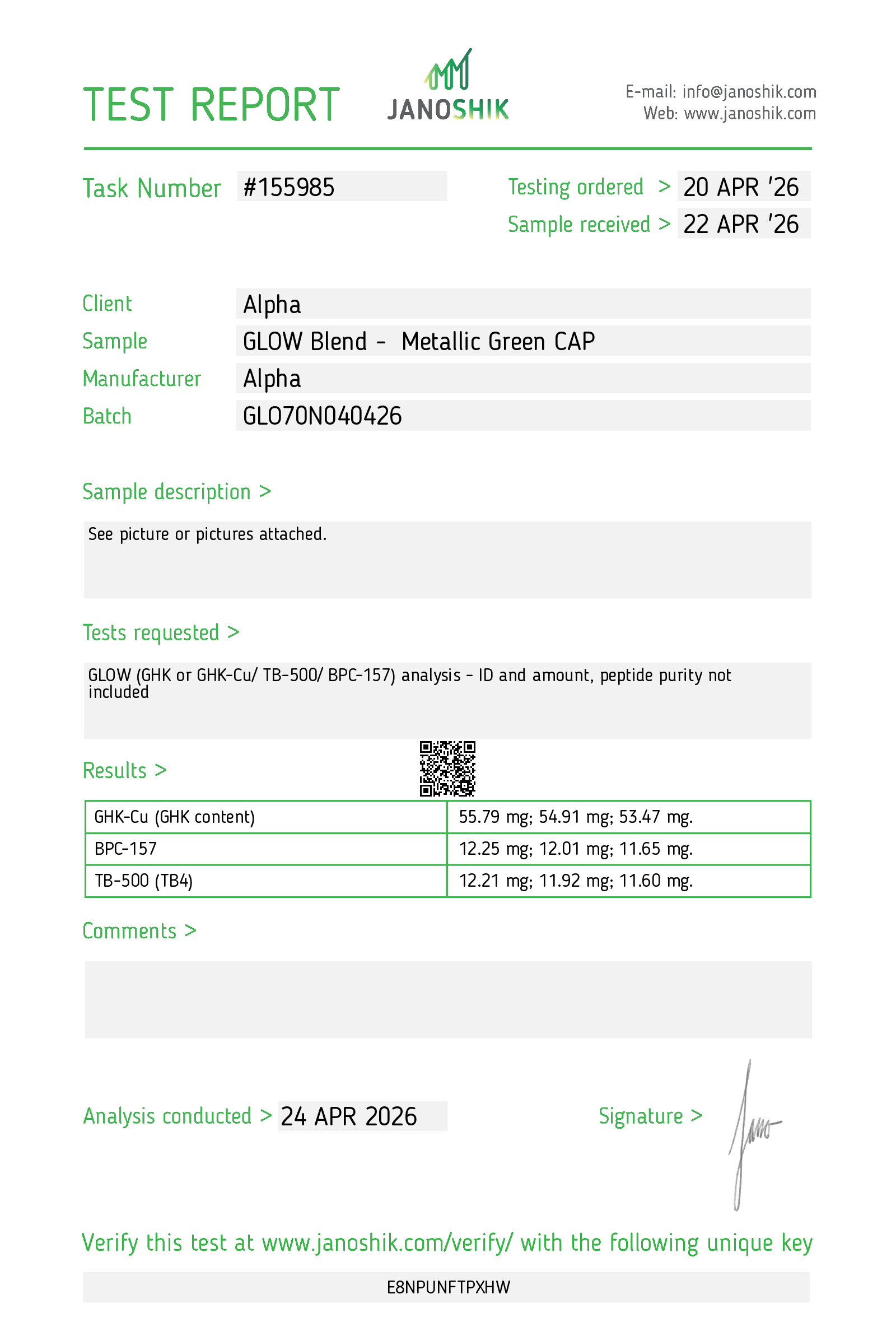
Certificate of Analysis
Report measures selected blend components, not sterility or clinical safety. A report covers a submitted sample or lot, not safety, sterility, effectiveness, or every product sold. Its provenance has not been independently authenticated.
Open attached COAAll classroom topics