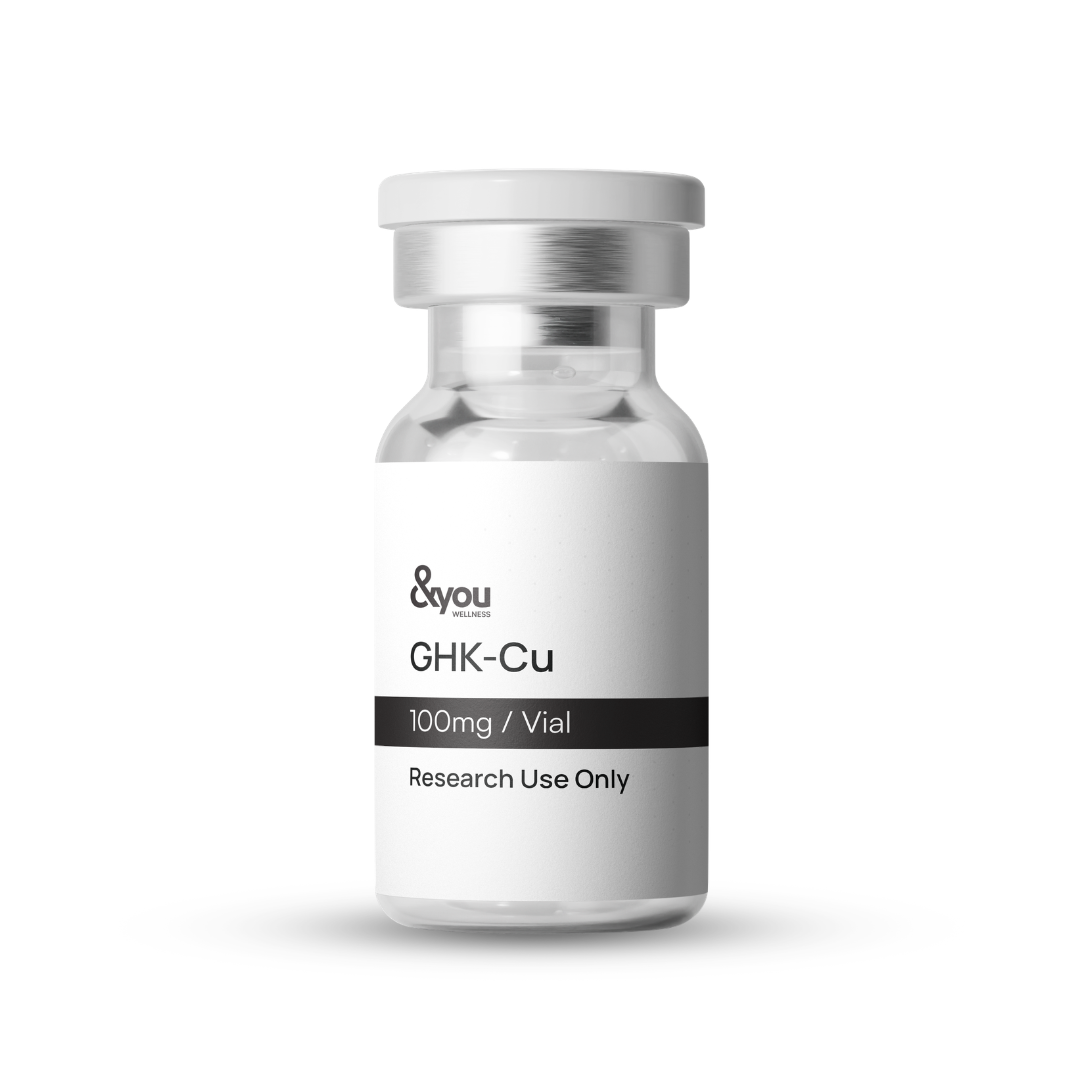
GHK-Cu
A copper-binding peptide studied in skin and tissue models, with different evidence for topical and systemic applications.
This material is educational, not medical advice or a treatment recommendation. Classroom claims and example protocols have not all been independently verified.
The Compound, Explained
Category: Longevity & Anti-Aging
Compound: GHK-Cu (Glycyl-L-histidyl-L-lysine copper)
Research Status: Widely used. Human topical research exists. Systemic injectable use is preclinical.
Regulatory Status: Not FDA approved. GHK-Cu was not among the seven peptides voted on by the FDA Pharmacy Compounding Advisory Committee on July 23 2026.
Widely used in cosmetic formulation, which is a separate regulatory category from therapeutic approval.
What This Is
A tripeptide your body already makes, bound to a copper ion.
Three amino acids: glycine, histidine, lysine. Attached to copper. That is the entire molecule. It occurs naturally in human plasma, saliva and urine, which puts it in a different category from most compounds in this space. You are not introducing something foreign. You are raising a signal that is already present and that declines with age.
Two distinct use cases run under one name, and confusing them is the most common mistake people make with this compound:
Topical. Applied to skin or scalp. This is the route with the deepest human research behind it and the reason GHK-Cu sits in most serious cosmetic formulations.
Systemic. Subcutaneous injection for whole-body effects, tissue repair and the epigenetic work. Much thinner human evidence.
Same molecule. Very different evidence bases. Keep them separate in your thinking.
Why This One Gets Called the Anti-Aging Peptide
Most compounds marketed as anti-aging accelerate one repair process. GHK-Cu is discussed differently because of a specific finding: research on human fibroblasts showed it shifting gene expression patterns in aging cells back toward a younger profile, across a very large number of genes.
That is a different claim from "builds collagen." Collagen stimulation is downstream. The upstream claim is that the cell's instruction set changes.
Hold that claim carefully. It is real published research and it is cell-culture research. Tab three covers exactly what that distinction is worth.
The Copper Is Not Incidental
The Cu is doing work. Copper is a cofactor for lysyl oxidase, the enzyme that cross-links collagen and elastin fibres, and for superoxide dismutase, one of your primary antioxidant enzymes. The peptide is partly a copper delivery vehicle, carrying the ion where it is usable rather than dumping free copper into tissue, which is a different and less desirable situation.
This also explains a practical rule you will see in the protocol tab: vitamin C can inactivate copper peptides on contact. Do not layer them topically.
Who This Is For
People whose primary target is skin, collagen structure or visible aging.
People dealing with wound healing or scar tissue.
People with hair thinning at the follicle level.
People building a longevity protocol who want the structural and connective tissue side covered rather than only the metabolic side.
Inside the Mechanism
Origin
GHK was first isolated from human plasma. Its concentration is highest in youth and falls substantially with age, and that decline is the framing most of the research is built around. This is a restoration argument, not an enhancement argument.
The peptide also appears at wound sites. When tissue is damaged, GHK is released locally from the extracellular matrix. That is your native repair signalling, the same way Thymosin Beta-4 rises in wound fluid.
Modulates Gene Expression
This is the mechanism that separates GHK-Cu from ordinary collagen support.
Work by Loren Pickart on human fibroblasts reported GHK-Cu altering expression across a very large set of genes, with the pattern shifting away from an aged profile and toward a younger one. Repair and regeneration genes moved up. Certain inflammatory and tissue-breakdown genes moved down.
What that means practically: it is not adding collagen. It is changing what the cell decides to build.
What it does not mean: that this has been demonstrated in a living human body at scale. Fibroblasts in a dish are the starting tier of evidence, not the finishing one.
Stimulates Collagen, Elastin and Glycosaminoglycans
Three components, not one. Most collagen products address collagen alone. Skin structure needs all three:
Collagen is tensile strength.
Elastin is recoil, the ability to return after deformation.
Glycosaminoglycans hold water and give tissue its cushioning.
Skin loses all three with age and loses them at different rates. Building collagen into a matrix with degraded elastin gives you firmness without resilience, which is why single-target approaches plateau.
Activates Antioxidant Enzymes
Superoxide dismutase is the enzyme that neutralises superoxide radicals. Copper is a required cofactor. GHK-Cu supports this pathway directly, which is a structurally different mechanism from a dietary antioxidant that scavenges radicals itself. One supplies ammunition. The other upgrades the machinery.
Anti-Inflammatory Action
Modulation, not suppression. The same distinction that matters with TB-500 matters here. Inflammation is a required phase of repair. Chronic low-grade inflammation is a driver of aging. The useful target is the second, not the first.
Follicle Effects
GHK-Cu has been studied for effects on hair follicle size and the growth phase of the hair cycle. Improved perifollicular blood supply and reduced inflammation around the follicle are the proposed mechanisms. This is why it appears in scalp formulations, frequently alongside more established hair compounds rather than replacing them.
Neuroprotection
The most speculative branch. Research interest is in whether GHK's anti-inflammatory and gene-regulatory effects extend to the nervous system. Intranasal use is being explored as a delivery route. Treat this as an open research question rather than an established application.
What the Research Actually Shows
This section is the framework. Learn it here and you can evaluate any compound you meet, including ones that do not exist yet.
Read the Status Tag First
GHK-Cu carries a split status and you have to read it as a split.
Topical, human. Controlled human studies on GHK-Cu creams exist, with outcomes measured on skin density, wrinkle depth and firmness. This is real human evidence.
Systemic, injected. Cell culture and animal models. The gene expression work, the wound healing work and the neuroprotective work sit here.
Anyone citing the topical human data to justify an injectable protocol is moving evidence between contexts where it does not transfer. Route matters. Dose matters. A compound proven on a face is not thereby proven in a bloodstream.
The Evidence Hierarchy
In vitro. Cells in a dish. Tells you a mechanism is possible. Tells you nothing about a whole organism.
Animal model. Usually rodent. Tells you the mechanism operates in a living system.
Human observational. People using something, outcomes recorded. No control group. Confounded by everything.
Human randomized controlled trial. Controlled, randomized, ideally blinded. This is where "proven" becomes an appropriate word.
Most GHK-Cu research sits in the first two tiers. The topical cosmetic work reaches the third and in places the fourth, usually with small sample sizes and frequently funded by parties with a product interest.
The 4,000 Genes Number
You will see this figure everywhere. Understand what it is before you repeat it.
It comes from gene expression analysis of cultured human fibroblasts. Genes moving above or below a threshold of change get counted. Four thousand is a real number from a real dataset.
It is also a number about a dish of cells, not a person. Changed expression in vitro is not the same as changed tissue in vivo, and it is a long distance from changed appearance, changed function or changed lifespan. The mechanism is genuinely interesting. The number is doing more marketing work than scientific work when it appears on a product page.
Sample Size and Funding
Find the n. Find who paid.
Cosmetic ingredient research is often funded by ingredient suppliers. That does not make it false, and it does make it worth noticing. Small studies produce dramatic effect sizes more often than large ones, and those effects tend to shrink when repeated at scale. That pattern is one of the most reliable in all of science.
The July 2026 Committee Vote
On July 23 2026 the FDA's Pharmacy Compounding Advisory Committee voted on seven peptides.
Recommended: BPC-157, KPV, TB-500, MOTS-c, Epitalon, Semax
Not recommended: Emideltide, also known as DSIP
GHK-Cu was not on that list. Not recommended and not rejected. Not assessed at that meeting.
That absence is information, and it is not evidence of a problem. Do not read it either way. What it means practically is that the regulatory position on GHK-Cu is unchanged, and its widespread presence in cosmetics does not constitute approval for anything else. Cosmetic use and therapeutic approval are separate regulatory categories entirely.
Holding Both Facts
GHK-Cu is naturally occurring, well characterized, decades into its research history and supported by genuine human topical data. It also has no large human trials behind its systemic use and a signature finding that lives in cell culture.
Hold both at once. That is what research literacy is, and it is more useful than either uncritical enthusiasm or blanket dismissal.
Sourcing & Verification
Original classroom lesson. Preparation, measurement, sourcing, or protocol examples are source material, not verified instructions or clinical guidance.
People will read the same gene expression study three times and then buy a vial with no way of knowing whether the copper is even bound to it.
The compound in the vial is the whole thing. A perfect protocol with a mislabeled, underdosed or contaminated vial produces nothing, and you will have no way of knowing why.
The Certificate of Analysis
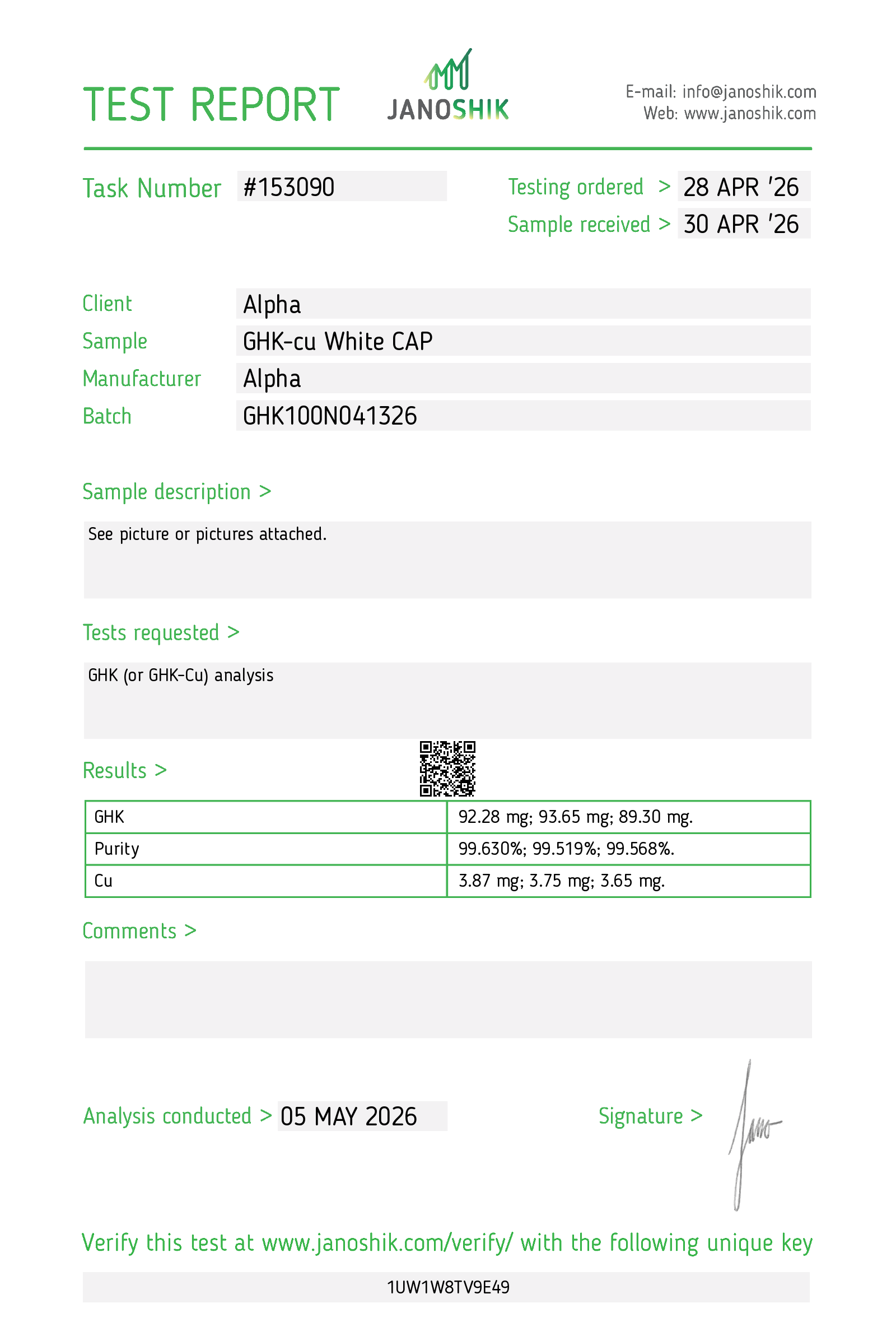
A COA is third-party lab confirmation of what is in the product and at what purity.
What a real one contains:
Named testing laboratory, not the phrase "third party lab"
Batch or lot number that matches the number on your vial
Test date
Purity percentage with the method stated, usually HPLC
Identity confirmation, usually mass spectrometry
Contact details for the lab that ran it
Walk away if you see:
"Available on request," followed by nothing
No laboratory named anywhere on the document
A batch number that does not match your vial
No date
A screenshot with no verifiable source
Ask whoever you currently buy from for a COA on your specific batch. Whatever happens next tells you everything you need to know about them.
Reading Purity Properly
99% purity means 99% of the material is the stated compound. It does not tell you what the remaining 1% is. A well-documented COA will.
Purity and identity are separate tests. A vial can be 99% pure something other than what the label says. You want both confirmed on the same document.
One Extra Check Specific to Copper Peptides
GHK-Cu is a complex, not a simple peptide. The copper has to actually be bound to it. Uncomplexed GHK is a different molecule with different behaviour, and free copper is something you do not want in a vial.
Look for copper content or complexation confirmed on the COA, not just peptide purity. Colour is a weak secondary signal. Properly complexed GHK-Cu carries a blue tint. Colour alone proves nothing and should never substitute for documentation, but a colourless vial sold as GHK-Cu is worth a question.
Storage and Handling
Lyophilised powder is stable for up to a year under proper conditions. Reconstituted solution is not, and it degrades with heat, light and time. Store cool and dry, protected from direct sunlight, humidity and excessive heat.
Preparation
Original classroom lesson. Preparation, measurement, sourcing, or protocol examples are source material, not verified instructions or clinical guidance.
GHK-Cu Reconstitution Guide
GHK-Cu is supplied as a purified, lyophilised powder. Proper preparation and handling matter with any peptide product, and vial strengths vary between suppliers.
Because vial strengths and preparation requirements can vary, always use the reconstitution volume specified for your exact product and vial strength.
What you will need:
GHK-Cu peptide vial
Bacteriostatic water (reconstitution solution)
Appropriate syringe
Alcohol pads
Step 1: Prepare and Sanitize
Wash your hands and prepare a clean workspace.
Clean the tops of the peptide vial and bacteriostatic water vial using an alcohol pad.
Allow the surfaces to dry before proceeding.
Step 2: Reconstitute the Peptide
Draw the appropriate amount of bacteriostatic water according to the instructions for your specific vial.
Insert the needle into the peptide vial and slowly introduce the solution along the inside wall.
Avoid directing the solution forcefully onto the peptide powder.
Step 3: Mix Gently
Important: do not shake the vial.
Gently roll or swirl until the peptide is fully dissolved. Avoid vigorous agitation. Properly reconstituted GHK-Cu typically presents with a blue tint from the copper complex.
Step 4: Storage After Reconstitution
Store reconstituted peptide according to the manufacturer's storage instructions.
Keep refrigerated when the product instructions specify refrigeration.
Protect the vial from excessive heat and light.
Do not freeze unless the manufacturer specifically indicates that freezing is appropriate.
A Note on Topical Preparation
Topical use follows different preparation logic from injectable use, including concentration, vehicle and pH. Do not assume an injectable reconstitution transfers to a topical application. Follow the guidance for the specific product format you hold.
Important
Reconstitution instructions vary depending on the peptide, vial strength and formulation.
Measurement
Original classroom lesson. Preparation, measurement, sourcing, or protocol examples are source material, not verified instructions or clinical guidance.
GHK-Cu Measurement Guide
Learn how to convert your peptide concentration into the correct syringe volume for GHK-Cu.
Use the reference graphic below as a quick visual guide, then use the dosage calculator for precise measurements based on your specific vial strength and reconstitution volume.
Calculator, pre-filled with GHK-Cu defaults:
https://peptidetrainings.com/tools/reconstitution-calculator?label=GHK-Cu
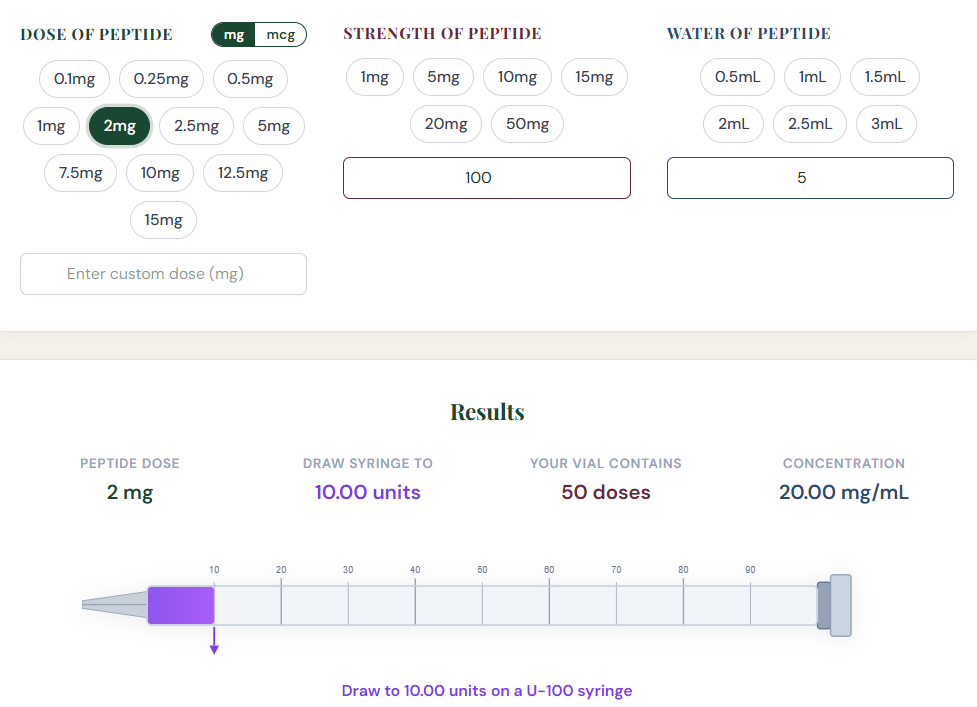
Draw Volume Reference
The correct syringe measurement depends on:
Peptide amount in the vial
Volume of reconstitution solution used
Desired dose
Syringe type and size
Calculate Your Dosage
Need to work out the exact syringe measurement for your dose?
→ Click here to calculate your dosage
Enter your peptide strength, reconstitution volume and desired dose to determine the corresponding syringe measurement.
Important
GHK-Cu vials are sold at multiple strengths. A measurement worked out for one vial size does not carry over to another, and the difference is easy to miss because the powder looks identical.
Always double-check your vial concentration, dilution and syringe type before measuring.
Protocol
Original classroom lesson. Preparation, measurement, sourcing, or protocol examples are source material, not verified instructions or clinical guidance.
GHK-Cu Dosing Protocol
GHK-Cu protocols vary depending on the intended application, product concentration and individual circumstances. The following framework is provided for educational reference and should not be treated as an established clinical dosing guideline.
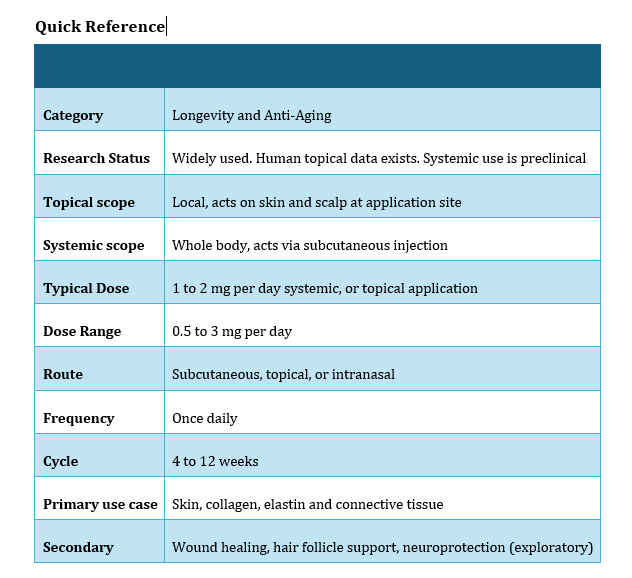
Typical Dose
Dose: 1 to 2 mg per day systemic, or topical application
Dose Range: 0.5 to 3 mg per day
Frequency: Once daily
Route: Subcutaneous injection, topical to skin or scalp, or intranasal
Cycle Length: 4 to 12 weeks
Route Determines Almost Everything
Topical. The most common route for skin-focused use. Applied to clean skin, usually once or twice daily. This is the route with the strongest human evidence behind it.
Subcutaneous. Used for systemic effects, wound healing and the broader anti-aging rationale. Abdomen or another appropriate subcutaneous site.
Intranasal. Explored in the context of neuroprotection. The least established route by a wide margin.
Weeks 1 to 4: initial phase
Dose: Lower end of the range, once daily
Purpose: Establish consistent exposure and observe individual response, particularly skin tolerance
Duration: 4 weeks
Weeks 5 to 12: Continuation
Dose: Maintained or adjusted within the stated range based on response
Frequency: Once daily
Duration: To the end of the cycle
After the cycle
Cycles typically run 4 to 12 weeks. Continuous indefinite use is not the standard framing for this compound. Time off allows you to assess what has actually changed and whether continuing is justified.
Clinical Notes
Topical application is the most common route for skin anti-aging use. Subcutaneous is used for systemic effects and wound healing. Intranasal is exploratory.
Vitamin C inactivates copper peptides. Do not combine them topically. Separate them by time of day, morning and evening, or drop one.
Direct acids and strong exfoliants applied at the same time as GHK-Cu follow the same logic. Separate the applications.
Copper is a mineral with an upper limit. If you are already taking copper in a supplement stack, account for it rather than adding blindly.
Monitor your response throughout the protocol rather than automatically increasing the dose.
Because human clinical evidence for systemic use remains limited, consult a qualified healthcare professional before using experimental peptide products.
Side Effects and Safety
Skin irritation with topical use at higher concentrations
Temporary skin darkening, rare
Injection site reactions
Generally very well tolerated
Research References
Stacking & Combinations
Original classroom lesson. Preparation, measurement, sourcing, or protocol examples are source material, not verified instructions or clinical guidance.
Understanding why compounds are combined is more useful than memorising someone else's stack. The goal is to evaluate whether each addition has a clear purpose, a complementary mechanism and a place in the overall protocol.
The Rule
Compounds make sense in a stack when they work through different mechanisms toward the same outcome.
GHK-Cu is unusually easy to stack, and that is worth interrogating rather than celebrating. It sits well in most protocols because its mechanisms, structural tissue building and inflammation modulation, rarely duplicate what else is in the stack. Broad compatibility is a genuine property here. It is also the exact property that makes a compound easy to add without a reason.
What Pairs With GHK-Cu, and Why
GHK-Cu + BPC-157. High synergy. BPC-157 drives angiogenesis and local repair signalling. GHK-Cu supplies the structural building side, collagen and elastin. Repair signal plus repair material. A popular skin and gut healing combination.
GHK-Cu + Epitalon. High synergy. Both are longevity-focused through separate routes. GHK-Cu for tissue repair and gene expression. Epitalon for telomere support. Different layers of the same argument.
GHK-Cu + TB-500. Moderate synergy. TB-500 mobilises systemic repair. GHK-Cu adds the collagen and skin dimension that TB-500 does not directly cover.
GHK-Cu + NAD+. Complementary. NAD+ addresses cellular energy and mitochondrial function. GHK-Cu addresses structure and repair. Energy plus material, two independent axes.
Four Questions Before Adding Anything
1. What specific mechanism does this add?
If you cannot identify what it contributes, there may not be a clear reason to add it.
2. Does it overlap with something already in the stack?
Redundancy adds complexity without adding meaningful value.
3. Do I understand what it does independently?
Every compound should have a clear rationale before it becomes part of a combination.
4. Can I tell which compound produced the effect?
Add four compounds simultaneously and it becomes difficult to determine what is actually working.
The Question Specific to This Compound
Because GHK-Cu pairs with almost anything, ask it plainly: is it in your stack because collagen, connective tissue or skin is an actual target, or is it in there because it was easy to add?
If skin and structural tissue are not part of what you are trying to change, this compound may be doing very little for you at cost.
A Word on Aggressive Stacking
Four, five and six compound stacks are common in peptide communities, often with limited discussion of how well the combinations have actually been studied.
More compounds do not automatically mean better results. More compounds mean more variables, more cost, more potential interactions and less clarity about what is producing an effect.
A smaller stack built around distinct mechanisms and a clear rationale is easier to understand and evaluate than a long list of overlapping compounds.
The goal is not to build the biggest stack. The goal is to build one that makes sense.
Certificate of Analysis
Report concerns a submitted sample and identified lot only; authenticity has not been independently verified. A report covers a submitted sample or lot, not safety, sterility, effectiveness, or every product sold. Its provenance has not been independently authenticated.
Open attached COAAll classroom topics