DSIP
A peptide investigated for sleep-related biology; clinical evidence remains limited and uncertain.
This material is educational, not medical advice or a treatment recommendation. Classroom claims and example protocols have not all been independently verified.
The Compound, Explained
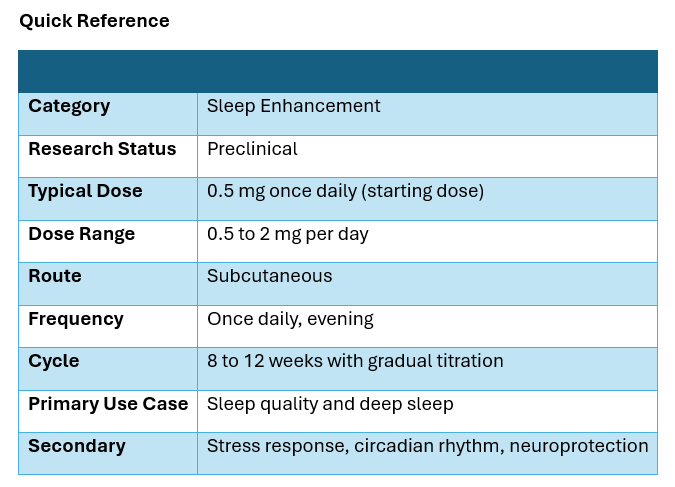
Category: Sleep Enhancement
Compound: DSIP (Delta Sleep-Inducing Peptide), also Emideltide
Research Status: Preclinical
Regulatory Status: Not FDA approved.
Reviewed and NOT recommended for compounding eligibility by the FDA Pharmacy Compounding Advisory Committee, July 23 2026. It is the only compound in this library to receive a negative recommendation.
Read That Status Line Again
Every other module in this course mentions the July 2026 vote and notes that the compound the committee rejected has more consumer interest than several that passed.
This is that compound.
That does not make DSIP dangerous, and it does not make it worthless. It makes this the most useful module in the course, because it is the one where the evidence and the enthusiasm point in opposite directions and you have to decide what to do about that.
Read this module differently from the others. Everywhere else the job is understanding a compound. Here the job is watching what a careful evaluation looks like when it comes back negative.
What This Is
A nonapeptide, nine amino acids, first isolated in 1977 from the cerebral venous blood of rabbits during induced sleep.
It was named for what it appeared to do: induce delta sleep, the slow-wave stage where the deepest physical restoration happens. That naming is worth noticing. The compound was named after a hypothesis, at the moment of discovery, before that hypothesis was tested properly. The name has carried the claim ever since.
Research has since expanded into stress response, neuroendocrine regulation, antioxidant activity and possible neuroprotection.
Why the Sleep Angle Is Compelling
Deep sleep is where physical repair happens. Growth hormone release concentrates there. Memory consolidation depends on it. It declines with age, often substantially, and people feel that decline directly.
A compound that increased slow-wave sleep specifically would be genuinely valuable, and it would do something that sedatives do not. Most sleep medications produce unconsciousness with altered or reduced slow-wave sleep, which is why people can sleep eight hours on them and wake unrefreshed.
That gap is real, it matters, and it is why DSIP has held interest for nearly fifty years despite everything in tab three.
What DSIP Is Not
It is not a sedative. It does not knock you out, and people expecting a sleeping pill will conclude it does nothing.
The proposed action is modulatory, a nudge toward deeper sleep architecture rather than a push into unconsciousness. Reported effects are subtle, and subtle effects on sleep are exactly the kind of thing that is hardest to evaluate honestly, for reasons the research tab covers.
Who This Is For
Given the evidence position, the honest answer is narrower than usual.
People who have addressed sleep fundamentals already, meaning consistent timing, light exposure, temperature, caffeine and alcohol timing, and still have a specific slow-wave sleep problem.
People who understand they are working with a compound a regulatory committee declined to recommend and have decided that is acceptable to them.
If you have not done the fundamentals, this compound is not the thing standing between you and better sleep, and no peptide is.
Inside the Mechanism
A caution before the detail: the mechanistic picture for DSIP is less settled than for any other compound in this course. Much of what follows is proposed mechanism rather than established mechanism, and the distinction matters more here than usual.
Modulates Multiple Neurotransmitter Systems
DSIP is described as influencing GABA, serotonin and opioid signaling pathways.
Read that list carefully, because it is doing something unusual. Most compounds in this library have one primary mechanism described in detail. DSIP has several described loosely.
A broad, non-specific mechanistic profile can mean a compound genuinely acts at multiple points. It can also mean nobody has pinned down what it primarily does. Nearly fifty years after discovery, the absence of a single well-characterized primary mechanism is itself informative.
GABA is the main inhibitory neurotransmitter, and it is the system most sleep medications act on. Serotonin is involved in sleep-wake regulation and mood. Opioid pathways connect to the reported pain-relief effects.
Influences the Hypothalamic-Pituitary Axis
DSIP affects release of luteinizing hormone, growth hormone and cortisol.
The cortisol effect is the one connected to the stress claims. Cortisol follows a daily rhythm and elevated evening cortisol is a common reason people cannot get into deep sleep. A compound moderating that would plausibly improve sleep quality without acting as a sedative at all.
Note the growth hormone point too. GH release concentrates during slow-wave sleep, so an effect on GH and an effect on deep sleep may be the same finding observed from two directions rather than two separate benefits.
Adenosine Signaling
Adenosine accumulates through the day and is the molecule that builds sleep pressure. Caffeine works by blocking its receptors.
DSIP's sleep effects may involve adenosine modulation, which would be a more specific mechanism than the neurotransmitter list. The word here is may, and this remains a proposed route rather than a demonstrated one.
Antioxidant and Neuroprotective Activity
Reported across studies, mechanism not clearly established. This is the least developed branch of DSIP research and the one most likely to appear in marketing.
The Structural Problem With the Mechanism Picture
Worth naming directly, because it explains tab three.
DSIP is a peptide of nine amino acids, and there is longstanding uncertainty about how much of it crosses the blood-brain barrier intact after peripheral injection. A compound whose proposed action is on central sleep circuits has to reach them.
That question has not been resolved to the standard other compounds here have met, and it sits underneath every claim on this page.
What the Research Actually Shows
This is the most important tab in the course. Not because DSIP is important, but because this is where the framework gets applied to a compound the answer comes back negative on.
Start With the Dates
Look at the reference list. 1977 for the discovery. 1984 for the neuroendocrine review.
Nearly fifty years since isolation, and the foundational work is still what gets cited.
Compare that to any other compound here. BPC-157 accumulated thirty years of active research. Retatrutide ran Phase III trials within a decade of development. MOTS-c was identified in 2015 and already has a positive committee recommendation.
DSIP has had more time than almost anything in this library and has not accumulated a comparable body of work. In research, sustained absence of follow-up is a signal. Promising early findings that attract investigation and then do not produce replicable results tend to stop attracting investigation.
That is not proof of nothing. It is a pattern worth reading honestly rather than around.
The Rabbit Problem
The original finding was in rabbits. Sleep architecture differs across species, rabbits are prey animals with fundamentally different sleep patterns from humans, and a compound isolated during induced sleep in a rabbit is a starting point rather than a conclusion.
Human work followed, and this is the crux: results in human insomnia have been inconsistent. Some studies found effects, others did not. Trials have generally been small, and the compound has never produced the kind of clear reproducible human result that moves something up the evidence hierarchy.
Nearly five decades of inconsistent human findings is different from nearly five decades of no human findings, and it is also different from a compound simply awaiting its trials.
The Self-Report Problem Is Worse Here Than Anywhere
Sleep is the hardest domain in this entire course to evaluate honestly, and it is worth understanding exactly why.
You are unconscious for the thing you are assessing. Your report is not of your sleep but of your memory of falling asleep and your feeling on waking. Those are different measurements.
Expectation shapes sleep powerfully. Believing you will sleep well is itself sleep-promoting. Placebo response in insomnia research is among the largest in any field, which is why sleep trials are so difficult to run well.
Regression to the mean is guaranteed. People start a sleep compound after a bad stretch. Bad stretches end. Sleep varies night to night around a personal average regardless of intervention.
Doing something helps by itself. Starting a nightly evening routine, dosing at a consistent time, paying attention to sleep, all of that improves sleep independently of what is in the syringe.
Stack these four and you have a domain where a compound with no pharmacological effect would still generate enthusiastic reports. That is not a reason for cynicism, it is a reason for measurement.
If you want to know whether DSIP does anything for you, you need objective sleep-stage data across enough nights to see past the noise, with a baseline taken before you start. Anything less is asking a compound to grade its own homework in the one domain where it is guaranteed a good mark.
The July 2026 Committee Vote
On July 23 2026 the FDA's Pharmacy Compounding Advisory Committee voted on seven peptides.
Recommended: BPC-157, KPV, TB-500, MOTS-c, Epitalon, Semax
Not recommended: Emideltide, also known as DSIP
DSIP was the one rejected.
Understand what happened here, because it is more informative than a simple no.
The committee reviewed seven compounds individually rather than as a category. Six passed. One did not. That is not a body dismissing peptides, it is a body distinguishing between them, which is exactly what you want from an evaluation.
And the compound it declined was arguably the most consumer-popular of the seven. MOTS-c and Epitalon are known mainly to longevity enthusiasts. KPV is obscure outside gut protocols. DSIP is a widely marketed sleep product with broad appeal.
Popularity and evidence are separate variables, and this vote made the gap between them visible in a single afternoon. That is the lesson this course has been repeating in every module, and this is the case that demonstrates it.
What the Rejection Does and Does Not Mean
It does not mean dangerous. The committee assessed whether evidence supported compounding eligibility, not whether the compound is hazardous. DSIP's side effect profile is mild.
It does not mean the research is fake. The research exists and was reviewed.
It does mean a body with no commercial stake looked at the full evidence base and concluded it was insufficient, while concluding the opposite about six other compounds in the same session. That comparison is what gives the finding weight.
It is also non-binding, and the FDA determines separately. Everything in this section is a committee recommendation, exactly as it is for the six that passed.
Holding Both Facts
DSIP addresses a real and underserved problem, has a plausible proposed mechanism, has been studied for nearly fifty years, and is reported positively by a great many people. It also has inconsistent human results, no well-characterized primary mechanism after five decades, an unresolved question about whether it reaches its target, operates in the domain hardest to self-assess, and was the single compound a review committee declined to recommend.
Hold both at once. In this case, holding both honestly means acknowledging that the second list is heavier than the first, and that is a legitimate place for an honest evaluation to land.
Sourcing & Verification
Original classroom lesson. Preparation, measurement, sourcing, or protocol examples are source material, not verified instructions or clinical guidance.
DSIP has a sourcing problem the others do not: A compound where the effect is subtle and self-assessed is a compound where nobody notices a bad vial.
What to Verify on This Compound
You have no feedback loop. With Retatrutide, an inert vial announces itself within weeks. With DSIP, a completely inert vial would produce the same enthusiastic sleep reports as a perfect one, for all the reasons in the research tab. Documentation is not one check among several here, it is the only check that exists.
Identity on a nonapeptide. Nine amino acids is a short sequence and cheap to synthesise, which reduces the incentive to substitute something else and raises the incentive to cut corners on synthesis quality. Truncated or incorrect sequences are the relevant impurity category. Ask for identity confirmation alongside purity, on the same document.
Watch the demand profile. DSIP sells well, and the committee rejection has not changed that. A compound with steady demand, low production cost and buyers who cannot detect a bad product is a difficult combination from a quality-control standpoint. That is a structural observation about the market, not an accusation about any supplier.
The COA Standard
A valid COA names the testing laboratory, carries a batch number matching your vial, states a test date, gives purity with the method used, and confirms identity. Anything answering "available on request," or arriving as a screenshot with no traceable source, is not a COA.
Storage
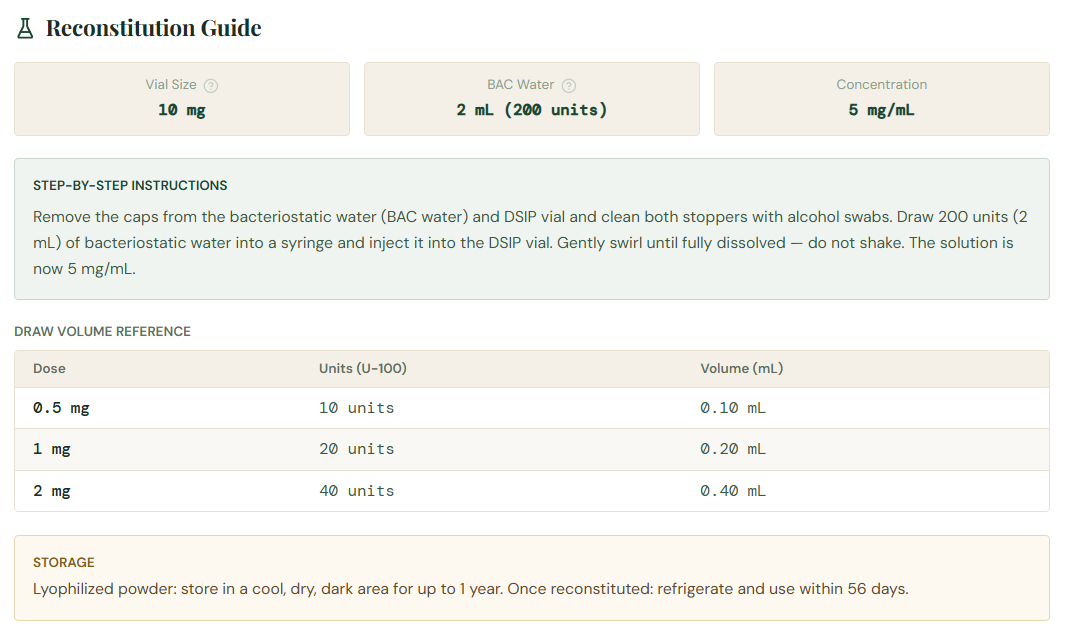
Lyophilised Powder: Cool, dry, dark, up to one year. Reconstituted: refrigerate and use within 56 days.
At 0.5 mg daily from a 10 mg vial you have twenty doses, well inside the window. At the top of the range you finish faster still. Storage is not a constraint on this compound the way it is on some others.
Preparation
Original classroom lesson. Preparation, measurement, sourcing, or protocol examples are source material, not verified instructions or clinical guidance.
DSIP Reconstitution Guide
DSIP is supplied as a lyophilized powder requiring reconstitution. Vial strengths vary, so use the volume specified for your exact product.
What you will Need:
DSIP vial
Bacteriostatic water
U-100 insulin syringes
Alcohol pads
Step 1: Prepare and Sanitize
Wash your hands and prepare a clean workspace.
Remove the caps from both the bacteriostatic water and the DSIP vial.
Clean both stoppers with alcohol pads and allow them to dry.
Step 2: Reconstitute
Draw 200 units (2 mL) of bacteriostatic water.
Insert the needle into the DSIP vial and introduce the water slowly along the inside wall.
Avoid directing the stream forcefully onto the powder.
Step 3: Mix Gently
Do not shake. Swirl gently until fully dissolved.
Step 4: Storage after Reconstitution
Refrigerate.
Use within 56 days.
Protect from light.
Do not freeze unless the manufacturer specifically indicates it.
Important
Note the 2 mL, not 1 mL. This gives 5 mg/mL rather than the 10 mg/mL that several other compounds in this library produce. Carrying a reconstitution habit across compounds is one of the most common dosing errors, and the volumes here are double what the same dose would require at 10 mg/mL.
Read the number for the vial in front of you.
Measurement
Original classroom lesson. Preparation, measurement, sourcing, or protocol examples are source material, not verified instructions or clinical guidance.
DSIP Measurement Guide
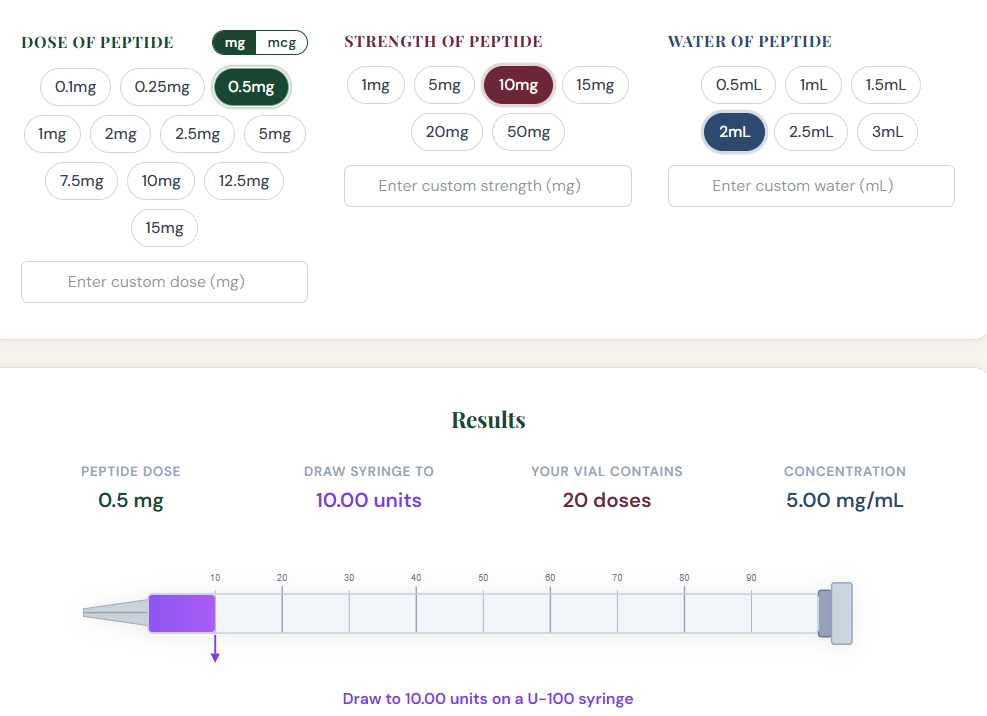
Calculator, pre-filled with DSIP defaults:
https://peptidetrainings.com/tools/reconstitution-calculator?label=DSIP
Draw Volume Reference
At 10 mg reconstituted with 2 mL, giving 5 mg/mL, on a U-100 syringe:
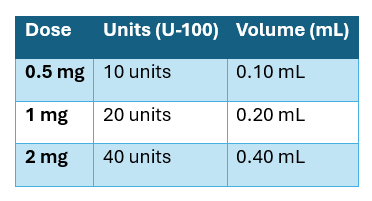
The correct measurement depends on vial strength, reconstitution volume, desired dose and syringe type.
Calculate Your Dosage
→ Click here to calculate your dosage
Important
The protocol steps through all three volumes. 0.5 mg for four weeks, then 1 mg, then possibly 2 mg. Each step needs recalculating rather than carrying the previous volume forward by habit.
The table above is valid only at 5 mg/mL. Reconstitute with 1 mL instead of 2 mL and every volume halves.
Evening dosing means low-light measurement. A practical point specific to this compound. Drawing a dose in a dimly lit bedroom at 10pm is where misreads happen. Draw in good light, or draw earlier and dose later.
Always confirm your vial strength, your reconstitution volume and your syringe type before drawing.
Protocol
Original classroom lesson. Preparation, measurement, sourcing, or protocol examples are source material, not verified instructions or clinical guidance.
DSIP Dosing Protocol
The following framework is provided for educational reference and should not be treated as an established clinical dosing guideline.
Typical Dose
Dose: 0.5 mg once daily, starting dose
Dose Range: 0.5 to 2 mg per day
Frequency: Once daily, evening
Route: Subcutaneous injection, abdomen or upper arms
Cycle: 8 to 12 weeks with gradual titration
The Titration Schedule
Weeks 1 to 4: 0.5 mg once daily
Week 5 Onward: May increase to 1 mg once daily
Week 9 Onward: May increase to 2 mg once daily if additional effect is sought
Timing is the Protocol
Administer in the evening. For a sleep compound this is not a convenience note, it is the mechanism of use.
Keep the timing consistent night to night. Consistent timing improves sleep on its own, which cuts both ways: it makes the protocol more likely to help and makes attribution harder. Plan for that rather than discovering it.
Do the Fundamentals First, and Say so Plainly
Before escalating the dose, check whether the basics are actually in place. Consistent sleep and wake times. Light exposure in the morning and reduced light in the evening. A cool, dark room. Caffeine timing. Alcohol, which reliably suppresses slow-wave sleep and is the most common hidden cause of the exact problem people buy DSIP to solve.
Any one of these outweighs what this compound is likely to deliver. A peptide is not a substitute for sleep hygiene and this is the compound where that sentence matters most.
Build in a way to evaluate it
Given everything in the research tab, decide before you start how you will assess this.
Take a baseline. Two weeks of sleep tracking before your first dose.
Use objective data if you can, sleep-stage tracking rather than how you felt.
Change one thing at a time. Starting DSIP, a new bedtime and a magnesium supplement in the same week teaches you nothing.
Treat the off-period as information. Whether sleep changes when you stop is the most useful signal you will get.
Clinical Notes
Administer in the evening for sleep-promoting effects.
Effects are reported as subtle. Anyone expecting sedation will conclude it does not work, which may or may not be the correct conclusion.
Persistent insomnia has diagnosable causes, including sleep apnea, thyroid dysfunction and mood disorders, all of which have effective treatments. A peptide is not the right first response to chronic sleep problems, and investigating the cause is.
Consult a qualified healthcare professional before using experimental peptide products.
Side Effects and Safety
Generally well tolerated
Mild drowsiness
Headache, rare
Injection site reactions
A mild profile, and read it in context. This is a preclinical compound with limited long-term human data, so a short side effect list reflects limited study alongside genuine tolerability. Mild side effects are the one area where DSIP's position is relatively strong.
Research References
Stack Logic
Original classroom lesson. Preparation, measurement, sourcing, or protocol examples are source material, not verified instructions or clinical guidance.
Sleep stacks have a specific failure mode: every component is judged by how you feel on waking, and that judgement is the least reliable instrument in this entire course.
What Pairs With DSIP, and Why
DSIP + Selank. Both act on anxiety and stress pathways. The rationale is that where sleep difficulty is driven by an overactive stress response rather than by sleep architecture itself, addressing the stress side is addressing the actual cause. Reasonable, and note it means you are treating two different hypotheses about why you are not sleeping.
DSIP + Pinealon. A common sleep optimisation pairing, with Pinealon contributing neuroprotection and sleep-quality effects through a separate route.
DSIP + Epitalon. Complementary. Epitalon's pineal gland activity connects to melatonin regulation and circadian rhythm, which is a different layer from DSIP's proposed action on sleep architecture. Timing regulation plus depth, in principle.
The Problem With Every Pairing Above
Each of those compounds has the same evaluation problem DSIP has, and stacking them multiplies it rather than averaging it out.
Three compounds, all subtle, all assessed on how you feel on waking, all started in the same week, all subject to the same placebo response and the same regression to the mean. There is no arrangement of those three that produces interpretable information.
If you are going to run any of them, run one, for a full cycle, with objective tracking and a baseline. Then run the next. It is slower and it is the only version that tells you anything you can keep.
What Actually Stacks With DSIP
The honest answer is not a peptide.
Consistent sleep and wake times. Morning light exposure. A cool dark room. Caffeine cut off early enough. Alcohol reduced, since it reliably suppresses the exact slow-wave sleep this compound is meant to increase.
Each of those has better evidence behind it than anything in this module, costs nothing, and addresses causes rather than symptoms. A compound layered on top of unaddressed fundamentals is being asked to compensate for something it cannot reach.
Where This Module Leaves You
DSIP is the compound this course has been pointing at since the first module, and it is worth being direct about what it demonstrates.
Six compounds went into that committee session and came out recommended. This one did not, and it was the most popular of the seven. Nothing about its marketing changed on July 23 2026. Nothing about how people talk about it changed. Only the evidence assessment did, and it is publicly available to anyone who looks.
You may still choose to run DSIP. Its side effect profile is mild, the problem it targets is real, and a negative committee recommendation is not a prohibition. That is a defensible decision.
What this course asks is that you make it knowing what you are choosing, rather than discovering the vote afterward from someone who had no reason to mention it.
That habit, checking what the evidence actually says before the enthusiasm reaches you, is the thing worth taking from this entire library. DSIP is simply where it is easiest to see.
Certificate of Analysis
No COA attachment was available for this course when checked.
All classroom topics