CJC-1295 / Ipamorelin
Two investigational compounds often discussed together, without clinical proof for the combination.
This material is educational, not medical advice or a treatment recommendation. Classroom claims and example protocols have not all been independently verified.
The Stack, Explained
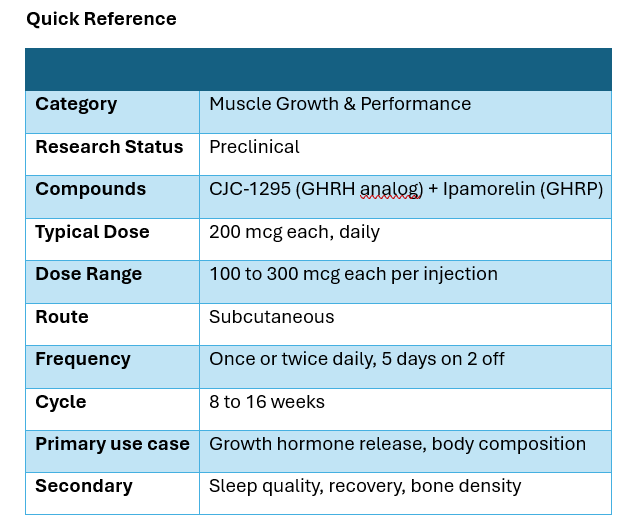
Category: Muscle Growth & Performance
Compounds: CJC-1295 with DAC (GHRH analog) + Ipamorelin (GHRP)
Research Status: Preclinical
Regulatory Status: Not FDA approved. Neither compound was among the seven peptides voted on by the FDA Pharmacy Compounding Advisory Committee on July 23 2026.
What This Is
The two-door approach to growth hormone, sold as one product.
If you have read the Ipamorelin or Sermorelin modules you already know the structure. There are two separate routes to a GH pulse:
GHRH analogs, including CJC-1295, act on GHRH receptors.
GHRPs, including Ipamorelin, act on the ghrelin receptor.
Different receptors, same outcome. Combining them produces a larger pulse than either alone, because you are opening both doors rather than pushing harder on one.
This is one of the few places in this field where the word synergy has a genuine mechanistic basis rather than a marketing one.
Why This Particular Pairing
Each half is the selective option in its class.
Ipamorelin is the GHRP that does not meaningfully raise cortisol or prolactin, unlike the older GHRP-6 and GHRP-2. Cortisol is catabolic, which means an older GHRP was partly working against the outcome people wanted.
CJC-1295 with DAC is the long-acting GHRH analog, sitting at the opposite end from sermorelin.
The result is a stack with more GH output than either compound alone and less hormonal noise than the older combinations. That is why it became the default.
The DAC Question You Need to Settle First
The most important thing on this page, and the thing most likely to be wrong in what you buy.
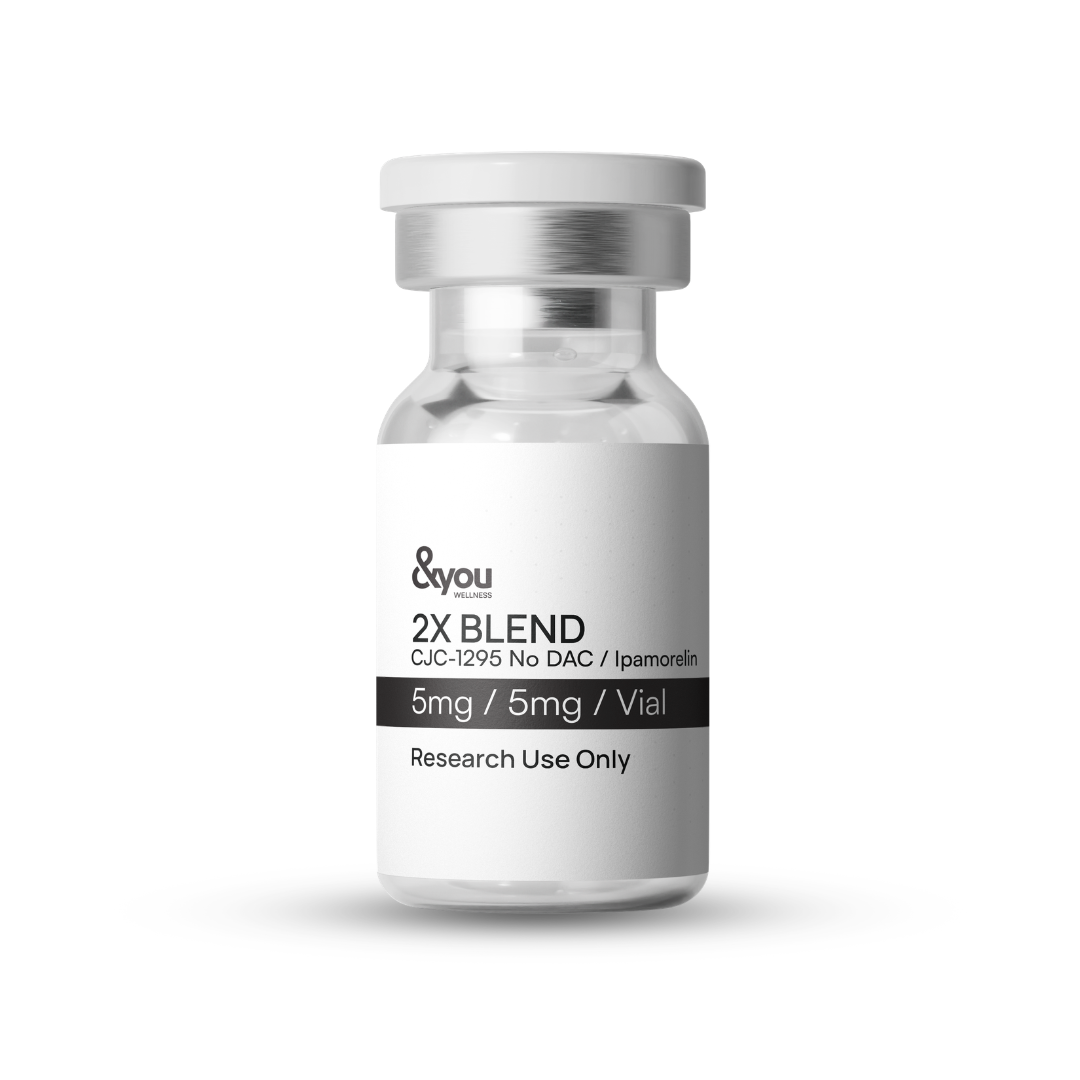
CJC-1295 is sold in two forms that are frequently both called CJC-1295:
CJC-1295 with DAC. The drug affinity complex extends its half-life to roughly 6 to 8 days.
CJC-1295 without DAC, often sold as Modified GRF 1-29. Half-life of roughly 30 minutes.
These are pharmacologically different products with the same name on the label. One sustains GHRH signalling for a week. The other produces a brief pulse and clears, behaving much more like sermorelin.
Which one you have changes your dosing frequency, your timing rules, and what the compound actually does in your body.
Establish which version you are buying before anything else. A supplier who cannot tell you immediately is not a supplier who knows.
What "Pre-Made" Buys and Costs
This is sold as a single product, often pre-mixed, and the two compounds are chemically compatible in solution. One injection, two peptides.
The convenience is real and it is a legitimate reason to choose it.
The cost is the same trade you saw in the KLOW module. A fixed combination means you cannot adjust one component without moving the other, cannot drop one if you react to it, and cannot introduce them in sequence to learn what each does. If you want that control, buy them separately and combine in the syringe yourself.
Who This Is For
People pursuing body composition, recovery and sleep through the GH axis who want the standard, well-tolerated approach.
People who have training, protein intake and sleep already in place, since GH is permissive rather than sufficient.
Inside the Mechanism
CJC-1295: The GHRH Half
Binds GHRH receptors on pituitary somatotrophs, stimulating both synthesis and release of growth hormone.
Note that it prompts production, not just release of what is already stored. That is characteristic of the GHRH class.
The DAC. The drug affinity complex binds to albumin in your blood, which is what extends the half-life from minutes to roughly 6 to 8 days. It is a delivery modification rather than a change to what the molecule does at the receptor.
Ipamorelin: The GHRP Half
Binds the ghrelin receptor, GHS-R1a, and triggers a GH pulse.
Ipamorelin mimics ghrelin, the hormone your stomach releases when empty, which has two jobs: signaling hunger and prompting GH release. Ipamorelin reproduces the second with much less of the first than older GHRPs.
Its defining property is selectivity. It activates the GH pathway while leaving cortisol and prolactin largely untouched.
The Tension Worth Understanding
Here is where the standard description of this stack contradicts itself, and it is worth seeing clearly.
You will read that this combination "maintains the natural pulsatile pattern" and, in the same paragraph, that DAC extends the half-life to 6 to 8 days.
Those two statements sit awkwardly together. Your natural GHRH signal is short-acting, released in bursts. A compound present continuously for a week is not reproducing that pattern, it is providing a sustained elevation of GHRH signaling.
The More Accurate Description: CJC-1295 with DAC raises the baseline of GHRH activity, and Ipamorelin produces the pulse on top of it. That is not the same as a physiological pulse pattern, and it is a reasonable design with a real trade-off.
Why it Matters Practically: Sustained receptor signaling is what drives downregulation. The short-acting compounds in this class, sermorelin and non-DAC CJC-1295, are chosen specifically to avoid that. The DAC version trades some of that protection for convenience and total output.
Neither approach is wrong. Knowing which one you are running, and why, is the point.
Your Feedback Loop, Partially Preserved
Both compounds prompt your own GH release rather than adding hormone from outside, so your regulatory systems stay in the loop. Somatostatin still rises when GH and IGF-1 climb.
The honest caveat, and it applies more to this stack than to any single secretagogue: that loop becomes less protective when the system is pushed from two directions continuously. Preserved feedback is a real safety property and it is not unlimited.
Where the Side Effects Come From
Every listed effect is a growth hormone effect.
Water retention and tingling. GH causes sodium and water retention. Tingling in the extremities follows from the same mechanism and is the early version of what becomes carpal tunnel at higher exposure.
Headache and flushing. Vascular effects.
Increased hunger. Ghrelin receptor activity, substantially less than with older GHRPs but not absent.
These scale with GH output, which means dose reduction is the appropriate response rather than pushing through.
What the Research Actually Shows
Read the Status Tag First
Preclinical, and worth understanding why.
Both compounds have real research behind their mechanisms. The 1998 work on Ipamorelin's selectivity and the 2006 CJC-1295 pharmacokinetics study are genuine, and the GH axis itself is among the best characterized systems in endocrinology.
What does not exist is human trial evidence for this combination, at these doses, in healthy adults, for body composition.
Neither compound completed clinical development. That is common and not by itself an indictment, and it does mean the trials that would settle these questions were never run.
Mechanism Established, Outcomes Assumed
The pattern that recurs across the GH-axis modules and applies most strongly here.
Well Supported: That CJC-1295 raises GHRH signaling. That Ipamorelin selectively triggers GH release. That the two together produce more GH than either alone. These are pharmacology findings and they are solid.
Not Established: What that produces in body composition, recovery or aging over 8 to 16 weeks in healthy adults.
The gap between those two is where most of the marketing for this stack lives.
GH Does Not Equal Results
The most important interpretive point, and the one that costs people the most money.
Raising growth hormone is not the same as achieving what people want from raising it. Body composition depends on training, protein intake, total energy balance and sleep. GH is permissive, not sufficient.
A GH pulse in someone not training and not eating adequately has very little to act on.
This also explains a common attribution error. Someone starts this stack, and simultaneously starts training more consistently and sleeping better because they have decided to take their health seriously, and credits the peptides with a result that several things produced together.
The Measurable Advantage
This stack shares a property with tesamorelin and ipamorelin alone: IGF-1 is measurable.
If the protocol is working, IGF-1 responds. That gives you an objective check on whether your product is real, whether your dose is doing anything and whether your timing is right.
On a compound with slow, largely invisible effects, that test is the difference between running a protocol and hoping. Take a baseline before you start.
What Is Not Established
Long-Term Use: 8 to 16 week cycles are convention rather than a studied duration. What sustained GH-axis stimulation does over years is unknown.
Optimal Dosing: The 100 to 300 mcg range per compound comes from practice, not dose-finding trials.
The GH and Cancer Question: GH and IGF-1 have growth-promoting effects, and the discussion in endocrinology about GH therapy and malignancy risk is long-running and unsettled. Worth knowing it exists, and a prescriber conversation for anyone with relevant history.
Glucose: GH opposes insulin and raises blood sugar. Anyone with insulin resistance, prediabetes or diabetes should treat this as a clinical conversation, and glucose is worth tracking across a 16 week protocol.
Holding Both Facts
This stack has a genuine mechanistic basis for its combination, uses the selective option from each class, preserves your feedback loop, and gives you a measurable marker to track.
It also has no human trials, a standard description that misrepresents what the DAC version actually does to the pulse pattern, outcome data far thinner than its mechanism data, and no long-term safety information in the population using it.
Hold both at once.
Sourcing & Verification
Original classroom lesson. Preparation, measurement, sourcing, or protocol examples are source material, not verified instructions or clinical guidance.
This is a combination product in the most crowded corner of the peptide market, which stacks two sourcing problems on top of each other.
What to Verify on This Compound
DAC or no DAC. Covered in tab one and it belongs here too, because this is where the error happens. Both versions are labelled CJC-1295. They behave completely differently. Get it in writing, and expect the COA to specify which molecule was tested.
Both components, separately confirmed. A single purity figure for a two-peptide product tells you nothing about the ratio or about whether both are present at stated amounts. Ask for identity and quantity on each.
Ratio, in writing. If you are buying pre-mixed, the split matters. Two vials with the same total can be different products. Run the per-dose calculation the way the KLOW module sets out.
Identity against a crowded field. CJC-1295, sermorelin, tesamorelin, ipamorelin, GHRP-2 and GHRP-6 all share this market at different prices. GHRP-6 substituted for ipamorelin reintroduces exactly the cortisol, prolactin and hunger effects this stack exists to avoid. Mass spectrometry confirmation is what separates them.
The Verification You Actually Have
IGF-1 bloodwork tells you whether your product is active. If you run this stack for six to eight weeks and IGF-1 has not moved, something is wrong with the product, the dose or the timing.
Very few compounds in this library give you an objective check on your supplier. Use it.
The COA Standard
A valid COA names the testing laboratory, carries a batch number matching your vial, states a test date, gives purity with the method used, and confirms identity. Anything answering "available on request," or arriving as a screenshot with no traceable source, is not a COA.
Storage
Lyophilized Powder: Cool, dry, protected from light. Reconstituted: refrigerate, protect from light, follow the manufacturer's window.
On a daily protocol running 8 to 16 weeks you will go through many vials. Check the strength each time you open a new one, since batches and suppliers change and the powder looks identical.
Preparation
Original classroom lesson. Preparation, measurement, sourcing, or protocol examples are source material, not verified instructions or clinical guidance.
CJC-1295 / Ipamorelin Reconstitution Guide
Vial strengths vary between suppliers, so always use the volume specified for your exact product.
What you will Need:
Your vial or vials
Bacteriostatic water
U-100 insulin syringes
Alcohol pads
Step 1: Prepare and Sanitize
Wash your hands and prepare a clean workspace.
Remove the caps and clean all stoppers with alcohol pads.
Allow them to dry.
Step 2: Reconstitute
Draw the volume specified for your vial strength.
Introduce the water slowly along the inside wall.
Avoid directing the stream forcefully onto the powder.
Step 3: Mix Gently
Do not shake. Swirl gently until fully dissolved.
Step 4: Storage after Reconstitution
Refrigerate.
Protect from light.
Follow the manufacturer's window.
Do not freeze unless specifically indicated.
Pre-Mixed or Two Vials
Both are common and the choice has consequences.
Pre-mixed. One vial, one reconstitution, one draw. Simplest, and you lose the ability to adjust either component independently.
Two vials. More work, and it is the option that gives you control. You can introduce one compound first and add the second later, adjust one dose without moving the other, or drop one if you react to it.
The two compounds are chemically compatible in solution, which is why combining them in one syringe is standard practice and why pre-mixed products exist.
If You Are Running Two Vials
Reconstitution volumes differ between compounds. Do not apply one figure to the other. This is the most common error in multi-vial GH protocols and it produces a concentration wrong by a factor of two or more without looking wrong.
Label both. Compound, concentration, date. You will be drawing these at night, from a fridge, before bed, which is exactly the setup where two small identical vials get confused.
Measurement
Original classroom lesson. Preparation, measurement, sourcing, or protocol examples are source material, not verified instructions or clinical guidance.
CJC-1295 / Ipamorelin Measurement Guide
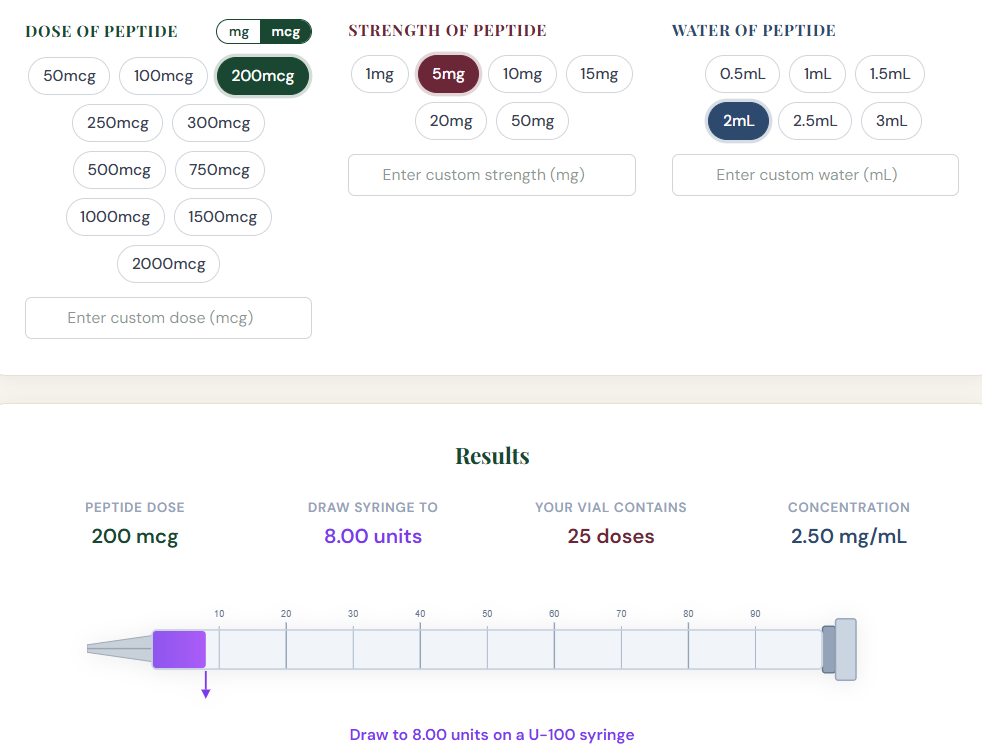
Calculator, pre-filled with defaults:
https://peptidetrainings.com/tools/reconstitution-calculator
Draw Volume
Two compounds means two calculations unless you are using a pre-mixed vial. There is no single reference table, since vial strengths vary widely across both.
Typical doses per injection:
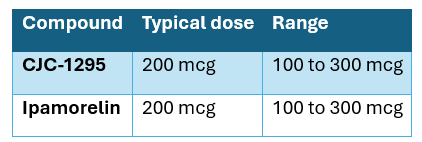
Work out each draw volume from that compound's actual vial strength and reconstitution volume.
Calculate Your Dosage
→ Click here to calculate your dosage
Important
Micrograms, not milligrams. A 2 mg vial holds 2000 mcg. A 200 mcg dose is one tenth of it.
Write your figures down. Two compounds, two concentrations, dosed daily for up to sixteen weeks. Recalculating from memory each night is how a protocol drifts. Work them out once and keep them with your supplies.
A pre-mix gives you one volume, not two. Your single draw delivers both at a fixed ratio. Do not increase the draw to get more of one, since that raises both.
You are dosing at night. Drawing in a dim bedroom before bed is where misreads happen. Draw in good light, or prepare earlier in the evening.
Twice-daily dosing doubles your total. 200 mcg each twice daily is 400 mcg of each per day, above the stated per-injection range in total. Track the daily figure, not just the per-dose one.
Always confirm your vial strength, your reconstitution volume and your syringe type before drawing.
Protocol
Original classroom lesson. Preparation, measurement, sourcing, or protocol examples are source material, not verified instructions or clinical guidance.
CJC-1295 / Ipamorelin Dosing Protocol
The following framework is provided for educational reference and should not be treated as an established clinical dosing guideline.
Typical Dose
CJC-1295: 200 mcg
Ipamorelin: 200 mcg
Dose Range: 100 to 300 mcg each per injection
Frequency: Once or twice daily
Route: Subcutaneous injection
Cycle: 8 to 16 weeks, commonly 5 days on and 2 days off
Timing Is Mechanism
Two rules, both derived from how GH release works.
30 to 60 minutes before sleep. Your largest natural GH pulse occurs during early deep sleep. Dosing before bed aligns the induced pulse with the one your body was going to produce anyway.
Fast for 2 hours beforehand. Elevated glucose and insulin blunt GH release. Dosing on an empty stomach gives the pulse a clearer run.
Getting these wrong does not make the stack dangerous. It makes it less effective, which on a compound with no immediate felt signal means you may never know.
The 5 On, 2 Off Structure
Weekly breaks are standard practice here, and the reasoning is receptor sensitivity. Continuous stimulation of any receptor system tends to reduce responsiveness, and short regular breaks are intended to limit that.
Worth knowing this is convention rather than a studied protocol. It is a reasonable hedge against a real mechanism, not a validated schedule.
Start Low
The range is 100 to 300 mcg each. Start at the bottom.
Water retention, tingling and hunger all scale with GH output. Starting low establishes tolerance, and starting high teaches you nothing about what a lower dose would have done.
Once daily before bed is the simpler protocol and the one most people run. Adding a second daily dose raises your total exposure substantially and is easy to add later if you want it.
Set Expectations Properly
Weeks 1 to 2. Sleep quality is usually the first thing people notice. Recovery often follows.
Weeks 8 to 12. Visible body composition change typically becomes noticeable.
IGF-1 should move well before anything visible does, which is why it is the marker to track.
This works with your natural rhythms rather than overriding them. It is not a fast compound and judging it at week four is judging it early.
Track IGF-1
Baseline before you start, retest at six to eight weeks.
On a protocol this long and this quiet, that test tells you whether the product is active, whether the dose is doing anything and whether your timing is right, before you have spent three months finding out.
Clinical Notes
Inject 30 to 60 minutes before sleep to align with the natural GH pulse.
Fast for around 2 hours before injection.
CJC-1295 and Ipamorelin are chemically compatible and can be drawn into the same syringe.
Confirm whether your CJC-1295 has DAC. It changes the appropriate dosing frequency.
GH raises blood glucose. Anyone with insulin resistance, prediabetes or diabetes should treat this as a prescriber conversation.
Training, protein intake and sleep determine what the GH has to work with.
Consult a qualified healthcare professional before using experimental peptide products.
Side Effects and Safety
Water retention, transient
Tingling or numbness in the extremities
Headache
Flushing
Increased hunger
All of these trace to raising growth hormone, and the hunger to ghrelin receptor activity. They are dose-related, which means adjusting downward is a legitimate response rather than an admission of failure.
Tingling and numbness are worth watching rather than dismissing. They are the early version of what becomes carpal tunnel at higher GH exposure, and they are a signal to reduce rather than push through.
Research References
Stack Logic
Original classroom lesson. Preparation, measurement, sourcing, or protocol examples are source material, not verified instructions or clinical guidance.
This is already a complete GH stack. Both doors to the GH axis are open, and adding a third GH-axis compound means duplicating a receptor rather than adding a mechanism.
That makes the useful additions ones that address what GH does not do, or that support the work GH enables.
What Pairs With It, and Why
CJC-1295 / Ipamorelin + BPC-157. The most mechanistically satisfying addition. BPC-157 increases growth hormone receptor density on tendon fibroblasts, which means more receptors to receive the signal this stack is producing. More signal plus better reception, which is two halves of one system rather than two versions of the same thing.
CJC-1295 / Ipamorelin + TB-500. Systemic repair support alongside GH-driven recovery. Different mechanism, overlapping goal, and it covers connective tissue that GH addresses only indirectly.
CJC-1295 / Ipamorelin + AOD-9604. AOD-9604 is a fragment of growth hormone associated with fat metabolism specifically. The rationale is targeted fat loss alongside the broader body composition effects. Note it has a thinner evidence base than the compounds above.
What Does Not Belong
A second GHRH. Sermorelin or tesamorelin alongside CJC-1295 is two compounds on one receptor. Duplication, not synergy.
A second GHRP. GHRP-2, GHRP-6 or hexarelin alongside Ipamorelin is the same problem, and with the older GHRPs it reintroduces the cortisol, prolactin and hunger effects this stack exists to avoid.
HGH itself. Using secretagogues alongside exogenous growth hormone defeats the reason for choosing secretagogues and suppresses the natural production you were stimulating.
IGF-1 LR3, without care. Defensible mechanistically, since it adds direct receptor stimulation at the end of the axis this stack works at the start of. It also means raising IGF-1 from two directions at once, which makes bloodwork necessary rather than optional. Read that module before combining.
The Question Specific to This Stack
How much GH are you actually aiming for, and what is measuring it?
This is where escalation happens quietly. Every addition amplifies the same output, and the side effects, water retention, tingling, joint discomfort, glucose, all scale with it. Stacking GH-axis compounds stacks their consequences, not just their benefits.
The preserved feedback loop that makes secretagogues attractive becomes less protective the harder the system is pushed from multiple directions at once.
Where This Leaves You
This stack is the default for a reason. The GHRH plus GHRP structure has a real mechanistic basis, each half is the selective option in its class, and the combination is well tolerated relative to what came before it.
What it does not have is human outcome data, and what its standard description gets wrong is the pulse pattern, since the DAC version sustains GHRH signalling rather than reproducing a physiological pulse.
Run it as designed: one GHRH, one GHRP, dosed at night away from food, at the low end of the range, with IGF-1 tracked and training and nutrition already in place. That protocol uses what this combination genuinely does well without asking it to do the work that belongs to everything else.
Certificate of Analysis
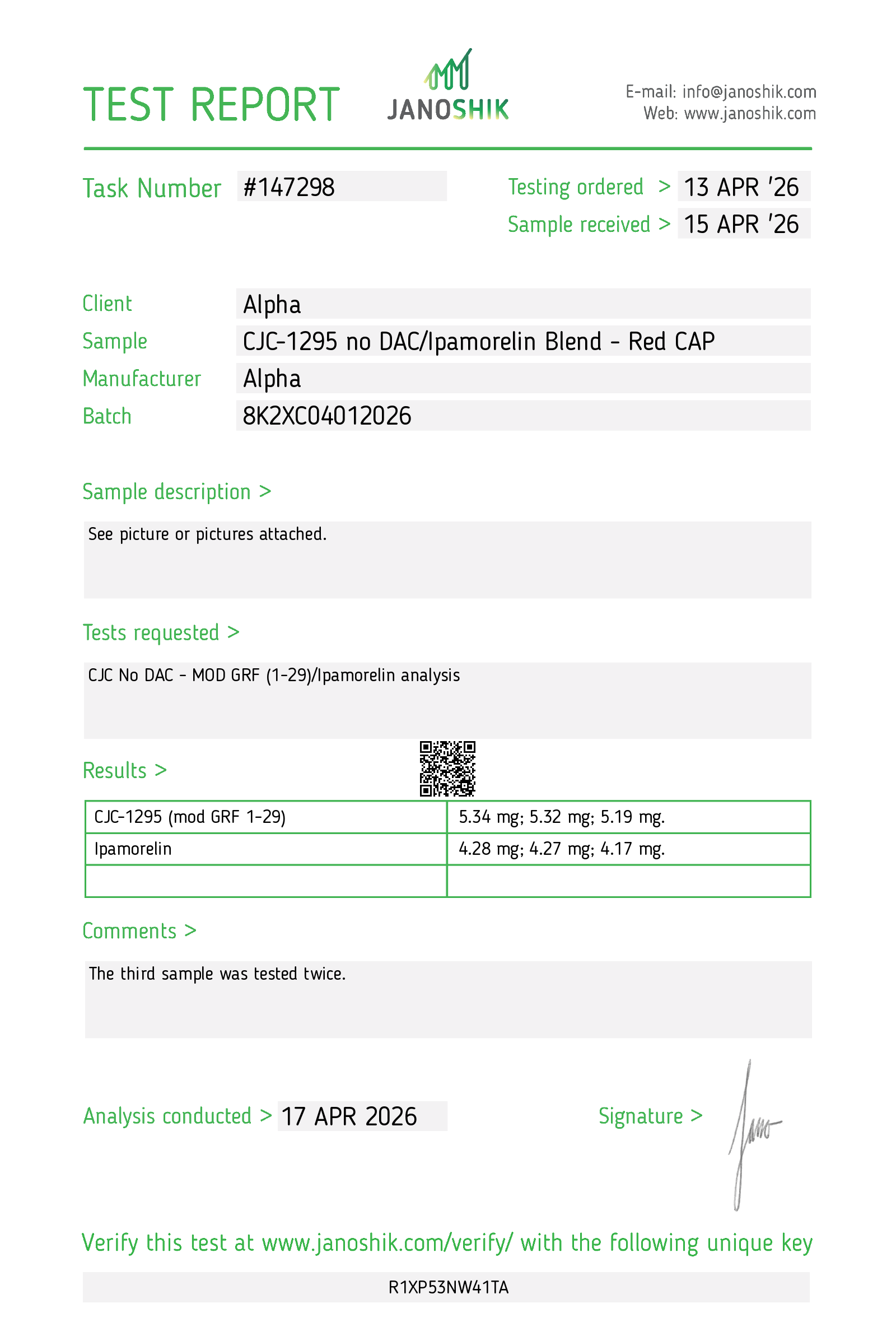
Report measures selected blend components, not sterility or clinical safety. A report covers a submitted sample or lot, not safety, sterility, effectiveness, or every product sold. Its provenance has not been independently authenticated.
Open attached COAAll classroom topics