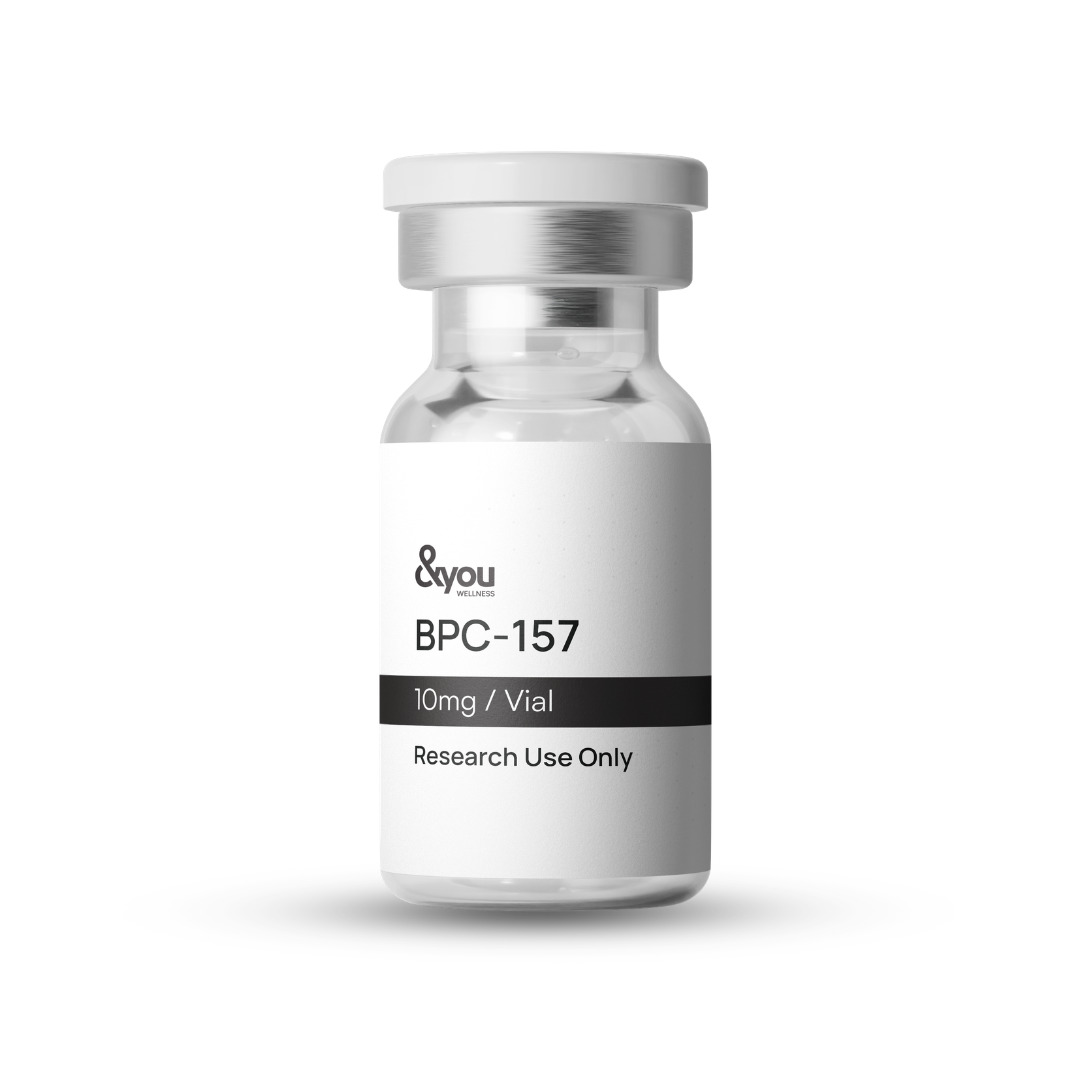
BPC-157
A preclinical peptide studied in models of tissue and gastrointestinal biology; human benefit remains unproven.
This material is educational, not medical advice or a treatment recommendation. Classroom claims and example protocols have not all been independently verified.
The Compound, Explained
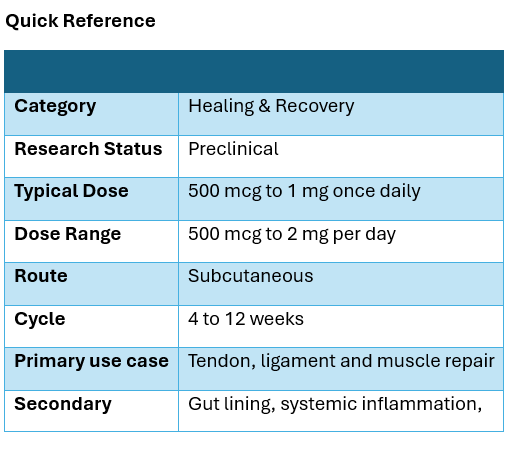
Category: Healing & Recovery
Compound: BPC-157 (Body Protection Compound, also PL 14736)
Research Status: Preclinical
Regulatory Status: Recommended for compounding eligibility by the FDA Pharmacy Compounding Advisory Committee, July 23 2026. Non-binding. Not FDA approved for human use. Classified as a research compound.
What This Is
A short chain of amino acids derived from a protein found in human gastric juice.
BPC stands for Body Protection Compound. The parent protein occurs naturally in your stomach. BPC-157 is a synthetic fragment of it, isolated because that fragment appeared to carry the protective activity.
That origin is not trivia. It is the reason gut research and musculoskeletal research run alongside each other for this compound, and it explains why people using it for a tendon injury frequently report gut effects they were not looking for.
Why This One Is the Reference Point
BPC-157 is the most studied compound in this library and the one most people encounter first. It is worth understanding what that status does and does not mean.
What it Means: Roughly thirty years of research. A large body of animal work across multiple injury models. A positive committee recommendation in July 2026. More published mechanism work than almost anything else here.
What it does not Mean: Human clinical proof. Thirty years of preclinical research is still preclinical research, and this is the compound where that gap gets papered over most often, precisely because the research volume sounds so convincing.
Anyone telling you BPC-157 is clinically proven in humans is either misinformed or selling you something.
It Works Locally
This is the single most practically important fact about the compound, and it drives the entire protocol.
BPC-157 acts where it is placed. Proximity to the injury site is not a refinement, it is the mechanism. That is why injection site guidance for this compound is specific in a way it is not for most others, and it is why the same compound gets injected in the abdomen for gut work and near the joint for a tendon.
Note the honest caveat: injecting near the injury is standard practice and mechanistically reasonable, and it has not been established as superior in controlled human trials. It is a well-reasoned convention rather than a proven one.
Who This Is For
People with a specific injury that is not resolving on its own timeline.
Post-surgical recovery.
Training-related connective tissue damage, particularly tendon, which heals slowly because it is poorly vascularized and metabolically quiet.
People working on gut lining issues, where the oral route becomes relevant.
A Note on Where Else This Appears
BPC-157 also features in the Wolverine Stack module, paired with TB-500. This module covers the compound on its own. If you are running it as part of that stack, read both, since the stack module covers why the combination exists rather than repeating what is here.
Inside the Mechanism
Promotes Angiogenesis Through VEGF
The headline mechanism, and the one most directly responsible for what people report.
VEGF, vascular endothelial growth factor, drives the formation of new blood vessels. New vessels mean oxygen, nutrients and repair cells reaching tissue that previously had poor supply.
This matters enormously for tendon and ligament specifically. Those tissues are poorly vascularised by design, which is a large part of why they heal so slowly compared to muscle. BPC-157 addresses that constraint directly rather than working around it.
A useful way to hold it: the repair crew was always willing, the supply road was inadequate.
Upregulates Growth Hormone Receptors
BPC-157 increases growth hormone receptor density on tendon fibroblasts, the cells that build tendon tissue.
Read what that does carefully, because it is a more elegant mechanism than it first appears. It is not adding growth hormone. It is increasing the number of receptors available to receive the growth signals already circulating in your bloodstream.
Not a louder signal. Better reception.
This is also why BPC-157 pairs sensibly with growth hormone secretagogues, which you will see in the stacking tab. One raises the signal, the other improves the tissue's ability to hear it.
Promotes Collagen Synthesis
Collagen is the primary structural protein in tendon, ligament and skin. Increased collagen production gives repair processes the raw structural material they need.
Straightforward, and worth noting it is downstream of the vascular work. Material reaching the site is a prerequisite for material being used at the site.
Effects on the Gut
The gastric origin is not incidental. Research covers intestinal lining integrity alongside the musculoskeletal work, with proposed mechanisms including improved blood supply to the gut lining and effects on tight junction integrity between intestinal cells.
This is also the one context where the oral route becomes reasonable. For gut-focused use, oral administration delivers the compound to the tissue of interest directly. For systemic or localized injury work, injection is used because oral bioavailability is substantially lower.
Route follows target. That is the rule with this compound.
Nervous System Effects
BPC-157 has reported calming effects on the nervous system and interactions with dopaminergic and serotonergic signaling in animal models.
This may explain why pain reduction is so commonly reported alongside faster healing, and it is worth separating those two things. Reduced pain is not the same as repaired tissue. If a compound reduces your pain and you resume loading an injury that has not finished healing, that is a risk rather than a benefit.
Hold that distinction. It is one of the more practically consequential points in this module.
What the Research Actually Shows
Read the Status Tag First
BPC-157 is tagged Preclinical, and this is the compound where that tag gets ignored most often.
It means the evidence base is predominantly animal studies and in vitro work. Not human clinical trials.
Preclinical is not the same as unproven. It means the research is real, it exists, and it has not passed through the stage where human safety and efficacy get established at scale.
The volume of research here is genuinely substantial, roughly thirty years of it. Volume and tier are different axes. A great deal of research at the animal tier does not become human evidence by accumulating.
The Evidence Hierarchy
Learn this and you can assess any compound in this field.
In vitro. Cells in a dish. Tells you a mechanism is possible. Tells you nothing about a whole organism.
Animal model. Usually rodent. Tells you the mechanism operates in a living system.
Human observational. People taking something, outcomes recorded. No control group. Confounded by everything, including the fact that most injuries improve with time regardless.
Human randomized controlled trial. Controlled, randomized, ideally blinded. This is where "proven" becomes an appropriate word.
BPC-157 sits in the middle tiers, heavily.
The Confound That Matters Most Here
Read the third tier again, specifically the last clause: Most injuries improve with time regardless.
This is the central interpretive problem with BPC-157, and it applies to almost nothing else in this course as sharply.
People start BPC-157 when an injury is bothering them, which is usually when it is at its worst. Injuries generally improve from their worst point whether or not anything is done. Recovery over the following weeks is then attributed to the compound.
That does not mean BPC-157 does nothing. The mechanism work is real. It means personal experience is unusually weak evidence for this specific compound, and the flood of enthusiastic anecdotes it generates should be weighted accordingly.
The reported timelines, two to four weeks for injury improvement and days for gut effects, overlap almost exactly with natural recovery curves. That is precisely the window where attribution is hardest.
Sample Size
Find the n on any study you read. A study with twelve rats and a study with two thousand humans are not equivalent evidence and should not carry equal weight in your thinking.
Small studies produce dramatic effect sizes more often than large ones, and those effects usually shrink when the study is repeated at scale. That is one of the most reliable patterns in all of science.
Watch the Verbs
Applies to any source you read on this compound, including product pages.
"Treats" and "cures" are clinical claims requiring clinical evidence, and no compound at this evidence tier has earned them. "Studied for" and "associated with" are accurate descriptions of preclinical research.
You will see the first pair used constantly for BPC-157. When you do, you have learned something about the source rather than about the compound.
The July 2026 Committee Vote
On July 23 2026 the FDA's Pharmacy Compounding Advisory Committee voted on seven peptides.
Recommended: BPC-157, KPV, TB-500, MOTS-c, Epitalon, Semax
Not recommended: Emideltide, also known as DSIP
BPC-157 was recommended.
What it Means: The committee found the evidence sufficient to recommend it be eligible for pharmacy compounding.
What it does not Mean: FDA approval. The vote is non-binding, the FDA determines separately, and no compound on that list is approved to treat any condition.
Two things worth Noticing: The committee assessed each compound individually rather than treating the category as one block, which is more nuance than most public commentary manages. And the compound rejected, DSIP, has more consumer interest than several that passed. Popularity and evidence are separate variables.
Holding Both Facts
BPC-157 has thirty years of research behind it, a coherent and well-described mechanism, a positive committee recommendation and an enormous volume of consistent user reports. It also has no large human trials, is not approved for human use, and generates outcome reports that natural recovery would substantially explain on its own.
Hold both at once. That is what research literacy actually is, and it is more useful than either uncritical enthusiasm or blanket dismissal.
Sourcing & Verification
Original classroom lesson. Preparation, measurement, sourcing, or protocol examples are source material, not verified instructions or clinical guidance.
BPC-157 is the most counterfeited compound in this field, and the reason is uncomfortable: it is the one people report results from most consistently, which makes it the one with the most buyers who will not question a weak result.
What to Verify on This Compound
Supplier saturation is the problem here: Because BPC-157 is the entry point for most people, it is sold by more suppliers than anything else, including many with no track record whatsoever. Volume of sellers is not a sign of a mature market. It is a sign of low barriers to entry.
Purity plus identity, on the same document: Purity tells you how clean the material is. Identity tells you what it is. BPC-157 is a short peptide and comparatively cheap to synthesise, which cuts both ways: less economic incentive to substitute something else, more incentive to cut corners on synthesis quality and leave truncated or incomplete sequences behind.
Look for the impurity profile, not just the headline number. Related peptide impurities are the relevant category here.
Do not use your own results as verification: This is the compound where that instinct fails hardest. Because natural recovery explains so much of the reported timeline, feeling better tells you very little about what was in the vial. Documentation is the only real check you have.
The COA Standard
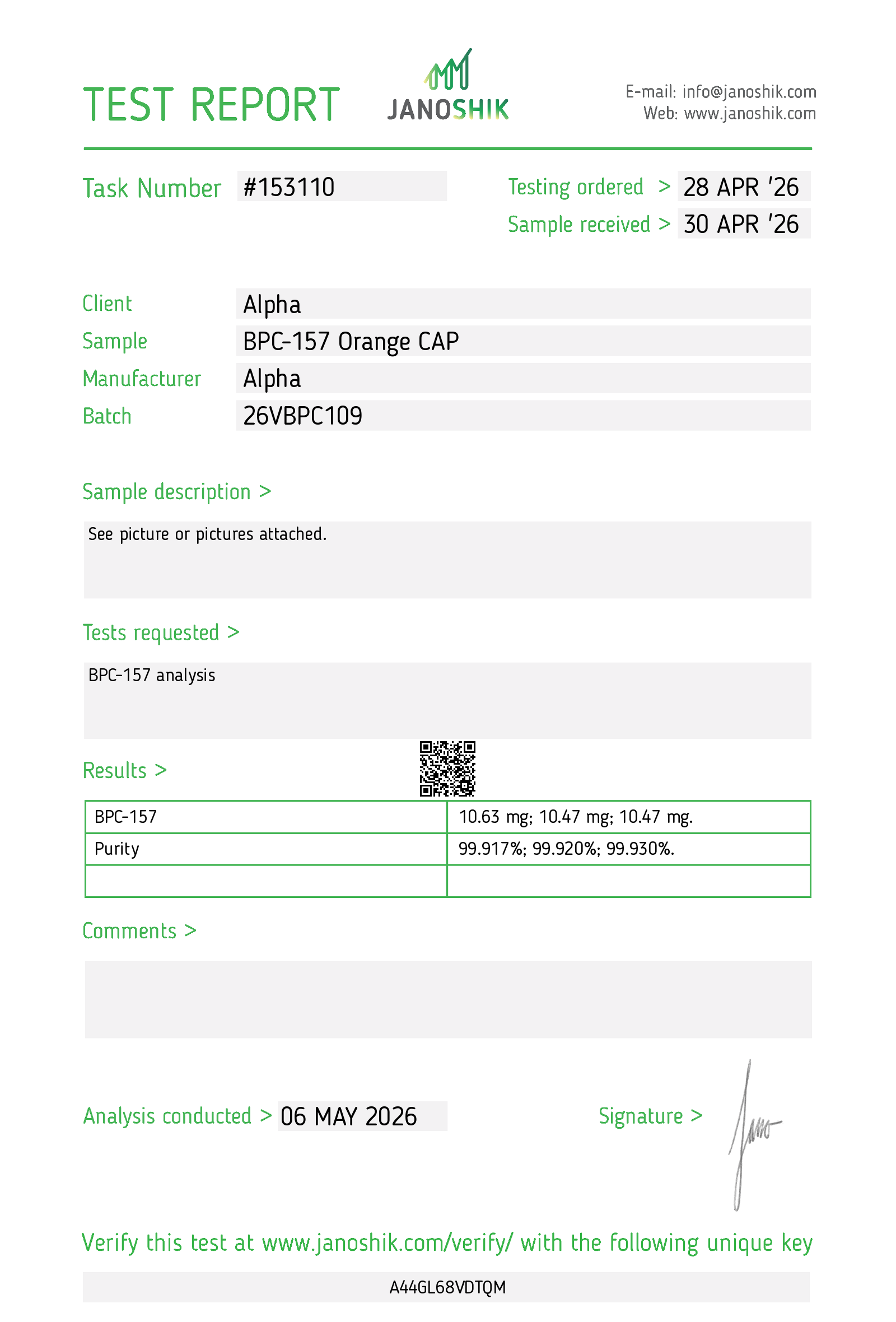
A valid COA names the testing laboratory, carries a batch number matching your vial, states a test date, gives purity with the method used, and confirms identity. Anything answering "available on request," or arriving as a screenshot with no traceable source, is not a COA.
Ask whoever you currently buy from for the COA on your specific BPC-157 batch. Given how many suppliers sell this compound, whatever happens next is the fastest way to narrow the field.
Storage
Lyophilized powder: cool, dry place. Reconstituted: refrigerate and use within 45 to 60 days. Protect from heat and light.
On a daily protocol a 10 mg vial at 1 mg per day runs about ten days, comfortably inside that window. At 500 mcg daily it runs twenty. Either way the vial finishes well before the solution expires, which is not true of every compound in this library.
Preparation
Original classroom lesson. Preparation, measurement, sourcing, or protocol examples are source material, not verified instructions or clinical guidance.
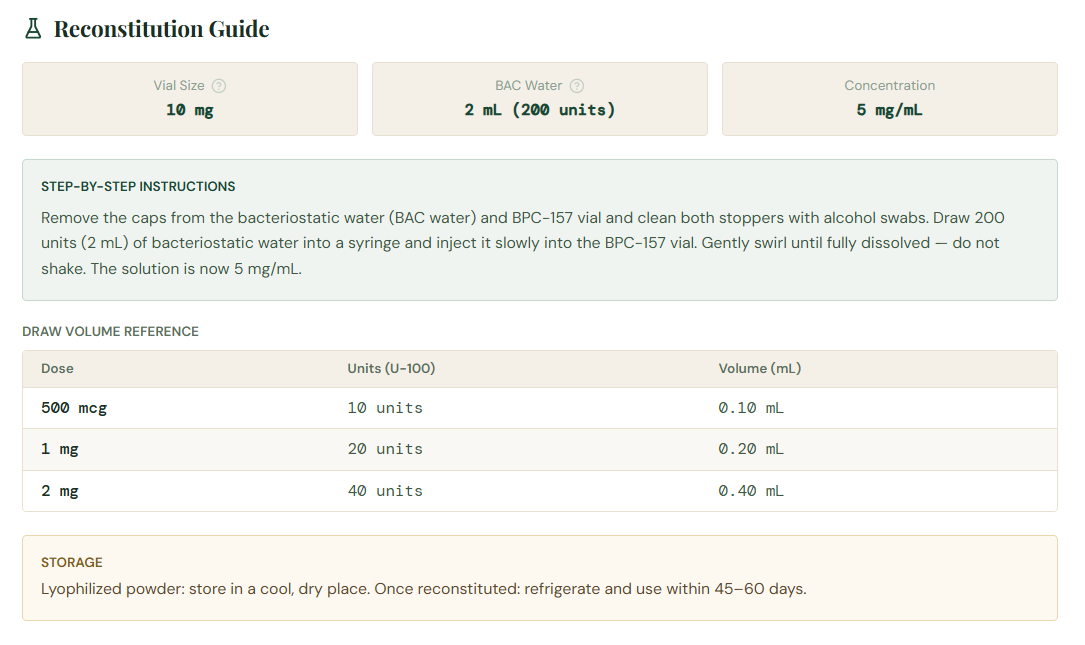
BPC-157 Reconstitution Guide
BPC-157 is supplied as a lyophilized powder requiring reconstitution. Vial strengths vary between suppliers, so always use the volume specified for your exact product.
The reference below reflects the most common configuration.
What you will Need:
BPC-157 peptide vial
Bacteriostatic water
Appropriate syringe
Alcohol pads
Step 1: Prepare and Sanitize
Wash your hands and prepare a clean workspace.
Remove the caps from both the bacteriostatic water and the peptide vial.
Clean both stoppers with alcohol pads and allow them to dry.
Step 2: Reconstitute
Draw 200 units (2 mL) of bacteriostatic water.
Insert the needle into the peptide vial and introduce the water slowly along the inside wall.
Avoid directing the stream forcefully onto the powder.
Step 3: Mix Gently
Important: Do not shake.
Gently swirl until fully dissolved. At the reference configuration the solution is now 5 mg/mL.
Step 4: Storage after reconstitution
Refrigerate.
Use within 45 to 60 days.
Protect from heat and light.
Do not freeze unless the manufacturer specifically indicates it.
Important
Note that this reference uses 2 mL, not 1 mL. Several compounds in this library reconstitute at 1 mL to give 10 mg/mL. BPC-157 at 2 mL gives 5 mg/mL, which means every draw volume is double what the same dose would require at the other concentration.
Copying a reconstitution habit across compounds is one of the most common sources of dosing error. Read the number for the vial in front of you.
Measurement
Original classroom lesson. Preparation, measurement, sourcing, or protocol examples are source material, not verified instructions or clinical guidance.
BPC-157 Measurement Guide
Learn how to convert your concentration into the correct syringe volume.
Calculator, pre-filled with BPC-157 defaults: https://peptidetrainings.com/tools/reconstitution-calculator?label=BPC-157
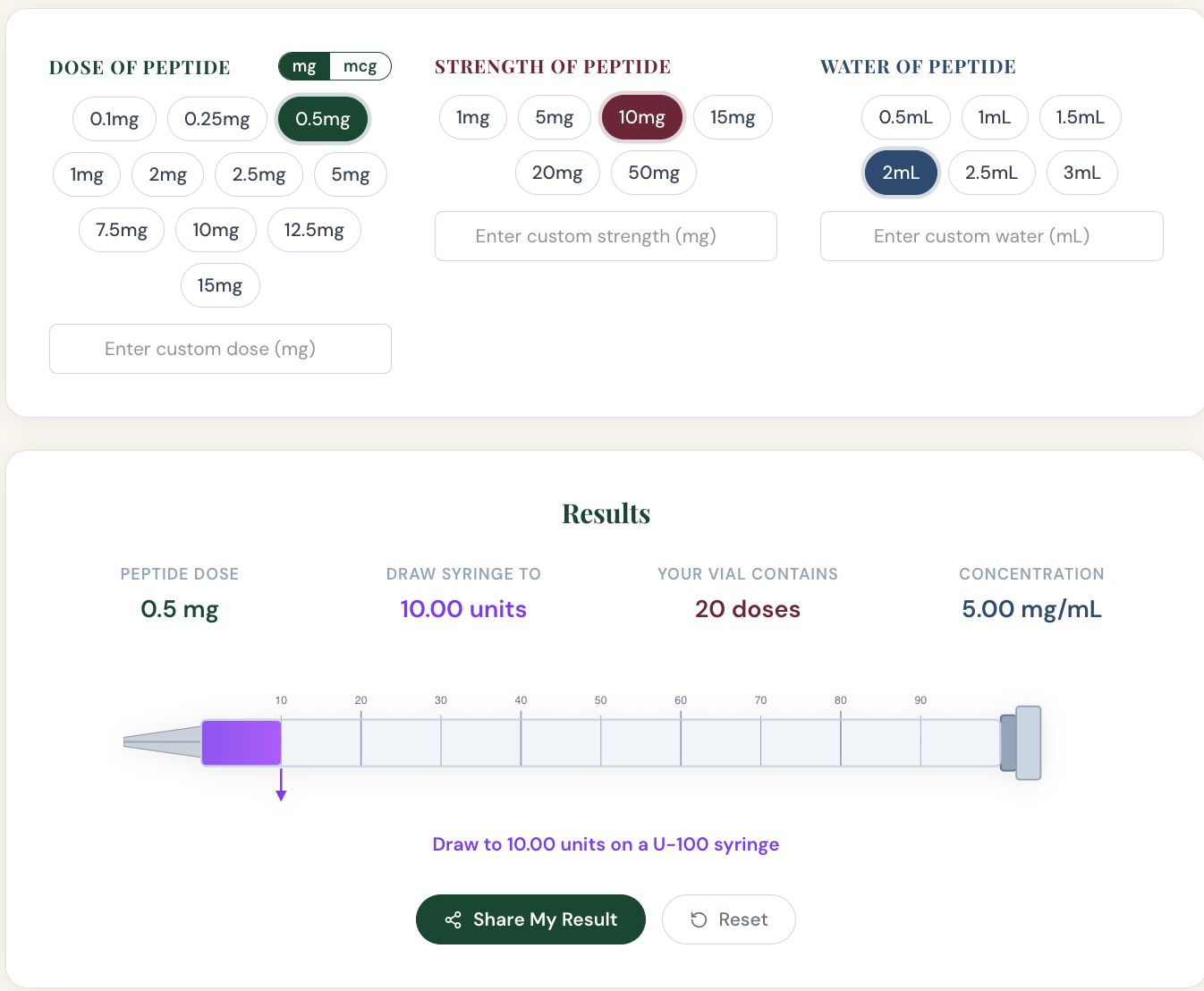
Draw Volume Reference
The correct syringe measurement depends on:
Peptide amount in the vial
Volume of reconstitution solution used
Desired dose
Syringe type and size
Calculate Your Dosage
Need to work out the exact syringe measurement for your dose?
→ Click here to calculate your dosage
Important: Micrograms and Milligrams
BPC-157 is one of the few compounds here dosed across both units, and this is where mistakes happen.
500 mcg is 0.5 mg. A thousand micrograms make one milligram.
A protocol written in micrograms and a vial labelled in milligrams describe the same thing in different units, and confusing them is a thousand-fold error, not a small one. It also does not look wrong in the syringe.
When you read a dose anywhere, check the unit before you check the number.
The table above is valid only at 5 mg/mL. Reconstitute the same 10 mg vial with 1 mL instead of 2 mL and every volume in that table halves.
Always confirm your vial strength, your reconstitution volume and your syringe type.
Protocol
Original classroom lesson. Preparation, measurement, sourcing, or protocol examples are source material, not verified instructions or clinical guidance.
BPC-157 Dosing Protocol
BPC-157 protocols vary depending on application, product concentration and individual circumstances. The following framework is provided for educational reference and should not be treated as an established clinical dosing guideline.
Typical Dose
Dose: 500 mcg to 1 mg once daily
Dose range: 500 mcg to 2 mg per day
Frequency: Once daily
Route: Subcutaneous injection near the injury site, abdomen, or upper arms
Cycle length: 4 to 12 weeks
Weeks 1 to 4: Initial Phase
Dose: 500 mcg to 1 mg once daily
Purpose: Establish consistent exposure
Duration: 4 weeks
Weeks 5 to 8: Adjustment Phase
Dose: 1 to 2 mg once daily, adjusted on response
Note: The higher end appears in community protocols where additional benefit is sought. It is a convention rather than an evidence-based escalation.
Duration: 4 weeks
Maintenance
Dose: 1 to 2 mg
Frequency: Every other day
Duration: Beyond week 8, based on individual response
Route Follows Target
The defining practical decision with this compound.
Localized Injury: Inject as close to the injury site as practical. This follows from the local mechanism, and note again that it has not been established as superior in controlled human trials. It is well-reasoned convention.
Gut health: Abdominal injection is commonly used. Oral BPC-157 is also reasonable here specifically, since the gut lining is the target tissue and the compound reaches it directly.
Systemic: Subcutaneous injection. Oral is not the choice here, as bioavailability is substantially lower for anything beyond the gut.
Clinical Notes
Dosing should be based on the specific product concentration and intended use.
Monitor your response throughout rather than automatically increasing the dose.
Potential interaction with anticoagulants: BPC-157 promotes angiogenesis, and anyone on blood thinners should treat this as a conversation with a clinician rather than a footnote.
Pain reduction and tissue repair are not the same thing. If pain drops and you resume loading an injury that has not finished healing, you have created a risk. Let the timeline guide loading, not the symptom.
Because human clinical evidence remains limited, consult a qualified healthcare professional before using experimental peptide products.
Side Effects and Safety
Nausea, rare and usually mild
Dizziness, rare
Injection site irritation
Potential interaction with anticoagulants
Generally reported as well tolerated. Note that the safety record here rests on animal data and user reports rather than on controlled human safety trials, which is a different kind of reassurance than it sounds like.
Research References
Stacking & Combinations
Original classroom lesson. Preparation, measurement, sourcing, or protocol examples are source material, not verified instructions or clinical guidance.
BPC-157 is the most stacked compound in this field. It appears in almost every protocol, frequently without anyone articulating what it is contributing to that particular one.
What Makes It Genuinely Stackable
Two real properties, not popularity.
It is Local: Because BPC-157 acts where it is placed, it occupies a niche most compounds do not. Systemic compounds rarely compete with it directly, which is why it slots into so many stacks without creating overlap.
It has an Unusual Second Domain: The gut work is mechanistically separate from the musculoskeletal work. That means it can contribute to a stack even when tissue repair is not the goal, as the Retatrutide pairing below shows.
What Pairs With BPC-157, and Why
BPC-157 + TB-500. The definitive pairing. Local repair signal plus systemic repair environment. Neither does the other's job. Covered in full in the Wolverine Stack module.
BPC-157 + GHK-Cu. BPC-157 drives blood supply and repair signalling. GHK-Cu supplies collagen and elastin, the structural material. Signal plus material, and it adds skin to a stack otherwise aimed at deeper tissue.
BPC-157 + Ipamorelin. Mechanistically neat. Ipamorelin raises growth hormone and IGF-1. BPC-157 increases growth hormone receptor density on tendon fibroblasts. More signal plus better reception, which is two halves of the same system.
BPC-157 + Retatrutide. Not about repair at all. The rationale is the gut research, aimed at managing gastrointestinal side effects during titration. A tolerance strategy rather than a results strategy.
The Pairing Worth Questioning
BPC-157 + Pentadeca Arginate: Widely listed as high synergy, and it is the one on this page to interrogate.
PDA is presented as an upgraded BPC-157 analog with enhanced nitric oxide signaling. If that framing is accurate, it is an improved version of the same compound, and running both is duplication rather than synergy.
Some researchers do run both. Before following them, ask what the second one adds that the first does not. If the answer is "more of the same thing," that is not a stack, it is a higher dose with two invoices.
The Question Specific to This Compound
Is BPC-157 in your stack because you have an injury, or because it is in everyone's stack?
It is the default addition in this field, which means it is often present without a reason. Local repair signaling does very little for someone with no local damage to repair.
There is a second problem specific to this compound. Natural recovery already confounds BPC-157 attribution badly, as covered in the research tab. Add three more compounds on top and you have no chance of isolating what did anything.
Certificate of Analysis
Report concerns a submitted sample and identified lot only; authenticity has not been independently verified. A report covers a submitted sample or lot, not safety, sterility, effectiveness, or every product sold. Its provenance has not been independently authenticated.
Open attached COAAll classroom topics